Short answer
Photosynthetically active radiation (PAR) is light between 400 and 700 nm that plants use for photosynthesis, measured in photons. PPFD is the PAR reaching the canopy each second in µmol/m²/s, and daily light integral (DLI) is the daily total in mol/m²/d, calculated as PPFD × hours × 0.0036. Lettuce typically needs a DLI of about 12–17, for example 250 µmol/m²/s for 16 hours.
What is photosynthetically active radiation (PAR)?
Photosynthetically active radiation (PAR) is the band of light from 400 to 700 nanometers (nm) that plants use to drive photosynthesis, roughly the same range as visible light. In short, PAR covers the wavelengths from violet-blue to deep red. PAR is counted in photons rather than energy or brightness, and it is the foundation for every useful grow light metric: PPF, PPFD and DLI.
Understanding PAR helps you answer the practical questions growers ask: how much light a crop needs, what color light is best for plant growth, how far grow lights should be from plants, and why a bright-looking lamp can still grow poor plants. This article explains the science and the measurements. If you are choosing and buying fixtures, see our separate guide to grow lights for indoor farming.
Some newer research and lighting standards also discuss extended PAR (ePAR), 400–750 nm, because far-red photons between 700 and 750 nm work together with shorter wavelengths to drive photosynthesis. When a datasheet quotes ePAR figures, compare it only with other ePAR figures. Classic research on photosynthesis by wavelength, often summarized as the McCree curve, showed that leaves use every wavelength in this range, with red photons generally more efficient than blue or green.
What is the difference between PAR, PPF, PPFD and DLI?
PAR defines which light counts, while PPF, PPFD and DLI measure how much of it a lamp produces, how much reaches the plants and how much they receive over a day. The units are in micromoles (µmol) of photons, where one mole is about 6.02 × 10²³ photons.
| Metric | What it measures | Unit | Used for |
|---|---|---|---|
| PAR | The 400–700 nm waveband plants use for photosynthesis | Range, nm | Defining which light counts |
| PPF (photosynthetic photon flux) | Total PAR photons emitted by a light each second | µmol/s | Comparing fixture output |
| PPE (photosynthetic photon efficacy) | PAR photons produced per unit of electricity | µmol/J | Comparing fixture efficiency |
| PPFD (photosynthetic photon flux density) | PAR photons arriving on a surface each second | µmol/m²/s | Setting light intensity at the canopy |
| DLI (daily light integral) | Total PAR photons received per square meter per day | mol/m²/d | Matching light dose to the crop |
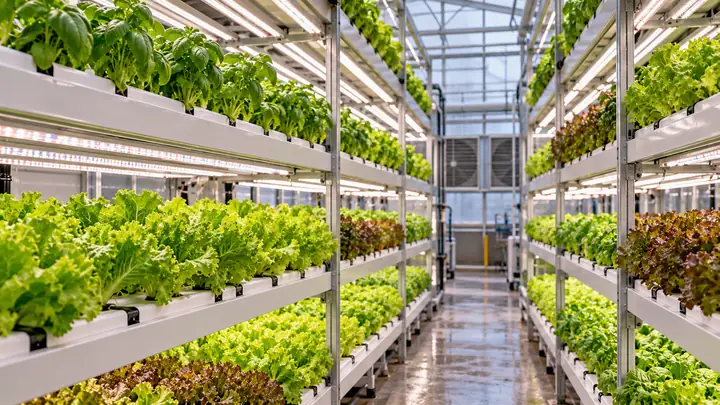
What does PPFD stand for in practice? It is the number you read on a quantum (PAR) meter held at leaf level. Full summer sun at midday is roughly 2,000 µmol/m²/s, while a typical indoor lettuce rack runs at about 200–300 µmol/m²/s for many more hours.
Why are lumens and lux the wrong units for plants?
Lumens and lux are weighted to human vision, which peaks in green-yellow light around 555 nm. Plants use blue and red photons very effectively, but a lux meter barely counts them, so a red-rich grow light can read low in lux yet deliver high PPFD. For sunlight, 1,000 lux is roughly 18–19 µmol/m²/s, but the conversion changes with every spectrum, which is why lumen ratings are not a reliable guide. Use a quantum sensor or the manufacturer's PPFD map instead.
How do you calculate DLI, and how much light do plants need?
You calculate daily light integral by multiplying PPFD by the number of seconds the light is on and converting to moles: DLI (mol/m²/d) = PPFD × hours of light × 0.0036. For example, 250 µmol/m²/s for 16 hours gives 250 × 16 × 0.0036 = 14.4 mol/m²/d.
DLI is the better target because plants respond to the total daily dose. You can reach the same DLI with lower PPFD over more hours, which often allows smaller, cheaper lighting. The table gives commonly cited starting ranges from university extension and horticultural research sources; cultivars and growing systems vary.
| Crop | Typical target DLI (mol/m²/d) | Example PPFD and photoperiod |
|---|---|---|
| Seedlings and transplants | About 6–12 | 100–200 µmol/m²/s for 16–18 h |
| Microgreens | About 6–12 | 100–200 µmol/m²/s for 16 h |
| Lettuce and leafy greens | About 12–17 | 200–300 µmol/m²/s for 16 h |
| Basil and culinary herbs | About 12–20 | 250–350 µmol/m²/s for 16 h |
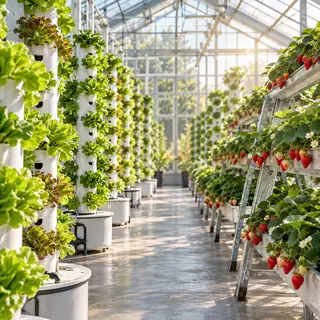
| Strawberries | About 15–25 | 300–450 µmol/m²/s for 14–16 h |
| Tomatoes, peppers, cucumbers | About 20–30 or more | Often sunlight plus supplemental light in greenhouses |
More light is not always better. Lettuce pushed far above its target DLI can develop tipburn, and high light without matching CO2, temperature and nutrients wastes electricity. Crop-specific advice is in our hydroponic lettuce guide, microgreens guide and growing tomatoes indoors.
What color light is best for plant growth?
No single color is best for plant growth: plants use all PAR wavelengths for photosynthesis, and each color band also sends signals that shape the plant. Red photons drive photosynthesis very efficiently, blue keeps plants compact, and a balanced mix that includes green and some far-red usually gives the best overall growth. So the best light for plants is not one color but the right light spectrum for plants at the right intensity. The table summarizes what each color band does.
| Waveband | Range (nm) | Main effects on plants |
|---|---|---|
| UV-A | 315–400 | Can increase pigments and leaf thickness; high doses stress plants |
| Blue | 400–500 | Compact growth, thicker leaves, stomatal opening; too much reduces leaf expansion |
| Green | 500–600 | Penetrates deeper into the canopy and lower leaves; helps workers see plants clearly |
| Red | 600–700 | Highly efficient for photosynthesis; main component of most grow light spectra |
| Far-red | 700–750 (and beyond) | Leaf expansion and stem elongation; influences flowering; boosts photosynthesis together with red |
Blue light vs red light for plants: is red light good for plants?
Yes, red light is good for plants; it is the most efficient waveband per photon for photosynthesis in most crops. But plants grown under red alone tend to stretch and develop abnormal leaves, so a blue grow light component, typically somewhere around 10–30% of photons in commercial fixtures, is added to keep growth compact and normal. The classic red-blue (purple) fixtures follow this logic; modern full spectrum fixtures add green and far-red for more natural growth and better visibility.
What do grow light colors and 6500K mean?
Kelvin values such as 3000K, 4000K or 6500K are correlated color temperature (CCT), describing how warm or cool white light looks to people. A 6500K grow light looks cool and bluish and has a higher blue share, which suits seedlings, cuttings and leafy growth; 3000–4000K looks warmer and contains more red, often preferred for flowering and fruiting crops. CCT is only a rough guide to spectrum, so the spectral distribution chart on the datasheet tells you far more. For seedlings, cool-white or blue-rich light at modest intensity is a sound choice.
How far should grow lights be from plants?
Grow lights should be as far from plants as needed to deliver the target PPFD evenly without heat or light stress, which depends on fixture output and beam design more than on a fixed number. Low-power LEDs sit close to the crop; high-power fixtures hang higher. The distance chart gives typical starting points for LED fixtures, to be confirmed with a PAR meter.
| LED fixture type | Typical distance above canopy | Notes |
|---|---|---|
| Strips, tubes and small lights (about 10–40 W) | 10–30 cm (4–12 in) | Seedling shelves, microgreens, cabinets |
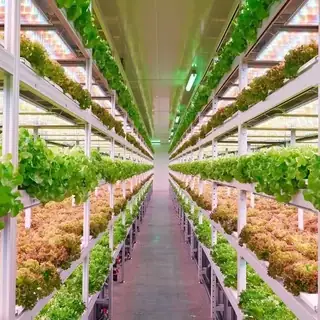
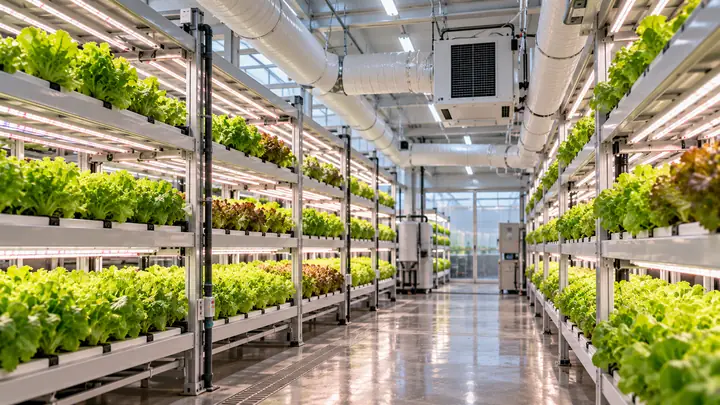
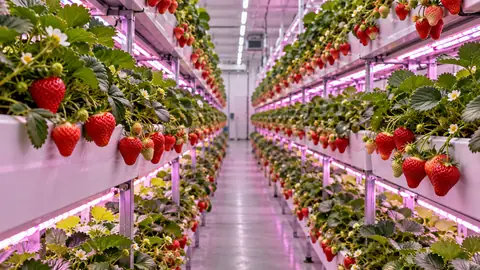
| LED bars in vertical racks (about 30–100 W each) | 15–40 cm (6–16 in) | Leafy greens and herbs on multi-tier racks |
| Mid-power panels (about 100–300 W) | 30–60 cm (12–24 in) | Tents, small rooms, single benches |
| High-power top lights (about 400–1,000 W) | 45–90 cm (18–36 in) | Tall crops, high ceilings, greenhouses |
How far should seedlings be from a grow light? Usually at the same or slightly greater distance than mature plants, with the fixture dimmed so PPFD stays around 100–200 µmol/m²/s. Signs that light is too close or too strong include bleached or yellowing top leaves and curled leaf edges; stretched, pale plants suggest too little light. Our seed starting and germination guide covers propagation setups.
The inverse square law, where intensity falls with the square of distance, applies strictly only to a point source. Arrays of LED bars over a reflective rack behave more like a broad panel, so PPFD drops more slowly with distance. That is why measuring beats rules of thumb.
How do you measure PAR and PPFD?
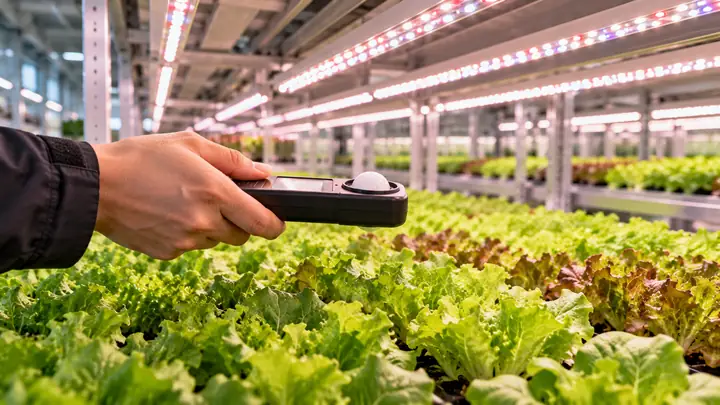
You measure PAR with a quantum sensor, a handheld or fixed meter that counts photons between 400 and 700 nm and reports PPFD. Smartphone apps can give rough estimates but are not reliable enough for commercial decisions.
- Use a full spectrum quantum sensor calibrated for LED light; older sensors may under-read deep red and blue.
- Measure at canopy height with the sensor level, after lights have warmed up for about 15–30 minutes.
- Take a grid of readings, for example every 15–30 cm across each shelf or bench, including edges and corners.
- Calculate average and uniformity. Divide the minimum reading by the average; values around 0.7–0.8 or higher indicate good uniformity.
- Convert to DLI with your photoperiod and adjust dimming, height or hours to reach the crop target.
- Repeat periodically, because LED output declines slowly and dust on lenses reduces light.
What color light attracts bugs, and what color does not?
Most night-flying insects are drawn most strongly to ultraviolet and blue light, the short wavelengths, while warm white, yellow, amber and red light attract fewer insects. No visible light color is completely insect-free, but long-wavelength light is the usual choice when you want lighting that does not attract bugs.
- Does red light attract bugs? Generally less than white or blue light, because many insects see red poorly. Red light does not repel insects, however.
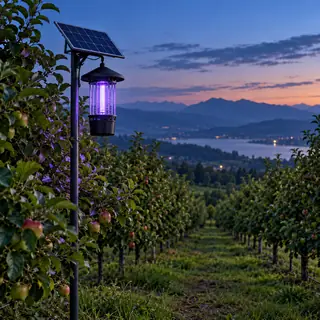
- Bug zappers and UV mosquito lamps rely on UV-A and blue light to lure insects; agricultural insect-killing lamps use the same principle on a larger scale. See our bug zapper safety guide.
- Are gnats attracted to blue light? Small flies such as fungus gnats can be drawn to light sources, but in grow rooms they are better controlled by managing wet media and using yellow sticky cards, which exploit insects' attraction to yellow surfaces; see our yellow sticky traps guide.
In enclosed indoor farms, grow light color has little effect on pest pressure compared with sealing, hygiene and screening at doors and air intakes.
Next steps
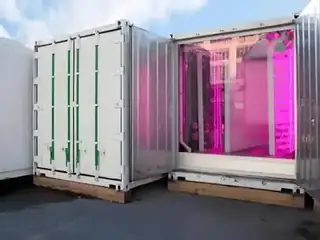
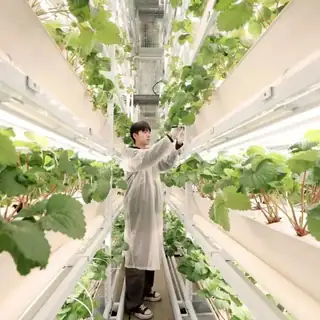
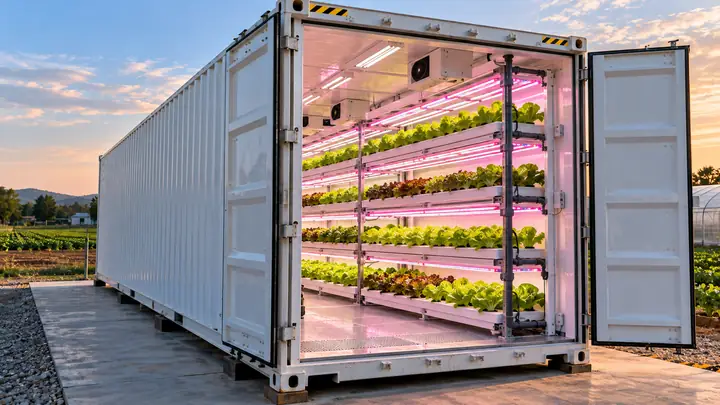
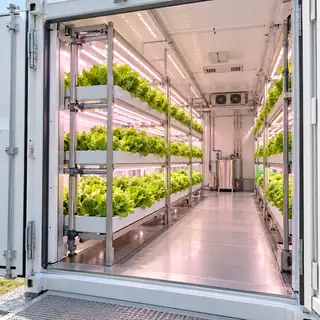
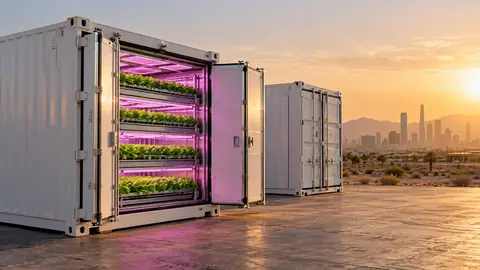
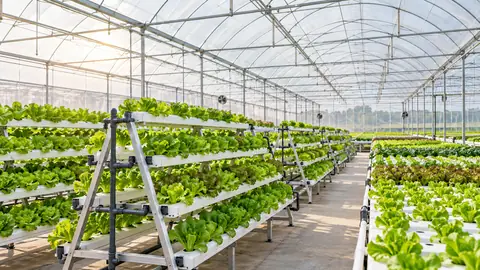
Photosynthetically active radiation turns lighting from guesswork into numbers: choose a DLI for the crop, convert it to PPFD and photoperiod, pick a spectrum that keeps growth balanced, and measure at the canopy. Mars Vertical Farm designs the lighting in its container and indoor plant factories, such as our indoor plant factory for leafy greens, around crop-specific DLI targets, with LED spectrum, mounting height and dimming set per tier. Share your crop and growing area, and our engineers can propose a factory-direct, custom-sized lighting and growing system.