Greenhouses & sunrooms
In short
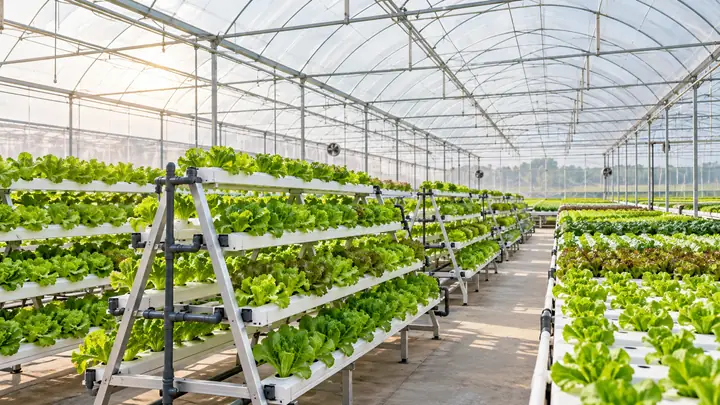
This is a complete hydroponic greenhouse for leafy greens: a multi-span film structure fitted with vertical A-frame NFT racks, flat NFT tables for larger heads and a tidal-bench nursery. It fits a commercial grower or cooperative in a tropical or subtropical climate that sells to supermarkets and wants more output from limited land.
Typical buyer: Commercial vegetable grower
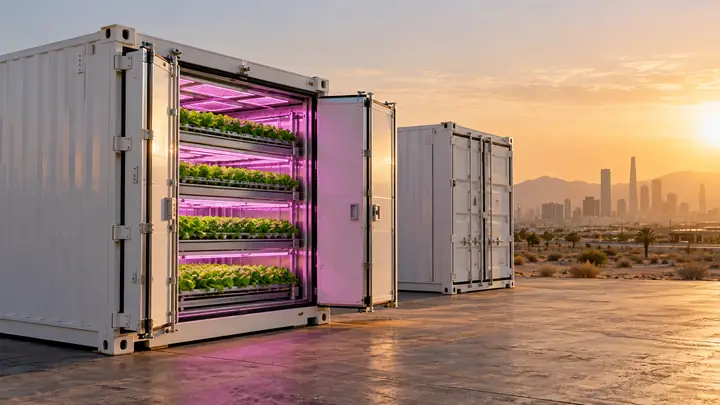
Cover image is illustrative.
System at a glance
- Greenhouse area
- Example 2,880 m² multi-span film structure
- Production systems
- A-frame NFT, flat NFT, tidal nursery benches
- Crops
- Lettuce, romaine, pak choi, water spinach, kale, basil
- Cycle length
- Typically 25–40 days from transplant, crop-dependent
- Nursery stage
- Typically 10–18 days on tidal benches
- Power supply
- 380 V 3-phase or 220 V single-phase, per local grid
- Water
- Recirculating; source water filtered before dosing
- Climate control
- Natural ventilation, insect netting, shade screen; optional fan and pad cooling
Challenge
What the buyer needs to solve
In tropical Southeast Asia, open-field leafy greens suffer from heavy rain, pests and inconsistent quality. Supermarkets and restaurant chains in cities like Ho Chi Minh City and Hanoi now ask for clean, uniform, traceable vegetables, and land close to cities is expensive.
Design constraints
- Heat and humidity: high temperatures for most of the year, with monsoon rains and strong winds.
- Pests: constant insect pressure, which makes pesticide-free production difficult in open fields.
- Land cost: the grower needs more plants per square meter than flat beds allow.
- Consistency: buyers expect the same head size and quality every week.
Solution
How the system is designed
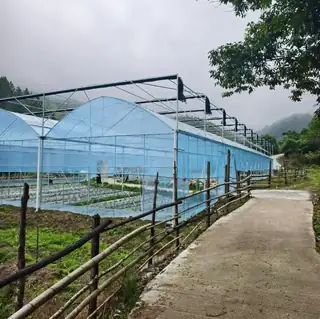
The structure is a customized multi-span steel frame greenhouse with plastic film roofing, roof and side ventilation, insect-proof netting and optional shade screens. Inside, the space splits into three zones that move plants from seed to harvest.
Zone layout
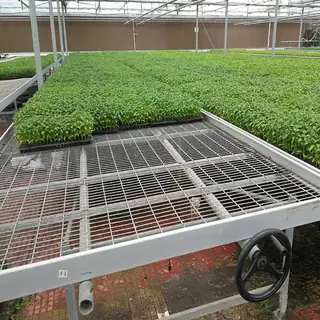
- Nursery: tidal rolling benches flood and drain seedling trays on a timer. Uniform watering gives even seedlings, and the rolling design removes fixed aisles to use more floor area.
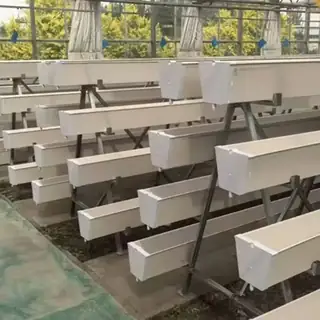
- Vertical production: A-frame multi-layer NFT racks hold 5–8 channel levels on each side. They suit lettuce, pak choi, water spinach and herbs, and multiply plant sites per square meter compared with flat tables.
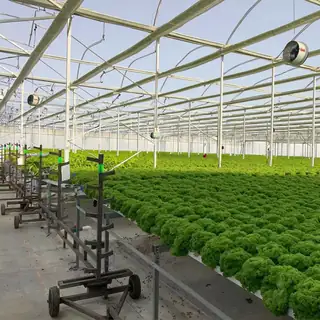
- Flat production: food-grade flat recirculating NFT tables grow larger crops such as romaine and kale, which need more space and light per plant.
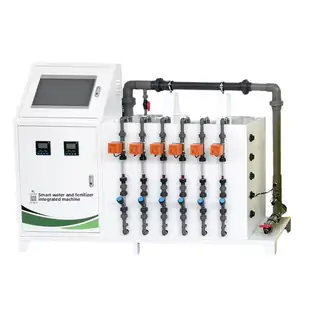
- Nutrient control: a smart fertigation machine mixes and doses nutrients by EC and pH for each zone and logs the data.
Every NFT system recirculates nutrient solution through return pipes to central tanks, so water use stays low and runoff stays out of the surrounding soil. The insect netting and closed water loop let the grower cut pesticide use sharply.
We adapt span width, gutter height and ventilation to your wind loads and local climate. Share your site plan and we will propose a layout.
Example configuration
| Item | Specification | Qty |
|---|---|---|
| Multi-span steel frame film greenhouse | Example 6 spans x 8 m x 60 m, hot-dip galvanized frame, film roof, roof and side vents, insect net | 1 (approx. 2,880 m²) |
| A-frame multi-layer NFT racks | 5–8 PVC channel levels per side, galvanized frame | Approx. 1,400 m² of greenhouse floor |
| Flat recirculating NFT tables | Food-grade PVC channels with return line | Approx. 600 m² of greenhouse floor |
| Tidal rolling nursery benches | Flood-and-drain trays, water recirculation, movable | Approx. 200 m² |
| Smart fertigation machine | EC/pH dosing, multi-zone scheduling | 1 unit |
| Nutrient tanks and pumps | Per zone, with return filtration | 3–4 sets |
| Shade screen and circulation fans | Internal screen, horizontal airflow fans | As per layout |
Design targets
- Designed to multiply plant sites per square meter compared with flat beds
- Recirculating nutrient systems built to keep water use and runoff low
- Insect netting and closed water loops designed to reduce pesticide use
- Uniform weekly harvests through a dedicated nursery zone
Timeline
How the project runs
Greenhouse projects of this size typically take 4–7 months from first contact to first crop, depending on site works and permits.
- Inquiry & consultation: We review your land, crops, buyers and local climate data.
- Proposal & quotation: We send a greenhouse layout, system zoning and quotation.
- R&D confirmation: Our engineers confirm structure loads, ventilation, channel counts and plumbing drawings.
- Contract: We agree on scope, installation support and payment terms.
- Production & QC: Steel structure, A-frames, NFT channels and benches are produced and inspected.
- Third-party lab testing: Material samples and electrical parts are checked by a third-party lab on request.
- Shipping & logistics: Sea freight to Ho Chi Minh City, Hai Phong or another regional port.
- After-sales support: We supervise or guide installation and support the first crop cycles, then remain available for parts and advice.
Equipment
Products in this solution
Vertical towers & racks
5- to 8-Layer A-Frame Hydroponic Rack
Hydroponic systems
Flat Food-Grade PVC NFT System with Pump
Hydroponic systems
Commercial Tidal Rolling Bench for Seedlings
Irrigation & fertigation
Smart Fertigation Machine with Dosing Pump
FAQ
Frequently asked questions
Can't find your answer? Our engineers reply within one business day.
Ask a questionWhy combine A-frame racks and flat NFT tables?
A-frames give the most plant sites per square meter and suit compact leafy greens and herbs. Larger crops such as romaine and kale need more space and light per plant, so flat NFT tables work better for them. Combining both lets you grow a wider product range for supermarket buyers from the same structure.
Will lettuce grow well in tropical heat?
Heat-tolerant lettuce varieties grow well in a ventilated, shaded greenhouse, especially when nutrient solution stays cool. We size ventilation and shading for your climate and can add fan and pad cooling or tank chillers. Working with a local seed supplier on heat-tolerant varieties also makes a big difference.
Can the greenhouse handle monsoon storms?
We design the steel frame to the wind and rain loads you provide from local codes or weather data. Gutter size, foundation depth and bracing follow those loads. Film and netting should be inspected before each storm season, and we include a maintenance checklist with the installation documents.
Get a quotation
Plan a project like this
Share your site, crop and target output, and we'll adapt this design to it.
- Itemized quotation in USD with lead time
- Layout drawings for custom systems
- Factory inspection or video call on request
- Export packing and shipping documents
Prefer email? inquiry@marsverticalfarm.com