Short answer
Grow lights are electric lamps that supply the light plants need for photosynthesis indoors. For commercial indoor farming, full spectrum LED grow lights are the standard because they reach about 2.5–3.0 µmol/J or more, versus roughly 1.6–1.9 µmol/J for high-pressure sodium. Leafy greens typically need about 200–300 µmol/m²/s, which works out to roughly 85–130 W of efficient LED per square meter.
What are grow lights, and which type is best for indoor farming?
Grow lights, also called plant grow lights or grow lamps, are electric lamps designed to deliver the intensity and spectrum plants need for photosynthesis, replacing or supplementing sunlight in grow rooms, vertical farms, greenhouses and grow cabinets. For most indoor farming today, full spectrum LED grow lights are the best choice, because they convert electricity into usable plant light more efficiently than older lamp types and run cooler at the canopy.
This guide is a buyer's guide to fixtures: the types of grow lights, LED form factors, how to calculate how many watts you need, the specifications that separate a professional fixture from a cheap one, and what to ask suppliers. If you want the science behind light metrics such as PAR, PPFD, DLI and spectrum, read our companion article on photosynthetically active radiation, PPFD and light spectrum.
Do LED lights help plants grow?
Yes, LED lights help plants grow as long as they deliver enough light intensity in the right wavelengths for long enough each day. An ordinary household LED bulb emits light plants can use, but usually far too little of it to grow a crop; dedicated LED grow lights for plants concentrate much more photosynthetic light on the plants per watt.
The key difference is that grow light performance is measured in photons, not lumens. Lumens describe brightness to the human eye, which is most sensitive to green-yellow light. A plant light is rated by its photosynthetic photon flux (PPF) in micromoles per second (µmol/s) and its efficacy in micromoles per joule (µmol/J). Ask for these numbers on any datasheet, and treat a fixture sold only on lumens or "equivalent watts" with caution.
What types of grow lights are there?
The main types of indoor grow lights are LED, high-pressure sodium (HPS), ceramic metal halide (CMH) and fluorescent. The table compares them on the factors that matter to a commercial buyer; values are typical ranges and vary by product.
| Type | Typical efficacy | Spectrum | Heat at canopy | Typical life | Best use today |
|---|---|---|---|---|---|
| LED grow lights (commercial) | About 2.5–3.0+ µmol/J | Tunable: full spectrum white, red-blue, with far-red or UV options | Low radiant heat; heat removed at the fixture | Often rated 50,000 h or more to 90% output (L90) | Vertical farms, container farms, greenhouses, grow cabinets |
| High-pressure sodium (HPS) | About 1.6–1.9 µmol/J | Orange-yellow, low in blue | High radiant heat; needs distance from crop | Lamps replaced every 1–2 years | Existing greenhouse top lighting |
| Ceramic metal halide (CMH) | About 1.4–1.9 µmol/J | Broad white | High | Lamps replaced periodically | Older installations, some greenhouses |
| Fluorescent (T5, CFL) | Roughly 1.0–1.3 µmol/J | White, various color temperatures | Low to moderate | Tubes replaced periodically | Legacy seedling shelves, hobby use |
| Incandescent and halogen | Very low | Mostly red and infrared | Very high | Short | Not suitable for growing |
The efficacy gap is the main reason vertical farms use LEDs almost exclusively: a more efficient fixture uses less electricity for the same light and puts less heat into the room, which also reduces the HVAC load. In the United States, the DesignLights Consortium (DLC) horticultural list, often used for utility rebates, raised its minimum efficacy to 2.5 µmol/J under its 2025 technical requirements.
Which LED grow light format fits your growing system?
The best LED grow light format depends on the distance between the light and the crop and on the shape of the growing area. Low, multi-tier racks need slim linear fixtures; tall rooms and greenhouses use high-output fixtures mounted higher.
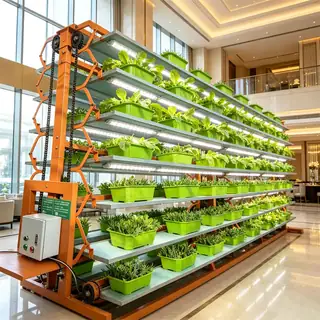
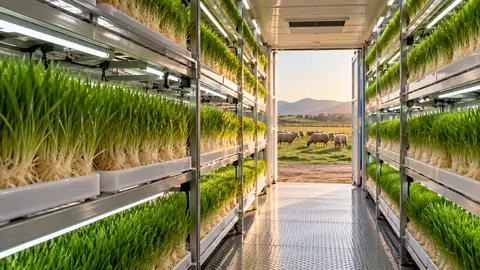
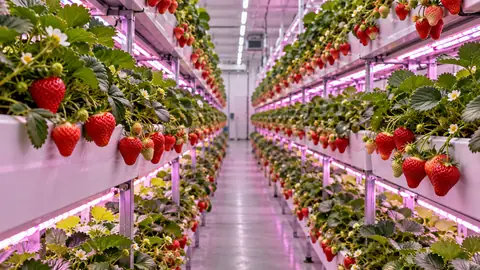
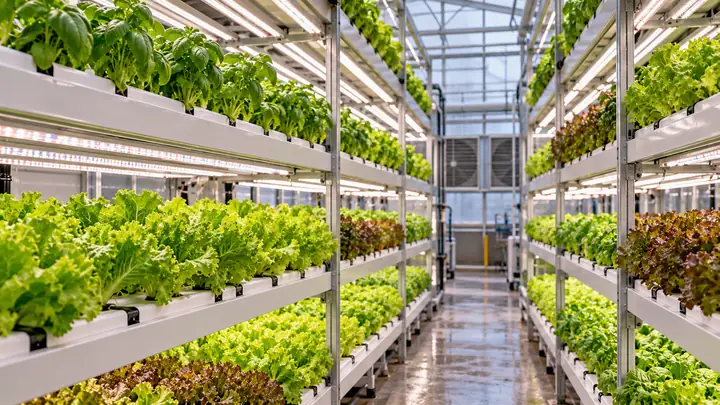
- LED bars and linear fixtures. Slim, IP-rated fixtures mounted 15–40 cm (6–16 in) above the crop in vertical racks and container farms. They spread light evenly along shelves, are the usual hydroponic grow lights in a multi-layer vertical grow rack, and are standard vertical farming equipment.
- Multi-bar top lights. Several bars on one frame, used above single-level benches and in greenhouses as an HPS replacement; these are the usual grow lamps for vegetables such as tomatoes and peppers.
- Panels and boards. Flat fixtures popular in grow tents, smaller rooms and LED grow lights for indoor gardening; check that the light footprint matches the bench.
- LED tubes (T5/T8 format). Low-cost LED grow lights for seedlings, microgreens and propagation shelves.
- LED grow light strips. Flexible strips for cabinets, shelves and display units; like any small grow light they have low output, so keep them close to the plants.
- Grow light bulbs. Screw-in LED grow bulbs suit houseplants, herbs on a windowsill or a single orchid. Fine for decoration and small pots, not for production.
- Interlighting. Vertical strips placed inside the canopy of tall greenhouse crops such as tomatoes and cucumbers.
Full spectrum LED grow lights vs red-blue lights
Full spectrum LED grow lights produce a broad, white-looking light that includes blue, green, red and often some far-red, while older red-blue (purple) fixtures concentrate only on the two peaks where chlorophyll absorbs most strongly. Both can grow plants well; the difference is mainly in plant shape, working conditions and inspection.
- Full spectrum white lets workers see true plant color, spot pests, deficiencies and disease, and work comfortably. Most commercial vertical farms now use white-based spectra with extra red.
- Red-blue fixtures can be very efficient but make the crop look purple-gray and tire the eyes during long shifts.
- Far-red and UV options are add-ons that influence leaf expansion, flowering, color and compounds; a UV channel, for example, can deepen red leaf color in lettuce; they are used deliberately for specific crops, not by default.
Spectrum effects on growth and the meaning of color temperatures such as 6500K are explained in our light spectrum guide, so this article stays focused on choosing fixtures.
How many watts of grow light do you need?
You calculate the grow light wattage you need from the target light intensity for your crop, the fixture efficacy and how much of the light actually lands on the canopy. The formula is: watts per square meter = target PPFD ÷ (fixture efficacy × utilization factor).
- Choose a target PPFD (photosynthetic photon flux density, µmol/m²/s at the canopy) for the crop, using the table below as a starting point.
- Find the fixture efficacy in µmol/J from the datasheet, for example 2.7 µmol/J.
- Estimate the utilization factor, the share of emitted light that reaches the canopy. In enclosed racks with reflective walls it is often around 0.8–0.9; over open benches it is lower.
- Calculate watts per square meter. For leafy greens at 250 µmol/m²/s: 250 ÷ (2.7 × 0.85) ≈ 109 W/m² (about 10 W/ft²).
- Multiply by the growing area of each tier and the number of tiers, then select fixtures whose combined PPF and wattage meet the target with even coverage.
- Ask for a light plan. A supplier should provide a PPFD map of your layout showing average and minimum values.
| Crop group | Typical target PPFD (µmol/m²/s) | Approx. LED power at 2.7 µmol/J, 0.85 utilization |
|---|---|---|
| Seedlings and microgreens | 100–200 | 45–90 W/m² (4–8 W/ft²) |
| Lettuce and leafy greens | 200–300 | 85–130 W/m² (8–12 W/ft²) |
| Herbs such as basil | 200–400 | 85–175 W/m² (8–16 W/ft²) |
| Strawberries, tomatoes and other fruiting crops (sole-source) | 400–700 | 175–305 W/m² (16–28 W/ft²) |
These targets assume long photoperiods typical of indoor farms, often 14–18 hours. Crop-specific guidance is in our hydroponic lettuce guide and how to grow microgreens.
Which specifications matter when buying LED grow lights?
The best LED grow lights for a commercial farm are defined by verified photon output, efficacy, uniformity and durability in a humid room, not by marketing wattage. Use this checklist when you compare quotations.
- PPF (µmol/s) and efficacy (µmol/J), measured by an independent laboratory with an integrating sphere, with the test report available.
- Spectral distribution chart showing the share of blue, green, red and far-red.
- PPFD map and uniformity for your mounting height; a minimum-to-average ratio of about 0.7–0.8 or better is a common target.
- Ingress protection: IP65 or higher for vertical farms, where fixtures are close to water and are cleaned regularly.
- Driver and control: driver brand and location, dimming (0–10 V, PWM or RS485/Modbus) and compatibility with your climate controller for sunrise-sunset ramps.
- Input voltage and power factor, for example 100–277 V AC, plus inrush current, so circuits and breakers are sized correctly.
- Thermal design and lifetime: heat sink material, rated ambient temperature and L90 lifetime.
- Certifications and warranty: CE and RoHS for many markets, UL 8800 safety for horticultural lighting and DLC listing where needed in North America, and a written warranty of typically several years.
- Mounting system: rack clips, hanging kits and cable routing that suit your shelves, channels or benches.
What about grow lights for indoor plants and herbs at home?
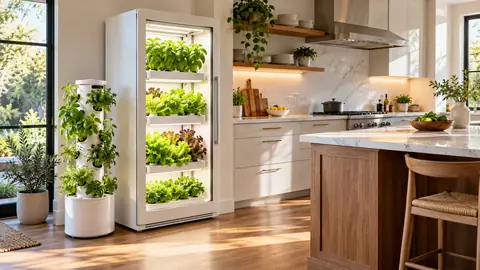
When choosing plant lights for indoor plants at home, a small full spectrum LED is usually enough: houseplants, succulents and orchids need far less light than a food crop, and herbs need moderate light for 12–16 hours a day. A grow light stand or a plant shelf with built-in LED bars places the light at a fixed, close distance, which is the simplest way to start growing herbs with grow lights on a kitchen counter. A herb grow light should give moderate intensity for 12–16 hours a day, while a succulent grow light can be less intense but benefits from long, consistent hours.
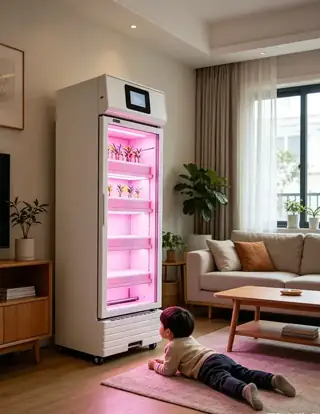
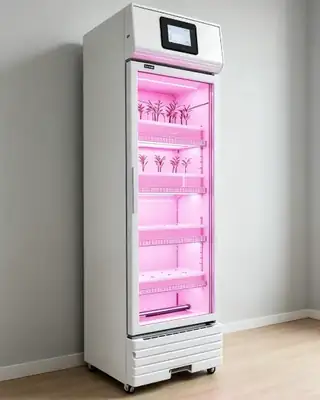
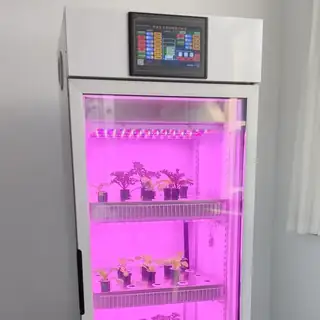
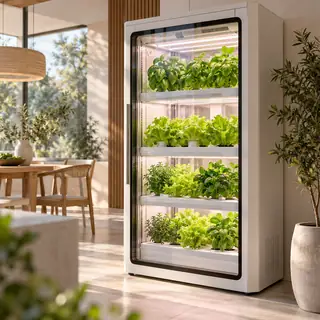
Beyond a simple herb garden under a light, serious hobbyists and small commercial growers often choose an enclosed grow cabinet, which combines LED lighting, a hydroponic system, a timer and fans in one unit, with the light distance already designed for the shelf. Our guides to the best herbs to grow indoors and grow cabinets and grow boxes cover these setups, and you can browse home grow systems with integrated LED lighting.
Next steps
Choosing grow lights for indoor farming comes down to measured PPF and efficacy, a light plan that hits your crop's target PPFD evenly, and fixtures built for the humidity of a grow room. Mars Vertical Farm supplies LED lighting as part of complete vertical racks, grow cabinets and container plant factories, with light levels designed for each crop and tier. Send us your crop, rack or room dimensions and power supply, and we will prepare a factory-direct lighting layout and quotation with custom sizing.