Short answer
Hydroponic lettuce is usually grown in NFT channels or deep water culture rafts with an EC of roughly 1.2 to 1.8 mS/cm, pH 5.5 to 6.0, day temperatures up to about 24 °C, and a daily light integral of about 12 to 17 mol/m²/day. Heads are typically ready 3 to 5 weeks after transplanting, with about 2 to 6 kg/m² per cycle.
What is hydroponic lettuce?
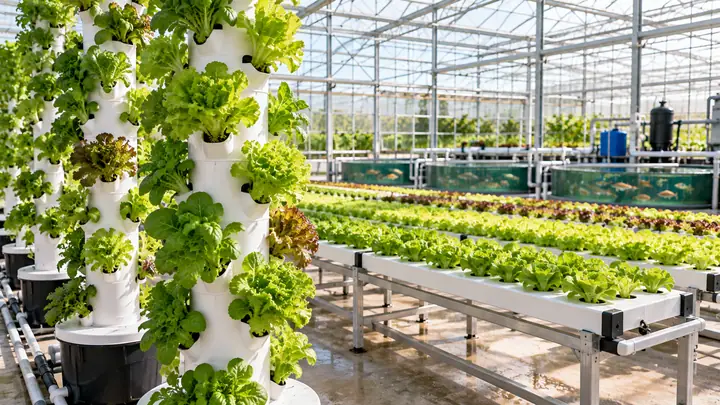
Hydroponic lettuce is lettuce grown without soil, with its roots in a flowing or aerated nutrient solution, usually in NFT channels, deep water culture rafts or vertical racks. Grown this way, lettuce typically reaches harvest about 4 to 6 weeks after transplanting, and a farm can harvest year-round in a greenhouse or indoors.
Lettuce is the crop most hydroponic farms start with, for good reasons. It is fast, compact, sells by the head or by weight, and has modest light and nutrient needs compared with fruiting crops. Growing lettuce hydroponically also keeps leaves clean of soil, cuts water use sharply compared with field production, and makes it possible to sell live lettuce with roots attached, which keeps fresh longer on the shelf.
This guide covers the systems, varieties, light, nutrition and climate needed for growing lettuce indoors or in a greenhouse, and what yield to expect per square foot or square meter.
Which hydroponic lettuce systems work best?
Three hydroponic lettuce systems dominate commercial production. Extension guidance gives typical planting densities for each:
| System | How it works | Typical density | Strengths | Watch-outs |
|---|---|---|---|---|
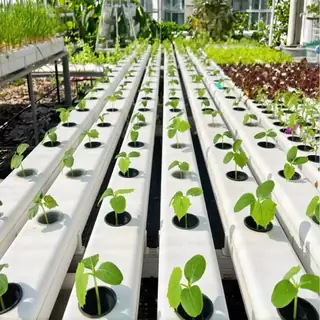
| NFT (nutrient film technique) | A thin film of solution flows down sloped channels | About 30 plants/m² (2 per ft²) | Light, easy to stack in racks and A-frames, easy to harvest | Little buffer if the pump stops; warm channels in summer |
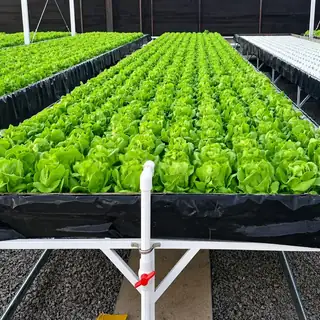
| Deep water culture (rafts) | Plants float on boards over aerated solution | About 35 to 40 plants/m² | Large water volume buffers temperature and EC; very forgiving | Heavy; needs aeration to keep dissolved oxygen high |
| Drip in substrate | Drippers feed plugs or troughs of media | About 20 to 25 plants/m² | Uses standard greenhouse irrigation | Media cost and handling; less common for lettuce |
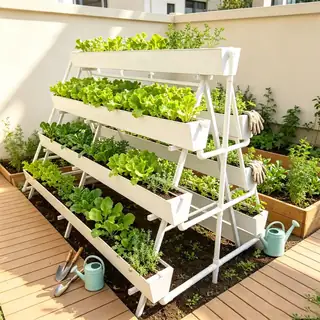
For a greenhouse that wants to fill floor area simply, rafts are hard to beat. For indoor farms and vertical lettuce gardens where height is the resource, NFT channels in racks or A-frames are the usual choice, such as our A-frame PVC NFT channel system for lettuce or square PVC NFT channels for leafy greens. Compare the options in NFT vs DWC vs Dutch bucket, or read our dedicated deep water culture guide.
What is the best lettuce for hydroponics?
Butterhead, leaf and romaine types are all grown hydroponically. The best lettuce for hydroponics depends on your market and your climate control:
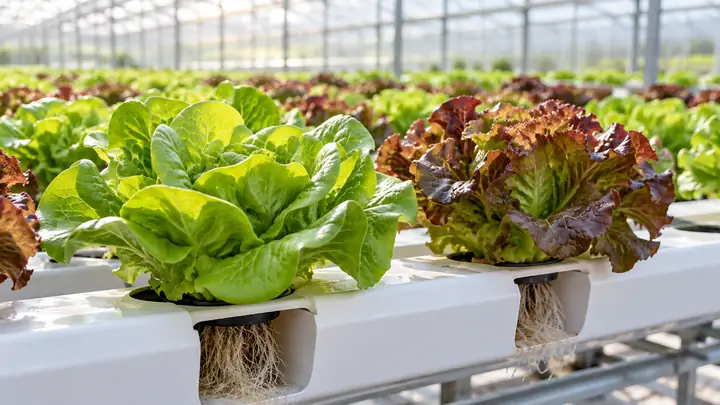
- Butterhead and Bibb: hydroponic Bibb lettuce is the classic live lettuce sold with roots in a clamshell. It is soft, fast and well suited to NFT.
- Green and red leaf, oakleaf and lollo types: fast, tolerant and popular for salad mixes and multi-leaf heads.
- Romaine: hydroponic romaine lettuce is in strong demand but more challenging indoors. It is more prone to tipburn and needs good airflow and steady growth.
- Baby leaf: sown densely and cut young, often on flood benches or in trays rather than channels.
Choose varieties bred for greenhouse or hydroponic production, with tolerance to bolting and tipburn. Seed catalogs usually flag these traits.
How do you grow lettuce hydroponically, step by step?
A typical crop cycle for planting hydroponic lettuce runs like this:
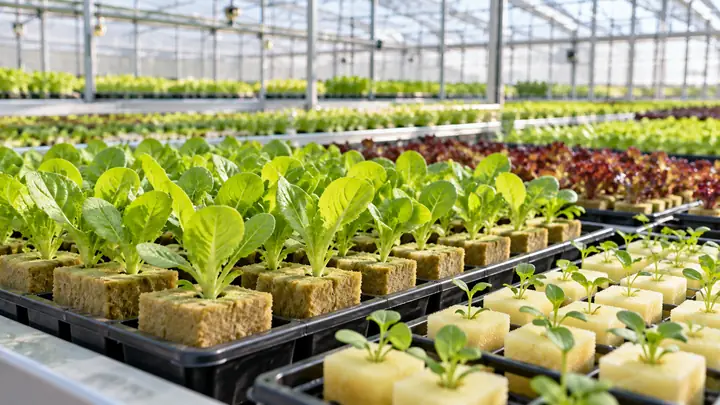
- Sow pelleted seed into rockwool, sponge or peat plugs, one seed per cell. Germinate at about 20 °C under low light or in the dark; seeds usually emerge in around 3 days.
- Raise seedlings under light for roughly 2 to 3 weeks on a weak nutrient solution (around 1.0 mS/cm EC). Healthy 3 week lettuce seedlings have three to four true leaves and roots showing through the plug.
- Transplant the plugs into net cups in channels or raft boards at the final spacing. Some farms use an intermediate "nursery" spacing for the first 1 to 2 weeks to make better use of space.
- Grow on at the production EC and pH, with steady light, temperature and airflow. Check EC, pH and solution temperature daily.
- Harvest heads roughly 3 to 5 weeks after transplanting, depending on variety, light and target weight. Sell as cut heads or as live lettuce with roots.
- Clean channels or rafts between cycles, and replace or sanitize the solution regularly to keep disease out.
Our guide to hydroponic growing media explains how to choose and use lettuce plugs.
How much light does lettuce need?
Lettuce light requirements are best expressed as a daily light integral (DLI): the total photosynthetic light the crop receives per day. Extension guidance for hydroponic lettuce gives an optimum of roughly 12 to 17 mol/m²/day. Below about 6.5 to 10 mol/m²/day, growth slows noticeably and crops take longer to reach weight. Too much light, especially combined with heat, raises the risk of tipburn and bolting.
In a greenhouse, how much sunlight lettuce plants need is the same DLI, but what they get depends on the season. A sunny summer day often supplies more than enough, so growers use shade, while winter days at higher latitudes may fall well short, so supplemental lighting is added.
Growing lettuce with LED lights indoors makes the target easy to hit. As an example, 16 hours a day at about 200 to 300 µmol/m²/s gives roughly 11.5 to 17 mol/m²/day. Seedlings need less, and germination needs very little.
What EC, pH and temperature does hydroponic lettuce need?
| Parameter | Typical target | Notes |
|---|---|---|
| Nutrient solution EC | Roughly 1.2 to 1.8 mS/cm | Lower for seedlings (about 1.0); adjust for season and variety |
| pH | About 5.5 to 6.0 | Alkaline source water usually needs acid correction |
| Day air temperature | Up to about 24 °C | Higher temperatures raise bolting and tipburn risk |
| Night air temperature | Up to about 18 °C | Lettuce tolerates cooler nights but grows more slowly |
| Relative humidity | About 50 to 70% | Very high humidity limits transpiration and calcium uptake |
| Dissolved oxygen (rafts) | About 6 to 8 ppm | Requires air pumps and air stones |
For recipes, dosing and how to correct drift, see our hydroponic nutrients, EC and pH guide.
Is growing lettuce in water different from growing it in soil?
In conventional lettuce agriculture, plants are direct-seeded or transplanted into field beds and harvested once, with a long gap between crops and heavy dependence on weather. Growing lettuce in water changes three things. First, the root zone is fully controlled: nutrients, pH and oxygen are set by the grower rather than the soil. Second, production is continuous: a new batch is transplanted as soon as one is harvested, often every week. Third, water use falls sharply, because recirculating systems lose water mainly through the plants themselves rather than through runoff and evaporation from soil.
The trade-offs are higher equipment cost, dependence on electricity for pumps and, indoors, lights, and the need for daily monitoring. A pump failure or a dosing error affects a whole system within hours, so alarms and backup matter more than in the field.
Romaine illustrates the difference well. Growing romaine lettuce indoors or in a greenhouse is entirely possible, and many growers grow romaine lettuce in water on rafts, but its upright, dense heart makes it more sensitive to tipburn than open leaf types. Varieties bred for protected cropping, steady temperatures and air blown into the canopy make the biggest difference.
What problems are common when growing lettuce indoors?
- Tipburn: brown, dead leaf edges caused by calcium not reaching fast-growing inner leaves. Improve airflow over and into the canopy, avoid very high humidity, and avoid pushing growth with excessive light.
- Bolting: the plant elongates and turns bitter, triggered mainly by heat and long days. Keep temperatures moderate and choose slow-bolting varieties.
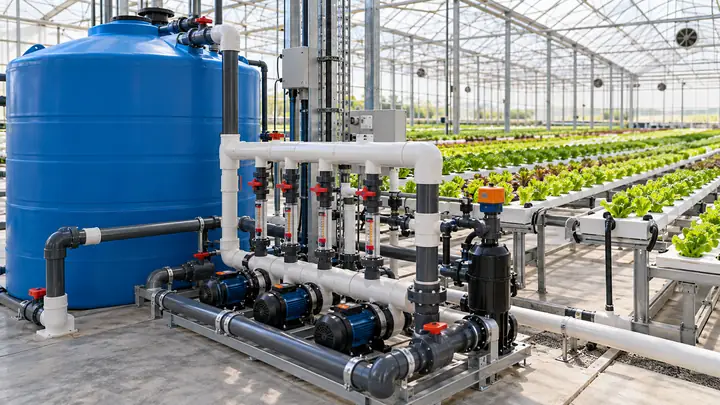
- Root rot (Pythium): brown, mushy roots, most likely in warm, poorly oxygenated water. Keep solution cool and aerated and sanitize between crops. Our pumps and plumbing guide covers aeration.
- Algae: green growth in channels or on plugs, from light reaching the solution. Cover openings and use opaque channels.
- Aphids and thrips: monitor with sticky traps and screen vents, especially in greenhouses.
What is hydroponic lettuce yield per square foot per year?
Extension figures put yield at roughly 2 to 6 kg/m² (about 0.4 to 1.2 lb/ft²) per crop cycle, depending on system, density and head size. Multiply that by the number of cycles a year to estimate annual output. With transplant-to-harvest times of roughly 3 to 5 weeks and a separate nursery area, a growing area can turn over around 9 to 14 times a year.
On that basis, a single growing layer might produce in the region of 4 to 15 lb per square foot per year, or roughly 20 to 70 kg/m², at the growing surface. Treat this as a planning range, not a promise. Real results depend on light, climate control, labor and how many weeks the space sits empty. In vertical racks, each extra lit layer adds area, so yield per square foot of floor rises roughly with the number of layers, provided each layer gets enough light and airflow.
For a full business plan, including floor layout and staffing, read how to start a vertical farm.
Can you grow lettuce indoors without a greenhouse?
Yes. Lettuce is one of the easiest crops to grow inside under LED lights, from a single shelf to a full plant factory. Indoors you control light, temperature and humidity completely, which means consistent heads every week regardless of the season. The trade-off is energy: you pay for all the light and for cooling to remove the heat the lights produce.
- Home and small-scale: an indoor lettuce garden can be a small tower, a shelf with NFT pipes, or a few containers on a windowsill. The best containers for growing lettuce indoors are shallow, at least 15 cm deep, with drainage, or a small hydroponic kit with its own pump and light.
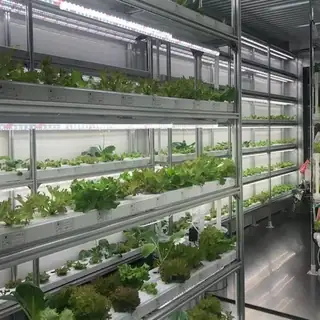
- Commercial: a lettuce farm indoors is usually built as multi-layer racks of NFT channels or trays in an insulated room or container, such as our hydroponic vertical plant factory for leafy greens.
Can lettuce be grown indoors in containers without a pump? Yes: growing lettuce indoors in containers of potting mix on a bright windowsill or under a small LED panel works for home grown lettuce, though growth is slower and less even than in hydroponics. A small hydroponic lettuce kit with a pump and timer is the easiest way to learn how to grow lettuce at home before scaling up.
Starting lettuce indoors and transplanting it outside is also common in soil gardens; growing lettuce from seeds indoors gives earlier and more even plants than direct sowing.
Planning a lettuce farm?
Mars Vertical Farm manufactures NFT channels, A-frames, raft systems and complete plant factories in Shanghai, with CE-marked products and an ISO 9001 quality system. Explore our plant factories, or tell us your target weekly output and we will propose a layout and quotation for your lettuce system.