
Short answer
A commercial dehumidifier for an indoor farm is a heavy duty unit that removes the water vapor plants transpire, typically 50 to several hundred liters per day. Size it from crop water uptake, not room volume: about 90–97% of water taken up is transpired, so convert the peak hourly transpiration to a 24-hour rating at your actual temperature and humidity, then add 20–30% margin.
What is a commercial dehumidifier, and why do indoor farms need one?
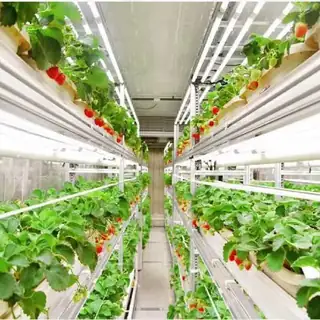
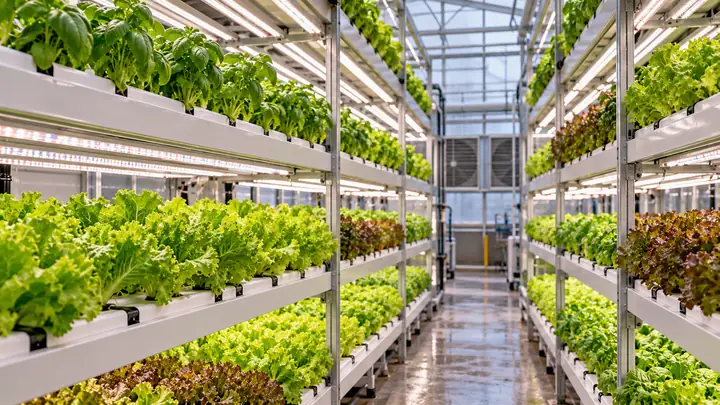
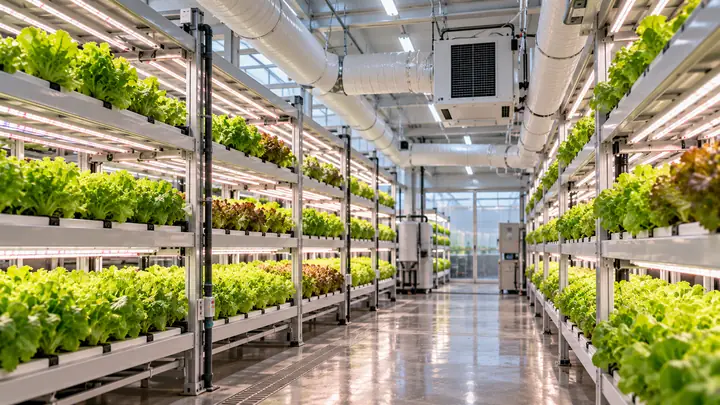
A commercial dehumidifier is a heavy duty machine that removes large volumes of water vapor from air, typically rated from about 50 L (over 100 pints) to several hundred liters per day, and built for continuous operation in warehouses, pools, factories and indoor farms. In a vertical farm, container farm or plant factory, it removes the water that plants transpire so humidity stays in the range crops and equipment need.
Plants release almost all of the water they take up back into the air. In a sealed room with no outside ventilation, that moisture has nowhere to go except into the dehumidifier or the air conditioning coil. Without enough dehumidification capacity, relative humidity (RH) climbs, transpiration slows, calcium transport suffers, and diseases such as gray mold and powdery mildew become more likely. This guide explains how to size a dehumidification system from crop transpiration, compares refrigerant, desiccant and HVAC-integrated options, and covers airflow and buyer checks for indoor farms.
What humidity and temperature should an indoor farm hold?
Most leafy greens and herbs grow well at roughly 20–24°C (68–75°F) with lights on and 60–75% RH, which corresponds to a vapor pressure deficit (VPD) of roughly 0.6–1.2 kPa. VPD describes the drying power of the air and is a better control target than RH alone, because the same RH feels very different to a plant at 18°C and at 26°C.
- Seedlings and propagation: higher humidity, often 70–85% RH, to protect young roots and cuttings.
- Leafy greens and herbs: about 60–75% RH. Very high humidity reduces transpiration and is associated with tipburn in lettuce, a calcium-related disorder.
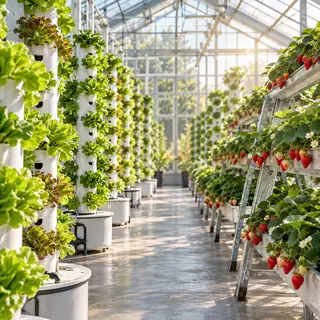
- Fruiting crops such as strawberries and tomatoes: similar or slightly drier air during flowering helps pollination and limits fungal disease.
- Mushroom rooms: very high humidity, often 85–95% RH, so they are managed differently; see our mushroom farm guide.
The hardest moment is usually lights-off. Temperature drops, RH rises quickly, and condensation can form on cool surfaces and leaves. A good control strategy ramps temperature down gradually and keeps the dehumidifier running through the transition. Leaf wetness at night is a common trigger for the diseases covered in our fungus gnats and powdery mildew control guide.
What types of dehumidification systems are used in indoor farms?
Indoor farms use three main approaches: standalone refrigerant dehumidifiers, desiccant dehumidifiers, and dehumidification built into the HVAC system. Many farms combine an air conditioning system for sensible cooling with dedicated dehumidifiers for latent load.
| Type | How it works | Strengths | Limitations | Typical indoor farm use |
|---|---|---|---|---|
| Commercial portable dehumidifier | Refrigerant coil on wheels, free-blowing | Low cost, easy to add or move | Limited capacity, noise, takes floor space | Small grow rooms, temporary commercial dehumidification |
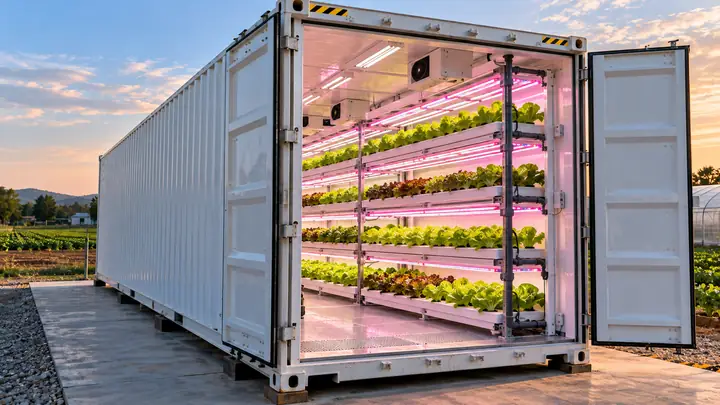
| Ceiling or wall hung dehumidifier | Refrigerant unit mounted overhead or on a wall | Saves floor space, good air distribution | Needs structural support and condensate drain | Container farms, grow rooms, small plant factories |
| Commercial ducted dehumidifier (inline) | Refrigerant unit connected to supply and return ducts | Quiet room, even distribution, can sit outside the room | Ductwork cost and design | Multi-tier vertical farms, larger rooms |
| HVAC-integrated dehumidification | Air handler or packaged unit overcools to condense moisture, often with reheat | One system for temperature and humidity, central control | Higher design complexity; reheat adds energy unless heat recovery is used | Large plant factories, warehouses |
| Industrial desiccant dehumidifier | Adsorbent wheel removes moisture, regenerated by heat | Works at low temperatures and to very low dew points | Needs regeneration energy; adds heat to process air | Cold rooms, drying rooms, low-temperature crops and storage |
Refrigerant (mechanical) dehumidifiers are the default for warm, humid grow rooms because they remove the most water per kWh at typical indoor farm conditions. Desiccant dehumidification systems make sense when air temperature is low, roughly below 15°C (59°F), where refrigerant coils lose capacity and can ice up.
When does a central dehumidifier system make sense?
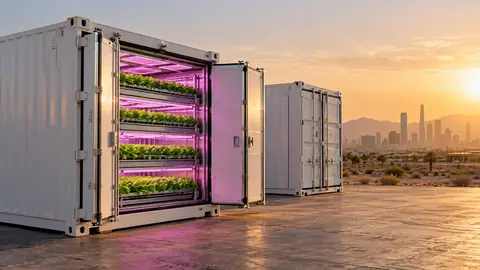
A central dehumidifier system makes sense once a farm has several grow rooms or a large multi-tier hall. Instead of many small units, one or two large commercial dehumidifiers, or an HVAC dehumidifier built into the air handler, serve the rooms through ducts, much like commercial building dehumidification in offices or pools. High capacity dehumidifiers of this kind are easier to service from outside the growing area and keep noise and heat away from the crop. The same industrial size dehumidifier used in a warehouse can work in an indoor farm, provided it is rated for continuous high humidity and its coils are protected against corrosion.
How do you size a commercial dehumidifier for an indoor farm?
You size a commercial dehumidifier for an indoor farm from the crop's water use, because in a sealed room most of the irrigation water that plants take up is transpired. Room volume alone, the method used for basements and offices, badly underestimates the load in a grow room.
- Measure daily water uptake. Record how much water the system receives per day, for example reservoir top-ups in a hydroponic system, minus any drain-to-waste. If the farm is not built yet, use crop and system data from the supplier and treat it as an estimate.
- Estimate the transpired share. Under indoor conditions plants typically transpire around 90–97% of the water they take up; only a small share stays in harvested biomass. Use 95% for a first estimate.
- Find the peak hourly rate. Most transpiration happens with lights on. Divide the transpired volume by lights-on hours, adding some allowance for night transpiration.
- Convert to a daily rating. Dehumidifiers are rated per 24 hours, so multiply the peak hourly rate by 24. One liter equals about 2.1 US pints.
- Correct for rating conditions. Capacity depends heavily on air temperature and RH. US residential units are rated at 65°F (18°C) and 60% RH, while many commercial and grow-room units are rated at 80°F (27°C) and 60% RH. Use the manufacturer's capacity curve at your actual setpoint.
- Subtract other moisture removal, carefully. Air conditioning coils remove some moisture, but only while they run; do not rely on them at lights-off when cooling demand falls.
- Add margin and redundancy. Add 20–30% for peaks and coil fouling, and split capacity across at least two units so one failure does not ruin a crop.
Worked example
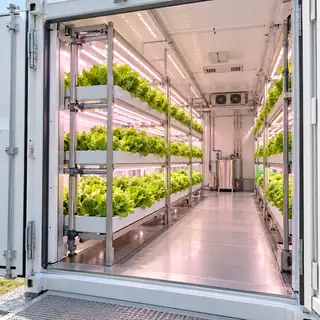
Suppose a container farm takes up 120 L (about 32 US gallons) of water per day. At 95% transpired, about 114 L/day enters the air. If roughly 80% of that happens during 16 hours of light, the peak rate is about 5.7 L/h, equivalent to a 137 L/day (about 290 pints/day) rating at room conditions. With a 25% margin, you would specify roughly 170 L/day (about 360 pints/day) at your actual temperature and RH, preferably as two units. Treat this as an illustration; your own water records are the best input.
How much cooling does an indoor farm HVAC system need?
In a sealed indoor farm, almost all electricity used inside the room ends up as heat that the HVAC system must remove. LED fixtures, pumps, fans and the dehumidifiers themselves all add sensible heat; only a few percent of light energy is stored by photosynthesis.
- Convert electrical load to heat: 1 kW of equipment in the room adds about 3,412 BTU/h. One ton of refrigeration equals 12,000 BTU/h, or about 3.5 kW.
- Example: 20 kW of lighting plus 3 kW of pumps, fans and controls adds about 78,500 BTU/h, roughly 6.5 tons of cooling before envelope gains, fresh air and safety margin.
- Dehumidifiers add heat: condensing water releases its latent heat, about 0.68 kWh per liter, back into the room as sensible heat, on top of the unit's own compressor and fan power.
- Insulation matters: a well-insulated, airtight envelope makes the load predictable and stops condensation on walls.
Lighting is usually the largest single load, so efficient fixtures reduce both electricity and HVAC size; see grow lights for indoor farming. Greenhouse HVAC works differently, because greenhouses usually exhaust humid air through vents and fans rather than condensing it; our greenhouse ventilation and heating guide covers that approach.
How should air move through a vertical farm?
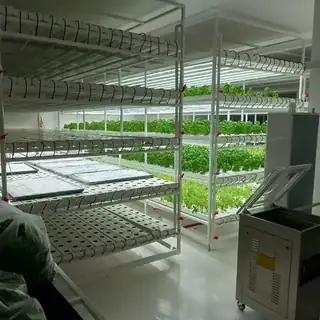
Dehumidification only works if air actually moves through the canopy. Dense multi-tier racks create still, humid pockets between leaves even when the room sensor reads a healthy value.
- Provide gentle air movement across every tier, commonly in the range of about 0.3–1 m/s (60–200 ft/min) at the canopy, using horizontal airflow fans or ducted air delivered along each shelf.
- Place return air paths so humid air from the racks reaches the dehumidifier rather than short-circuiting near the unit.
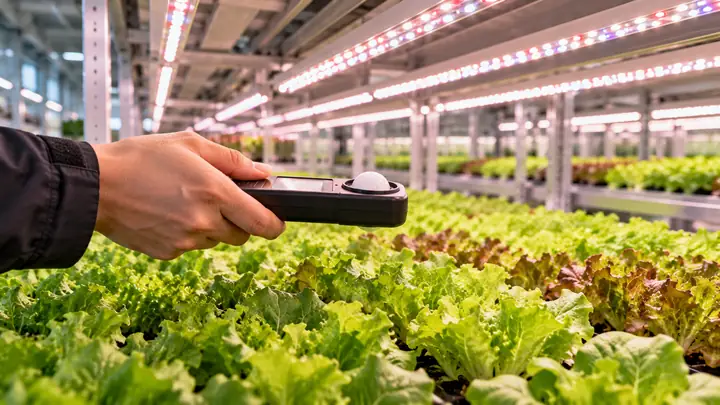
- Mount temperature and RH sensors at canopy height on several tiers, not only near the ceiling or the door.
- Pipe condensate to a drain or a collection tank. Condensate is low in dissolved minerals and can often be reused for irrigation after filtration and disinfection, which recovers a large share of the farm's water.
Climate data from several points is easiest to manage through a central controller; see IoT in smart agriculture for sensors and alarms.
Buyer checklist for industrial dehumidifiers
When comparing commercial dehumidifiers, ask every supplier for the same data so you compare capacity at your conditions rather than headline numbers. These are the points we check when specifying climate equipment for our plant factories.
- Capacity at your setpoint, for example at 24°C and 65% RH, not only at the rating point.
- Energy efficiency in liters per kWh or pints per kWh at those conditions; efficient commercial units often reach roughly 2–4 L/kWh at warm, humid rating conditions.
- Operating range: minimum air temperature, defrost method and maximum ambient.
- Power supply: 220–240 V single-phase or 380–480 V three-phase, 50 or 60 Hz, and starting current.
- Construction: coated coils for humid, fertilizer-laden air, stainless or powder-coated cabinet, washable filters.
- Controls: built-in humidistat versus external control, dry contacts or Modbus for integration with the farm controller.
- Installation: ducted or free-blowing, condensate pump, noise level and service access.
Next steps
A commercial dehumidifier sized from transpiration, combined with properly sized cooling and good airflow, is what keeps an indoor farm's climate stable through every light cycle. Mars Vertical Farm designs container and indoor plant factories with lighting, HVAC, dehumidification and fertigation matched to the crop plan, such as our fully automated container plant factory and custom indoor farms in the plant factories range. For a broader comparison of formats, see container farm vs. indoor plant factory. Share your crop, room size and local climate, and we will propose a factory-direct climate package sized to your project.