Plant factories
In short
This is an indoor vertical strawberry farm that grows day-neutral varieties under LED light in a sealed, climate-controlled room. It fits a fresh-produce grower, farm shop group or retail supplier in a northern climate that wants to sell local strawberries outside the normal summer season.
Typical buyer: Fresh-produce grower
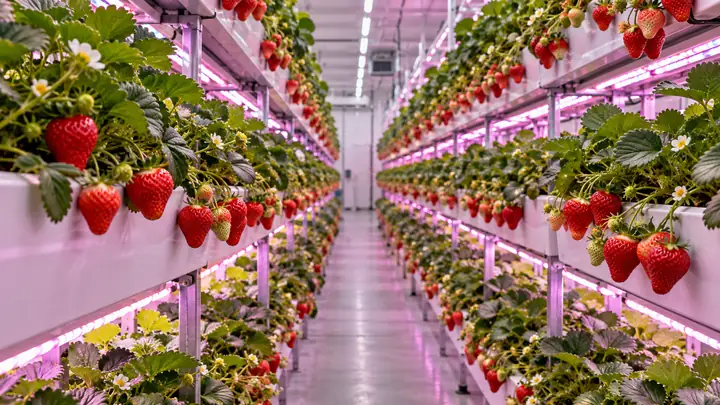
Cover image is illustrative.
System at a glance
- Growing room
- Example 300 m² insulated room, 4–6 m clear height
- Growing format
- Multi-layer substrate troughs with drip fertigation
- Crop
- Day-neutral (everbearing) strawberry varieties
- Power supply
- 380–415 V, 3-phase, 50 Hz; lighting is the largest load
- Time to first harvest
- Typically 8–12 weeks after planting, variety-dependent
- Plant replacement
- Typically every 8–12 months
- Climate control
- Separate day/night temperature setpoints, humidity and CO₂ control
- Pollination
- Bumblebee hives or assisted pollination
Challenge
What the buyer needs to solve
In Northern Europe, field and polytunnel strawberries run from late spring to early autumn. From roughly October to April, retailers rely on imports from Spain, Morocco, Egypt or further away. Those berries are picked firm to survive transport, and buyers increasingly ask for local, low-residue fruit year-round.
What makes indoor strawberries harder than lettuce
- Flowering and fruiting: strawberries need the right light intensity, day length and temperature difference between day and night to flower and set good fruit.
- Pollination: in a sealed room there is no wind and no wild insects, so pollination must be planned.
- Disease: botrytis and powdery mildew spread quickly when humidity and airflow are not controlled.
- Energy: lighting and climate control are the main running costs, so the design must use space and light efficiently.
The grower needs a system that controls these variables tightly and still lets staff reach every plant for pruning and harvesting.
Solution
How the system is designed
The design uses our intelligent strawberry plant factory layout inside an existing insulated warehouse or a new sandwich-panel room. Plants grow in substrate troughs on a multi-layer vertical hydroponic strawberry system, with LED lighting tuned for flowering crops on each layer.
Key subsystems
- Environment control: the strawberry environment control system manages temperature, humidity, CO₂, airflow and photoperiod, with separate day and night setpoints to support flowering and fruit quality.
- Fertigation: a smart fertigation machine doses nutrients by EC and pH and feeds the troughs by drip. Drain water is collected and can be filtered and reused.
- Airflow: horizontal fans move air through the canopy on every layer, which helps keep leaf surfaces dry and reduces fungal pressure.
- Pollination: the layout leaves space for bumblebee hives, and we also discuss mechanical or airflow-assisted pollination where hives are not practical.
Racks sit on a fixed or mobile base depending on room height and aisle width. Staff harvest from the floor or a low platform, and every layer has its own drip and drain line so problems stay local.
Planting stock matters as much as equipment. We recommend certified, disease-free day-neutral plants from a local nursery and help you plan the replanting rhythm. Contact us with your room dimensions to get a layout.
Example configuration
| Item | Specification | Qty |
|---|---|---|
| Strawberry plant factory package | Room layout, insulation guidance, integration of racks and controls | 1 project (approx. 300 m² growing room) |
| Multi-layer vertical strawberry racks | Food-grade substrate troughs, 3–5 layers, drip and drain per layer | Approx. 20–30 rack units |
| LED grow lights | Full-spectrum fixtures suited to flowering and fruiting crops | 1 bar set per layer |
| Environment control system | Temperature, humidity, CO₂, photoperiod; PLC with remote monitoring | 1 set |
| Smart fertigation machine | EC/pH dosing, multi-channel injection, drip scheduling | 1 unit |
| HVAC and canopy fans | Cooling, heating and dehumidification sized for lighting heat load | As calculated |
| Drain collection and filtration | Return tank with filter for drain-water reuse | 1 set |
Design targets
- Designed to produce strawberries in winter months when field supply stops
- Built to keep humidity and airflow in ranges that reduce fungal disease pressure
- Fertigation with drain collection for nutrient and water reuse
- Minimal or no pesticide use in a sealed growing room
Timeline
How the project runs
A strawberry plant factory of this scale typically takes 4–7 months from first discussion to first fruit, including the plants' establishment period.
- Inquiry & consultation: We discuss your market window, target varieties, building and energy costs.
- Proposal & quotation: We provide a room layout, rack count, lighting plan and quotation.
- R&D confirmation: Our R&D team confirms the lighting design, HVAC loads and fertigation layout for your building.
- Contract: We sign the contract with scope, acceptance tests and delivery terms.
- Production & QC: Racks, controls and fertigation units are built and tested at our 2,000 m² Shanghai factory.
- Third-party lab testing: Electrical components and controls are checked by a third-party lab for CE and market requirements.
- Shipping & logistics: Sea freight to a UK or Nordic port, followed by delivery to site.
- After-sales support: We guide installation and commissioning, then support the first crop cycles with remote reviews of climate and fertigation data.
Equipment
Products in this solution
Plant factories
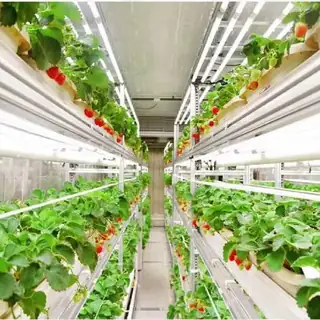
Climate-Controlled Indoor Strawberry Plant Factory
Vertical towers & racks
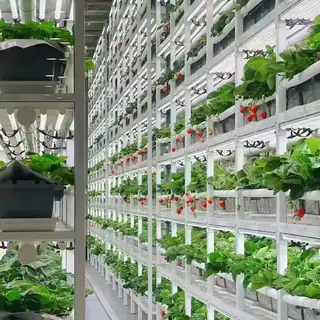
Multi-Layer Vertical Strawberry Growing System
Irrigation & fertigation
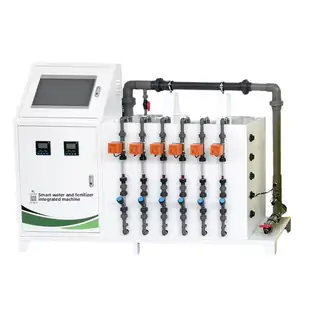
Smart Fertigation Machine with Dosing Pump
FAQ
Frequently asked questions
Can't find your answer? Our engineers reply within one business day.
Ask a questionWhich strawberry varieties work best indoors?
Day-neutral, or everbearing, varieties are the usual choice because they flower without needing a long cold period or a specific day length. Your local nursery and agronomist should confirm the final choice based on taste, shelf life and buyer preferences. We set the lighting and climate plan around the variety you select.
How do the flowers get pollinated?
Most indoor strawberry farms use commercial bumblebee hives, which work well in enclosed rooms with the right light. Where hives are not suitable, growers use airflow or hand-held pollination tools. Our layout leaves space for hives and keeps lighting and airflow compatible with bee activity.
What drives the running cost?
Electricity for LED lighting and climate control is the largest cost, followed by labor and planting stock. We size the lighting to the crop's needs rather than the maximum, and the control system can shift light hours to cheaper tariff periods. We include an estimated power demand in the proposal so you can model costs.
Can we use an existing building?
Yes, in many cases. A clean, insulated warehouse with enough height for several layers and adequate power is a good starting point. We review your floor plan, wall insulation, ceiling height and electrical capacity, then advise whether you need extra insulation, a vapor barrier or a power upgrade.
Get a quotation
Plan a project like this
Share your site, crop and target output, and we'll adapt this design to it.
- Itemized quotation in USD with lead time
- Layout drawings for custom systems
- Factory inspection or video call on request
- Export packing and shipping documents
Prefer email? inquiry@marsverticalfarm.com