Plant factories
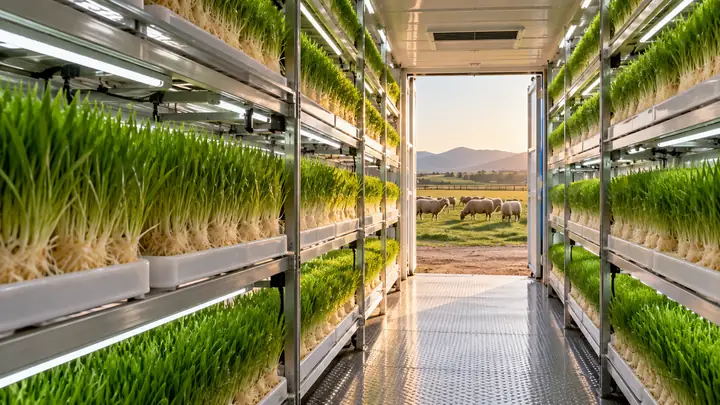
In short
This is a container-based hydroponic fodder system that turns barley or wheat seed into fresh green feed in about seven days. It fits a dairy, sheep or goat farm in a dry region that wants a daily, predictable supply of green fodder to supplement roughage, using a small fraction of the water that irrigated pasture needs.
Typical buyer: Dairy and sheep farm
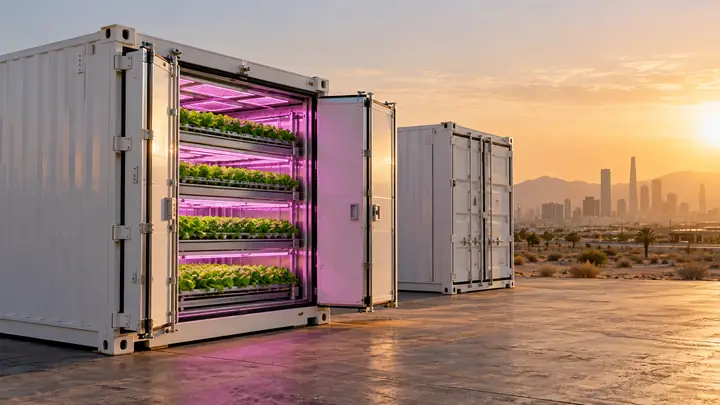
Cover image is illustrative.
System at a glance
- Footprint
- Approx. 100 m² for two 40 ft containers plus seed prep area
- Growth cycle
- Typically 7 days seed to harvest
- Seed
- Barley (preferred), wheat or oats, cleaned and untreated
- Seed to fodder ratio
- Typically 1:5 to 1:7 fresh weight, depending on seed quality
- Design output
- Daily harvest; volume confirmed per tray count and seed load
- Water use
- Typically a few liters per kg of fodder, versus far more for irrigated pasture
- Power supply
- 380 V 3-phase or 220 V single-phase, confirmed per design
- Room temperature
- Held at roughly 18–24 °C by the control system
Challenge
What the buyer needs to solve
Mixed livestock farms in South Africa, Namibia, Botswana and similar semi-arid areas face long dry seasons and recurring drought. When pasture fails, farmers buy in lucerne or silage at high prices, and transport costs add more. Green feed is usually the hardest input to secure in the dry months.
What the farm needs
- Daily supply: fresh fodder every morning for milking cows and ewes, without relying on rainfall.
- Low water use: borehole water is limited and often hard or sandy.
- Simple operation: farm staff should be able to load seed and harvest mats in a short daily routine.
- Reliability: the unit must handle dust, heat and power interruptions common on rural sites.
Solution
How the system is designed
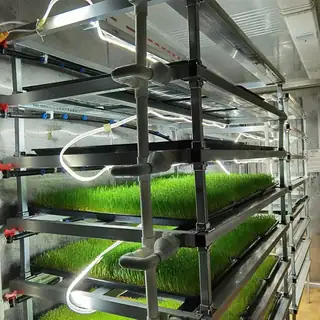
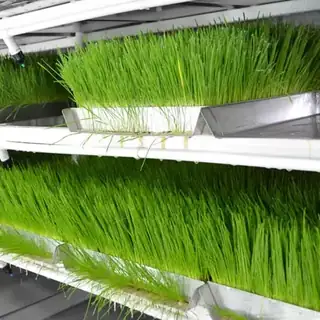
The design uses two fully automatic container hydroponic forage systems, each a 40 ft insulated container fitted with multi-level trays, spray irrigation, LED lighting and climate control. Seed goes into the trays on day one and comes out as a dense green mat of roots and shoots on day seven. Because each day's trays are at a different stage, the farm harvests a fresh batch every day.
System layout
- Growing units: the containers follow our high-productivity forage plant factory design, with PLC-timed irrigation and temperature control to keep seed in the range where it sprouts fast and resists mold.
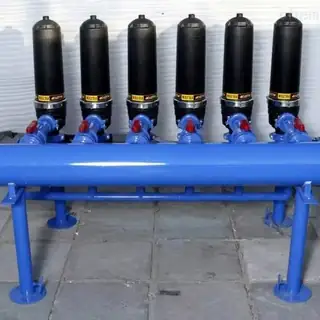
- Water treatment: a fully automatic disc filter removes sand and particles from borehole water before it reaches the spray nozzles, which keeps nozzles clear and trays clean.
- Seed preparation: a soaking and rinsing station outside the containers lets staff clean and pre-soak seed, which improves germination and lowers mold risk.
- Power backup: we recommend a generator or solar-battery connection sized to keep irrigation and ventilation running during outages.
Hydroponic fodder is high in moisture and works as a supplement, not a full replacement for roughage. We recommend you agree on feeding rates with your animal nutritionist. Talk to us about your herd size and target daily volume.
Example configuration
| Item | Specification | Qty |
|---|---|---|
| 40 ft container hydroponic forage system | Insulated shell, multi-level trays, spray irrigation, LED lights, PLC control | 2 units |
| Disc filter | Fully automatic backwash, for borehole water with sand | 1 unit |
| Seed soaking and rinsing station | Food-grade tanks with drain | 1 set |
| Water storage tank | 5 m³, shaded, with float valve | 1 |
| Backup power interface | Connection for generator or solar-battery system | 1 per container |
| Spare parts kit | Nozzles, pump, sensors, timer relays, trays | 1 kit |
Design targets
- Designed for a fresh fodder harvest every day of the year
- Typically 7 days from seed to feed
- Built to use a small fraction of the water needed by irrigated pasture
- Short daily routine for loading seed and harvesting mats
Timeline
How the project runs
Fodder containers are mostly standard, so projects typically take 2.5–4 months from first contact to first harvest.
- Inquiry & consultation: We discuss herd size, feeding goals, seed availability, water source and power.
- Proposal & quotation: We propose the number of units and trays and send a quotation.
- R&D confirmation: Engineers confirm voltage, filter sizing from your water test, and any insulation or cooling upgrades.
- Contract: We sign the contract with scope and delivery terms.
- Production & QC: Containers are built and run through a full irrigation and control test before dispatch.
- Third-party lab testing: Electrical safety and component checks are completed by a third-party lab where required.
- Shipping & logistics: Sea freight to Durban or Cape Town, then road transport to the farm.
- After-sales support: We guide installation and train staff on seed prep, loading, harvest and cleaning, then support troubleshooting remotely.
Equipment
Products in this solution
Plant factories
Seven-Day Forage Grass Plant Factory
Irrigation & fertigation
Centrifugal Disc Filter for Agricultural Water
FAQ
Frequently asked questions
Can't find your answer? Our engineers reply within one business day.
Ask a questionHow much fodder does one container produce?
Daily output depends on the number of trays, seed load per tray and seed quality. Sprouted barley typically yields five to seven times the seed weight as fresh fodder. We calculate your daily volume from the tray layout in the proposal and match the number of units to your herd size and feeding plan.
Can hydroponic fodder replace hay or silage?
No. Fresh fodder is high in moisture and low in dry matter, so it works best as a supplement that adds green feed to the ration. Animals still need roughage for rumen health. Ask your nutritionist to set feeding rates for each animal group before you switch from your current ration.
How do you prevent mold in the trays?
Mold usually comes from dirty seed, warm stagnant air or poor cleaning. The design controls temperature and airflow, and the soaking station lets staff clean seed before loading. We also provide a cleaning routine for trays and nozzles. Using clean, untreated seed with a high germination rate makes the biggest difference.
Get a quotation
Plan a project like this
Share your site, crop and target output, and we'll adapt this design to it.
- Itemized quotation in USD with lead time
- Layout drawings for custom systems
- Factory inspection or video call on request
- Export packing and shipping documents
Prefer email? inquiry@marsverticalfarm.com