Short answer
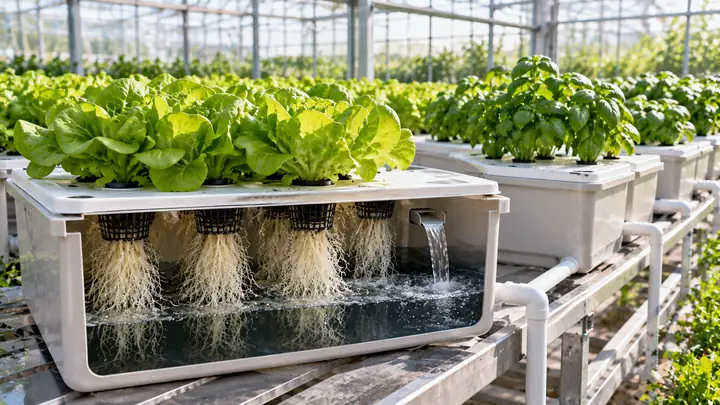
The Kratky method is a passive hydroponic technique in which a plant sits in a net pot above a covered container of nutrient solution with no pump or air stone. As the plant drinks, the level drops and leaves a humid air gap for root oxygen. A head of lettuce typically uses about 3 to 4 liters of solution, so one fill can last from transplant to harvest.
What is the Kratky method?
The Kratky method is a passive, non-circulating hydroponic technique in which a plant sits in a net pot above a covered container of nutrient solution, with no pump, air stone or electricity. As the plant drinks, the solution level falls and leaves a humid air gap that the upper roots use for oxygen, so one fill can carry a lettuce crop from transplant to harvest.
The method was developed and published by Dr. Bernard Kratky at the University of Hawaii College of Tropical Agriculture and Human Resources (CTAHR), who tested it on lettuce, cucumbers and tomatoes in both small bottles and commercial-size tanks. Today Kratky hydroponics is the most common entry point for people building a DIY hydroponic system, and it is also a useful teaching tool for anyone planning a larger recirculating farm. This guide explains how it works, how to set it up, how to mix a Kratky method nutrient solution, and how it compares with other DIY hydroponics builds such as bucket, PVC pipe and tower systems.
How does Kratky hydroponics work?
Kratky hydroponics works by letting the plant create its own root-zone air supply as it consumes water. At the start, only the bottom 2–3 cm (about 1 in) of the net pot touches the solution, so roots can reach it while the stem and crown stay dry.
- Week 1–2: roots grow down into the solution and the plant begins drawing water and nutrients.
- Mid-crop: the level drops, often by 15–25 cm (6–10 in) in a tall container, and the upper roots adapt to the moist air layer under the lid. These "air roots" take up oxygen, while the submerged roots keep taking up water and nutrients.
- Harvest: the crop is planned so that it finishes before the container runs dry. Kratky's guidance is to end the cycle when less than about 10% of the original solution remains.
Why doesn't the Kratky method need a pump or air stone?
Deep water culture needs an air pump because roots sit fully submerged in solution. In a Kratky hydroponic system the expanding air gap does that job, so there is nothing to power, fail or make noise. The trade-off is less control: you cannot easily adjust nutrient strength or pH mid-crop, and warm solution holds less dissolved oxygen, so performance drops in hot rooms. For the fully aerated version of the same idea, see our deep water culture (DWC) guide.
How do you set up a Kratky hydroponic system?
A basic Kratky method hydroponics system takes under an hour to build, whether you buy a Kratky hydroponics kit or assemble a small DIY hydroponic system from household parts. You need a lightproof container, a lid, a net pot, a growing medium and a seedling. Follow these steps:
- Choose a container. Use an opaque, food-safe plastic container: a 4 L (1 gal) jug for one lettuce, a 10–20 L (3–5 gal) bucket for one larger plant, or a 40–60 L tote for several lettuce heads. Paint or wrap clear containers to stop algae.
- Cut holes in the lid. Size holes so 5–7.5 cm (2–3 in) net pots sit snugly. Space lettuce at roughly 20 × 30 cm (8 × 12 in), the spacing Kratky used in commercial tanks.
- Start seedlings. Germinate in rockwool cubes, sponge plugs or coir plugs and grow until two or three true leaves appear. Our seed starting trays and germination guide covers this stage.
- Mix the nutrient solution. Dissolve a complete hydroponic fertilizer at the label rate for leafy greens, typically giving an EC of 1.2–2.0 mS/cm, and check pH is roughly 5.5–6.5.
- Fill to the correct level. Fill until the bottom 2–3 cm of the net pot is immersed. Do not cover the crown.
- Transplant and cover. Set the plug in the net pot, add clay pebbles or perlite around it if needed, seal gaps in the lid, and place the container under light.
- Leave it alone. Check weekly for leaks, pests and plant health, but do not refill to the original level once air roots have formed.
How big should a Kratky container be?
Container size is the key design decision, because the plant must finish before the solution runs out. The table shows typical starting points; actual water use varies with light, temperature and humidity.
| Crop | Typical volume per plant | Typical cycle after transplant | Typical EC (mS/cm) |
|---|---|---|---|
| Leaf or butterhead lettuce | 3–4 L (about 1 gal) | 4–6 weeks | 1.2–2.0 |
| Basil, parsley, cilantro | 4–8 L (1–2 gal) | 4–8 weeks, or cut-and-come-again with top-ups | 1.0–1.6 |
| Pak choi, kale, Swiss chard | 4–10 L (1–2.5 gal) | 4–8 weeks | 1.5–2.2 |
| Cucumber | Around 100 L (25–30 gal) | About 10–12 weeks | 2.0–2.5 |
| Tomato | Very large; often 50 L (13 gal) or more per plant | Long season; usually needs managed refills | 1.5–2.5 |
Kratky's own trials found that a roughly 200 g head of lettuce used about 3–4 L of solution in Hawaii, which is why a 4 L bottle suits only short leafy crops. Fruiting crops are possible but need much bigger containers, so most growers stick to leafy greens and herbs.
What nutrient solution does the Kratky method use?
The Kratky method uses the same complete, water-soluble hydroponic fertilizer as any other hydroponic system, mixed once at the start. Because nothing is added later, the starting mix must contain every macro and micronutrient the crop needs.
- Use a complete hydroponic formula. One-part or two-part hydroponic fertilizers with calcium, magnesium and chelated micronutrients work well. Garden fertilizers made for soil usually lack micronutrients or contain urea and slow-release coatings that behave poorly in water.
- Start water matters. As the plant uses water, dissolved salts concentrate. Kratky noted that water starting at EC 0.2 can reach about 2.0 by the time only 10% of the solution is left. Hard or salty water may need reverse osmosis (RO) filtering first.
- Keep pH in range. Most leafy crops do best at pH 5.5–6.5. Kratky reported finishing crops without adjusting pH when using commercial hydroponic fertilizer, but checking at the start is cheap insurance.
- Topping up: if a container runs low before harvest, add a small amount of half-strength solution to cover only the lowest roots, not back to the original level, so air roots are not drowned.
Can you make DIY hydroponic fertilizer or plant food?
You can mix DIY hydroponic nutrients from individual salts such as calcium nitrate, potassium nitrate, monopotassium phosphate and magnesium sulfate plus a micronutrient blend, and commercial growers routinely do this with A and B stock tanks. For small home systems, weighing errors and missing trace elements are common, so a ready-made hydroponic fertilizer is usually more reliable. Homemade "organic" teas from compost or kitchen scraps tend to rot in still water and are not recommended. Our hydroponic nutrients, EC and pH guide gives target ranges by crop.
Which plants grow best with Kratky hydroponics?
Fast, compact leafy crops grow best with Kratky hydroponics because they finish before the solution is used up and their water demand is predictable.
- Best: lettuce of all types, pak choi, spinach in cool rooms, arugula, basil, mint, chives, parsley and green onions. See lettuce varieties for hydroponics for variety picks.
- Possible with large containers: cucumbers, peppers and tomatoes. They drink many liters per week in full fruit, so they usually need very large tanks or planned refills.
- Poor fit: strawberries are a common wish, but they are long-lived plants that prefer a well-drained, well-aerated crown and steady feeding, so recirculating NFT gutters, A-frames or substrate troughs perform far better than still water.
What other DIY hydroponic systems can you build?
Beyond Kratky, most DIY hydroponics plans fall into four simple builds, each adding a pump or air supply for more control. These are the most popular hydroponics systems for beginners:
| DIY system | How it works | Power needed | Best crops | Main risk |
|---|---|---|---|---|
| Kratky container | Still solution, falling level, air gap | None | Lettuce, herbs | Runs dry or overheats |
| 5 gallon bucket DWC | Roots in aerated solution in a 19 L bucket | Air pump | Lettuce, herbs, one large plant | Root rot if air or temperature fails |
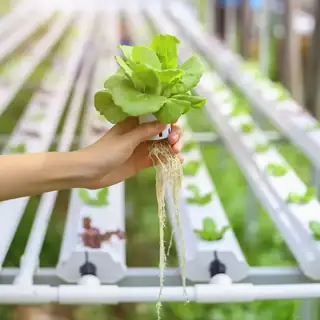
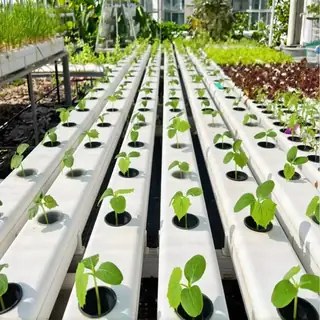
| PVC pipe hydroponics (NFT) | Thin film of solution flows down sloped PVC pipes | Water pump | Lettuce, herbs, leafy greens | Pump failure dries roots quickly |
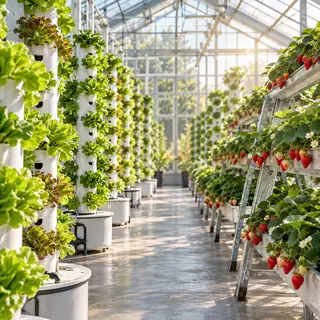
| DIY hydroponic tower | Solution pumped to the top of a vertical pipe and trickles down | Water pump and timer | Lettuce, herbs, strawberries | Uneven flow, clogged outlets |
| Ebb and flow tote | Tray floods and drains on a timer | Water pump and timer | Seedlings, herbs, potted plants | Timer or drain failure |
How do you make a 5 gallon bucket hydroponic system?
A DIY 5 gallon bucket system uses a food-safe 19 L bucket, a lid with one 7.5–15 cm (3–6 in) net pot, an air pump with tubing and an air stone. Fill with nutrient solution to just below the net pot, run the air stone continuously and change the solution every two to three weeks. Without the air pump, the same bucket works as a Kratky container for one large herb or lettuce plant.
Is PVC pipe safe for DIY hydroponic gardens?
PVC builds are common in DIY hydroponics because pipe is cheap and easy to cut, but use pipe rated for potable water and avoid flexible vinyl that may leach plasticizers. Paint or wrap white pipe if light reaches the roots. A DIY PVC tower typically uses a 100–110 mm (4 in) vertical pipe with angled planting holes and a small submersible pump on a timer. Purpose-made channels with a flat floor spread the water film better than round pipe; see our hydroponic towers guide and NFT hydroponics guide for design details.
What are the most common Kratky mistakes?
Most Kratky failures come from water level, light leaks and heat rather than from the method itself.
- Overfilling: submerging the crown or refilling to the top after air roots form causes rot and wilting.
- Light leaks: clear containers or gaps in the lid grow algae, which competes for nutrients and oxygen.
- Warm solution: above roughly 24–26°C (75–79°F), dissolved oxygen falls and root disease risk rises. Keep containers out of direct sun and off warm floors.
- Undersized containers: a big plant in a small jug runs dry mid-crop.
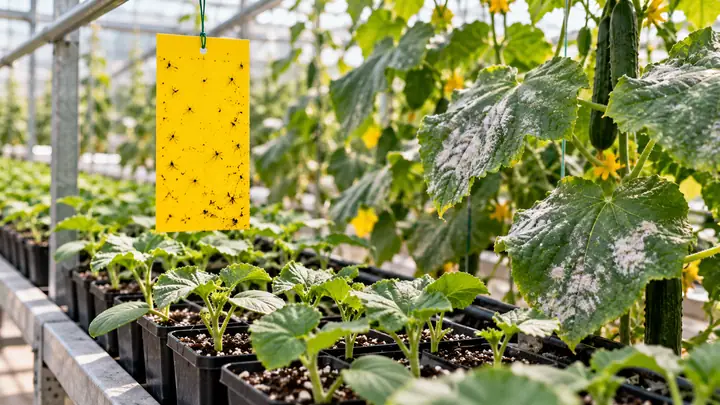
- Open water: any gap lets mosquitoes and fungus gnats breed. Seal lids and cover unused holes.
- Wrong fertilizer: soil fertilizers without micronutrients cause yellowing and stunting.
Can the Kratky method work commercially?
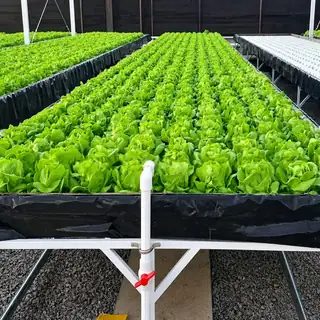
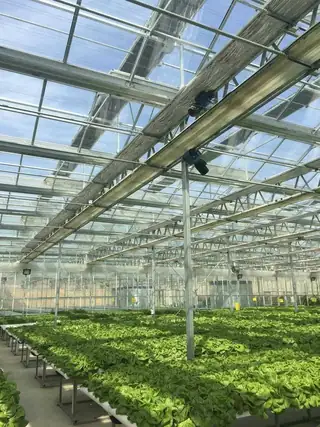
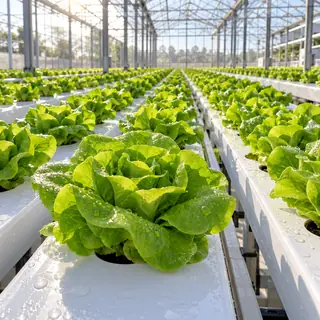
The Kratky method can work at small commercial scale, and Kratky himself described tanks with polystyrene lids holding lettuce at 20 × 30 cm spacing and harvested on a weekly rotation. However, most commercial farms move to recirculating systems once they grow beyond a few hundred heads, because recirculation allows nutrient dosing, pH control, sterilization and higher plant density.
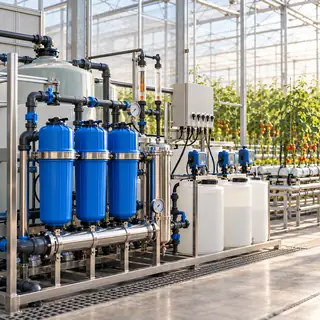
A typical progression is: Kratky or DIY hydroponics kit for learning, then a small recirculating NFT or deep water culture system, then a commercial layout with automated fertigation. Useful options at that stage include our custom deep water culture floating raft system, which is essentially a powered, managed version of the Kratky tank, and food-grade PVC NFT channels in the hydroponic systems range. Compare all methods in types of hydroponic systems.
Next steps
The Kratky method is the simplest way to learn how roots, water, nutrients and oxygen interact, and it remains a practical choice for small batches of lettuce and herbs. When you are ready to move from a DIY hydroponic system to a production setup, tell us your crop, space and target output and our engineers can suggest a factory-direct DWC, NFT or tower layout in standard or custom sizes.