












Short answer
To get rid of fungus gnats, let the top 2 to 5 cm of growing medium dry between waterings, catch adults on yellow sticky traps, and treat larvae with Bti or Steinernema feltiae nematodes for at least three to four weeks, one full life cycle. Powdery mildew is controlled by lowering humidity, improving airflow, removing infected leaves and applying contact treatments such as potassium bicarbonate early.
How to get rid of fungus gnats: what actually works?
The most reliable answer to how to get rid of fungus gnats is to break their life cycle: let the top 2–5 cm (1–2 in) of growing medium dry between waterings, trap adults with yellow sticky traps, and treat larvae in the medium with biological controls such as Bacillus thuringiensis subsp. israelensis (Bti) or beneficial nematodes, repeating for at least three to four weeks. That combination is integrated pest management (IPM) in practice.
Fungus gnats and powdery mildew are the two problems indoor, greenhouse and hydroponic growers ask about most, and both are driven by the growing environment: too much moisture at the root zone for gnats, and humid, still air around the leaves for mildew. If you are wondering how to get rid of gnats in plants on a windowsill or in a commercial propagation house, the principles are the same. This guide explains how to identify each, gives step-by-step IPM plans, compares control methods, and shows how equipment and climate design prevent both. It does not recommend branded pesticides; where a product is needed, choose one registered for your crop and location and follow its label.
What are fungus gnats, and do they kill plants?
Fungus gnats are small, dark flies, commonly of the genus Bradysia, whose larvae live in moist growing media and feed on fungi, algae, decaying organic matter and, when numbers are high, young roots. Adults are about 3 mm (1/8 in) long with long legs and antennae and fly weakly around the media surface. They do not bite people.
- Fungus gnat larvae: translucent, legless, worm-like, up to about 6 mm (1/4 in) long, with a shiny black head capsule. They live mostly in the top few centimeters of the medium.
- Life cycle: females can lay up to about 200 eggs in moist media. At roughly 18–24°C (65–75°F) the cycle from egg to adult takes about three to four weeks, so populations build quickly indoors all year.
Do fungus gnats kill plants? Adults are mainly a nuisance, but heavy larval populations can damage roots of seedlings and cuttings, cause wilting and stunting, and spread root-rot organisms such as Pythium on their bodies. Mature, healthy plants in well-drained media usually tolerate them; propagation areas are where they cause real losses. Shore flies, which look similar but are stockier with spotted wings and breed in algae, are often found alongside them.
Step-by-step fungus gnat control plan
Effective fungus gnat control targets the larvae in the medium and the adults on the surface at the same time, because killing only adults leaves the next generation underground. Use this IPM sequence:
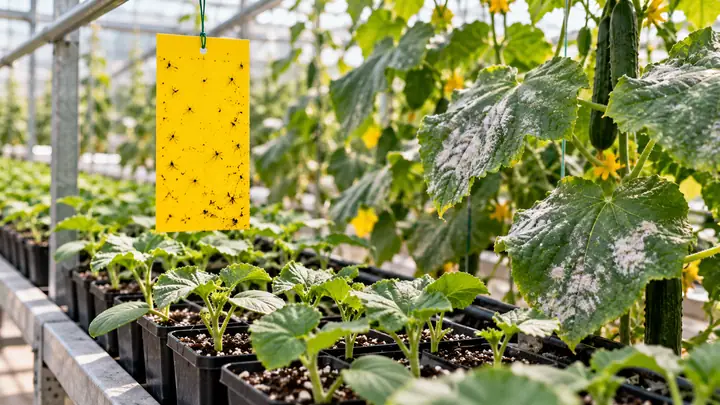
- Monitor. Place yellow sticky traps just above the media surface, at least one and preferably three to four per 93 m² (1,000 sq ft) in greenhouses or one or two per tent, and check them weekly. Push potato slices about 6 mm (1/4 in) thick into the medium; turn them after two to three days to look for larvae.
- Fix watering. Let the surface dry between irrigations, bottom water where possible, and stop overwatering seedlings. This one change often solves light infestations.
- Clean up. Remove dead leaves, spilled media, algae on benches and floors, and standing water under benches.
- Cover or top-dress media. A thin layer of coarse sand, perlite or a fitted cover on rockwool and coir makes the surface less attractive for egg laying.
- Apply biological controls to larvae. Drench media with Bti, which kills fungus gnat larvae but not most other organisms, or apply Steinernema feltiae nematodes, which seek out and kill larvae within a few days. In greenhouses, soil-dwelling predatory mites (Stratiolaelaps scimitus) and rove beetles (Dalotia coriaria) give ongoing control.
- Repeat and record. Re-treat at the intervals on the label and keep counting trap catches for at least one full life cycle, three to four weeks, before declaring the problem solved.
- Use chemical products only as a last step. If numbers stay high, choose a product registered for fungus gnats on your crop and setting, check pre-harvest intervals for edible crops, and confirm it is compatible with any beneficials.
For gnats on indoor plants in a home or office, steps 1 to 5 are usually enough. Our yellow sticky traps guide explains trap placement and counting in more detail.
Does 3% hydrogen peroxide kill fungus gnat larvae?
Using 3% hydrogen peroxide for fungus gnats is a popular home remedy, typically mixed at about one part peroxide to four parts water and used as a soil drench. It can kill some larvae on contact, but it breaks down within hours, has no residual effect, can harm beneficial microbes and nematodes, and has little published research behind it. Treat it as a minor supplement to drying the medium, not a cure. The same applies to H2O2 for root rot in hydroponics: low doses are sometimes used to oxidize organic matter in reservoirs, but fixing warm solution, low oxygen and poor sanitation does more for root health.
Do bug zappers and gnat traps work?
A bug zapper catches some adult gnats, because fungus gnats are weakly attracted to light, but it does nothing to larvae and is less effective than yellow sticky traps placed at the media surface. Vinegar-based gnat bait traps mainly catch fruit flies, not fungus gnats. See do bug zappers work? and plug-in bug zapper safety before buying one for a grow room.
Fungus gnat control methods compared
Each method targets a different life stage, which is why combining them works better than relying on one. The table compares the common options.
| Method | Stage targeted | Speed | Notes |
|---|---|---|---|
| Drying media and bottom watering | Eggs and larvae | One to two weeks | Foundation of control; prevents reinfestation |
| Yellow sticky traps | Adults | Immediate catches | Monitoring and mass trapping; no effect on larvae |
| Bti drench | Larvae | Days | Highly selective; repeat per label |
| Steinernema feltiae nematodes | Larvae | Larvae die within a few days | Needs moist media; store cool and apply promptly |
| Predatory mites and rove beetles | Larvae and pupae | Weeks to establish | Preventive in greenhouses and propagation |
| Hydrogen peroxide drench | Some larvae | Hours, no residual | Home remedy; limited evidence |
| Light traps and zappers | Some adults | Immediate | Weak attraction; supplement only |
| Registered insecticides | Adults or larvae, by product | Varies | Last resort; follow label, protect beneficials |
What is powdery mildew, and what is the white stuff on plants?
Powdery mildew is a group of fungal diseases that grow on the surface of leaves, stems and flowers as white to gray, powdery patches that can be rubbed off. It usually starts as small, round white spots on leaves of plants, often on older or shaded leaves, and spreads until leaves are coated, yellow and dry.
Different powdery mildew fungi attack different crops, for example Podosphaera species on cucurbits, roses and strawberries, and Golovinomyces and Leveillula species on many vegetables and herbs. Not every white powder on plants is powdery mildew. Other fungal diseases, insects and residues can look similar, so check before treating:
| What you see | Likely cause | How to tell |
|---|---|---|
| White powdery patches that wipe off, mostly on upper leaf surfaces | Powdery mildew | Spreads from spots to whole leaves; no free water needed |
| Yellow angular patches on top, gray or purple fuzz underneath | Downy mildew | Fuzz on leaf undersides; favored by wet leaves |
| Cottony white mold on stems with soft rot | White mold (for example Sclerotinia) | Hard black bodies may form inside stems |
| White fluffy clusters in leaf joints | Mealybugs | Insects visible under a hand lens; sticky honeydew |
| White crust or dust on leaves after spraying or misting | Mineral or spray residue | Even film, no spreading spots; wipes off cleanly |
What causes powdery mildew on plants?
Powdery mildew on plants is favored by high humidity around the leaves combined with dry leaf surfaces, moderate temperatures, shade and still air. Unlike most leaf diseases, it does not need free water on the leaf to infect, which is why it thrives indoors and in greenhouses.
- Humidity: high relative humidity, especially at night or in a dense canopy, promotes infection and spore production.
- Temperature: most powdery mildews grow best at moderate temperatures, roughly 15–27°C (60–80°F), and slow down in very hot conditions.
- Low light and crowding: shaded lower leaves and tightly spaced plants with little airflow are hit first.
- Susceptible crops: squash, zucchini, cucumbers, melons, roses, strawberries, tomatoes, peppers, peas and many herbs.
- Spread: spores travel on air currents, clothing and tools, and new plants can bring infection in.
How do you treat powdery mildew on plants?
Treating powdery mildew works best as early, repeated action combined with climate changes, because no spray cures a heavily infected leaf. Follow these steps:
- Act at the first spots. Inspect lower and inner leaves weekly and remove badly infected leaves into a sealed bag.
- Lower humidity and move air. Keep relative humidity mostly in the 50–70% range for leafy and fruiting crops, avoid night-time humidity spikes, and use circulation fans so air moves gently through the canopy. Our indoor farm HVAC and dehumidification guide explains sizing.
- Open up the canopy. Prune, space plants and remove old leaves to let light and air in.
- Apply contact treatments early. Options with good extension support include potassium bicarbonate, horticultural or plant oils, sulfur and biological fungicides based on Bacillus strains, all used at label rates and repeated because most have little residual effect.
- Respect compatibility. Do not apply sulfur above about 32°C (90°F) or on plants recently sprayed with oil, and do not spray oils on heat- or water-stressed plants.
- Rotate and record. Commercial growers rotate modes of action to slow resistance and record each application.
Do baking soda and milk sprays work for powdery mildew?
Baking soda (sodium bicarbonate) at about 1 tablespoon per gallon (roughly 4 g per liter) of water can suppress powdery mildew on contact, but it can burn leaves and leaves sodium behind, so potassium bicarbonate is usually the better choice. Diluted milk sprays have shown some suppression on cucurbits in trials, but results vary. Either can help with light infections, but neither is a substitute for climate control.
How do you treat powdery mildew on squash, zucchini, cucumbers and roses?
To treat powdery mildew on squash, zucchini and cucumbers, start with resistant varieties, which are widely available and the single most effective step, then combine wider spacing, removal of old leaves and early contact treatments. Rose powdery mildew treatment follows the same pattern: choose resistant cultivars, prune for airflow and treat at first sign. Because each mildew species is host-specific, mildew on roses will not spread to cucumbers, but the conditions that favor one favor them all.
How do you prevent fungus gnats and powdery mildew in indoor and hydroponic systems?
Prevention comes from root-zone and air management built into the growing system, which is why equipment choice matters as much as treatments.
- Water from below. Tidal or ebb and flow benches wet media from the bottom and let the surface dry, which deters gnats and keeps leaves dry. See ebb and flow flood tables and our customized tidal seedling tray system.
- Choose and manage media. Coarse, well-drained media and covered rockwool or coir slabs give gnats fewer breeding sites; our hydroponic growing media guide compares options.
- Keep hydroponics lightproof. Algae in channels, reservoirs and on plugs feeds gnat larvae, so cover reservoirs and unused holes.
- Control climate. Closed seedling cabinets and smart grow cabinets and plant factories that regulate temperature, humidity and airflow make powdery mildew far less likely than open rooms.
- Quarantine and sanitize. Inspect new plants, clean trays and benches between crops, and keep weeds and debris out of the growing area.
- Keep seedlings on the dry side. Overwatered propagation trays are the classic gnat nursery; see seed starting trays and germination.
Next steps
Knowing how to get rid of fungus gnats and powdery mildew is mostly about controlling water at the roots and humidity at the leaves, then adding traps and biological controls before reaching for chemicals. If you are designing a propagation room, greenhouse bench system or indoor farm with these problems in mind, share your crops and layout and our engineers can suggest factory-direct tidal benches, seedling cabinets or climate-controlled systems sized to your space.