Short answer
Hydroponic nutrients are water-soluble fertilizers that supply all essential elements, usually as separate A and B concentrates to keep calcium apart from sulfates and phosphates. Growers control the solution with EC, typically about 1.2–1.8 mS/cm for lettuce and 2.0–3.5 mS/cm for tomatoes, and pH, usually held around 5.5–6.5 so nutrients stay available.
What are hydroponic nutrients?
Hydroponic nutrients are water-soluble fertilizers that supply every mineral element a plant needs, because in hydroponics there is no soil to provide any of them. A complete hydroponic nutrient solution contains the macronutrients nitrogen, phosphorus, potassium, calcium, magnesium and sulfur, plus micronutrients such as iron, manganese, zinc, copper, boron and molybdenum, dissolved at concentrations the crop can use.
Growers control that solution with two measurements: EC (electrical conductivity), which tells you how concentrated the fertilizer is, and pH, which decides whether roots can actually absorb each element. Get the recipe, EC and pH right and most hydroponic systems run smoothly; get them wrong and no amount of lighting or climate control makes up for it. This guide covers what nutrients are needed for hydroponics, how to choose and mix hydroponic fertilizer, EC and pH targets by crop, and the meters and controllers that keep them on target.
What nutrients are needed for hydroponics?
Plants need the same elements in hydroponics as in soil. The difference is that you must supply all of them, in balance, from the start. The table shows the role of each element and commonly cited concentration ranges for leafy greens and fruiting vegetables. Treat them as starting points, not a recipe; ideal values depend on crop, stage, light and the water you start with.
| Element | Main role | Commonly cited range in solution (ppm) |
|---|---|---|
| Nitrogen (N) | Leaf and stem growth, chlorophyll | Roughly 100–200 |
| Phosphorus (P) | Roots, energy transfer, flowering | Roughly 30–60 |
| Potassium (K) | Water regulation, fruit quality | Roughly 150–300 |
| Calcium (Ca) | Cell walls; prevents tipburn and blossom-end rot | Roughly 100–200 |
| Magnesium (Mg) | Center of the chlorophyll molecule | Roughly 30–60 |
| Sulfur (S) | Proteins, flavor compounds | Roughly 50–100 |
| Iron (Fe) | Chlorophyll formation | Roughly 2–5 |
| Manganese, zinc, copper, boron, molybdenum | Enzymes and growth regulation | Trace amounts, well under 1 ppm for most |
Leafy crops generally want relatively more nitrogen. Fruiting crops such as tomatoes and strawberries want more potassium and calcium once they set fruit, which is why many growers switch between a vegetative and a fruiting recipe.
How do you choose a hydroponic fertilizer?
Why are hydroponic nutrients sold as A and B solutions?
Calcium reacts with sulfates and phosphates in concentrated form to create insoluble precipitates. To prevent that, commercial hydroponic fertilizer is usually split into two parts. Part A holds calcium nitrate and often iron chelate; Part B holds potassium phosphate, magnesium sulfate, potassium sulfate and the micronutrients. Each part is dissolved into its own stock tank and dosed separately into the irrigation water, where they mix safely once diluted. Never pour A and B concentrate into each other.
Powder vs. liquid fertilizer for hydroponics
- Powder or dry hydroponic nutrients cost less per unit of nutrient, ship cheaply and store well. They suit commercial farms that mix their own stock tanks, and bulk hydroponic nutrients are almost always sold dry.
- Liquid fertilizer for hydroponics is convenient for small systems because it pours and measures easily, but you pay to ship water.
- Single-salt recipes, built from individual fertilizer salts, give large growers full control and the lowest cost, but require water analysis and careful calculation.
Do organic hydroponic nutrients work?
Organic hydroponic fertilizer is possible but harder. Organic materials release nutrients only after microbes break them down, and in a recirculating tank they can feed biofilms, clog emitters and lower oxygen. Commercial organic hydroponics usually relies on a well-established microbial community, as in aquaponics, or on specially formulated soluble organic products with careful filtration. For most commercial lettuce and tomato growers, mineral fertilizers remain the practical choice.
What makes good hydroponic nutrients?
Rather than looking for one "best hydroponic fertilizer", check that a product is complete (contains calcium, magnesium and all micronutrients), fully water-soluble, chelates iron in a form that stays available at your pH, publishes a guaranteed analysis, and matches your crop and water. A fertilizer formulated for soft water will behave differently in hard water.
What is EC in hydroponics?
EC measures how easily the solution conducts electricity. Dissolved fertilizer salts carry current, so higher EC means a stronger solution. EC is expressed in mS/cm (millisiemens per centimeter), which is numerically the same as dS/m; some meters read in µS/cm, where 1 mS/cm equals 1,000 µS/cm.
Many hobby meters display ppm instead. A ppm meter or TDS meter for hydroponics is really an EC meter that multiplies the reading by a conversion factor, and different meters use different factors:
- 500 scale: 1.0 mS/cm displays as about 500 ppm.
- 700 scale: 1.0 mS/cm displays as about 700 ppm.
Because the same solution can read 600 ppm on one meter and 840 ppm on another, EC in mS/cm is the safer unit for recipes and for sharing data. EC also tells you only total salt concentration, not which elements are present, so periodic laboratory analysis is worthwhile in recirculating systems.
What EC and pH should you use for each crop?
This EC chart for hydroponics gives typical starting ranges. Use the lower end for seedlings, low light and hot weather, and the upper end for mature plants under strong light.
| Crop | Typical EC (mS/cm) | Typical pH |
|---|---|---|
| Lettuce | 1.2–1.8 | 5.5–6.2 |
| Spinach, kale, other leafy greens | 1.4–2.2 | 5.5–6.5 |
| Basil and most herbs | 1.0–1.6 | 5.5–6.5 |
| Mint | 1.2–2.0 | 5.5–6.5 |
| Strawberry | 1.2–2.0 | 5.5–6.2 |
| Cucumber | 1.8–2.5 | 5.5–6.2 |
| Pepper | 1.8–2.8 | 5.8–6.5 |
| Tomato | 2.0–3.5 | 5.5–6.5 |
What is the best pH for hydroponics?
For most crops, the best pH for hydroponics is about 5.5–6.5, with many growers aiming near 5.8–6.0. In that window, nearly all nutrients stay soluble and available. Above about 6.5, iron, manganese and phosphorus become less available and young leaves turn pale. Below about 5.5, calcium and magnesium uptake can suffer and roots may be damaged.
Hydroponic targets are slightly lower than soil targets. Soil pH for lettuce is usually recommended at about 6.0–7.0, but in soilless systems there is no soil buffering, so the solution itself is held slightly more acidic.
How do you adjust pH in hydroponics?
- To lower pH (the usual problem, because hard water and nitrate uptake push pH upward): dilute phosphoric acid or nitric acid. Phosphoric acid is common in small systems; nitric acid is often preferred in large ones because it adds nitrogen rather than excess phosphorus. Always add acid to water, never water to acid, and wear eye and hand protection.
- To raise pH: potassium hydroxide or potassium carbonate in small doses.
- Treat alkalinity at the source: if your water has high bicarbonate, it will keep pushing pH up. Acid injection into the source water or reverse osmosis fixes the cause instead of the symptom.
Adjust EC first, then pH, because adding fertilizer changes pH. Make small additions, let the tank mix, and re-read.
How do you mix a hydroponic nutrient solution?
- Test the source water for EC, pH and alkalinity. Its starting EC is part of your total; a high reading may mean you need RO water.
- Fill the tank with most of the water you need, leaving room to top up.
- Add Part A at the label or recipe rate and mix thoroughly.
- Add Part B separately and mix again.
- Measure EC and adjust: add concentrate to raise it, or water to lower it.
- Measure pH and adjust with acid or base in small steps.
- Record the readings and the amounts added, so you can repeat or correct the mix.
- Recheck daily, and replace or partly renew the solution on a regular schedule or when analysis shows imbalances.
Which meters and pH controllers do you need?
EC meters and pH meters for hydroponics
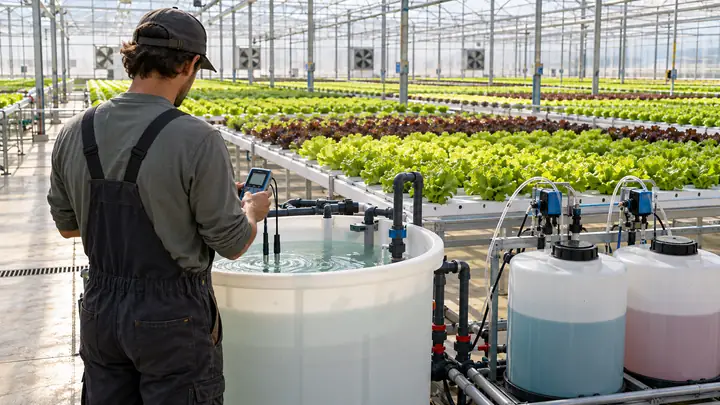
At minimum you need an EC meter and a pH meter for hydroponics, or a combined unit. Pen-style meters are fine for small systems; continuous inline probes suit commercial tanks. pH probes drift and age, so calibrate pH meters with fresh pH 4 and pH 7 buffers regularly, often weekly, and EC meters with a standard solution such as 1.413 mS/cm. Store pH probes moist, never dry. A hydro pH tester with expired buffers or a dried-out probe is one of the most common causes of mysterious deficiencies.
Automatic pH controllers and nutrient dosers
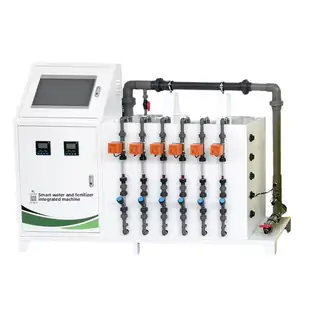
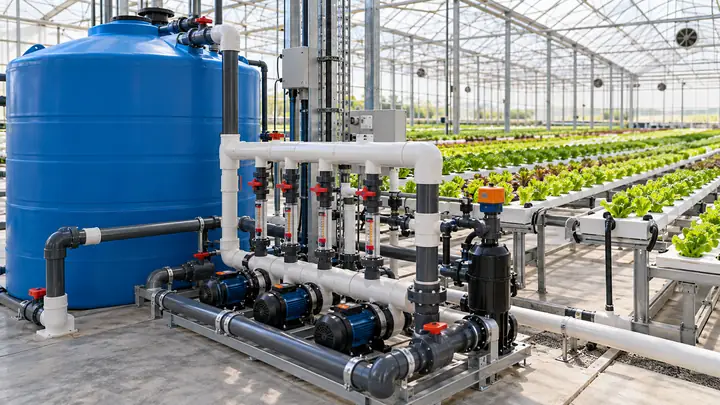
A hydroponic pH controller reads a probe continuously and doses acid (or base) through a small pump until the target is reached. Combined auto pH and EC control systems also dose A and B concentrates. On commercial farms they hold targets more tightly than manual checks, save labor and log data. Look for adjustable dosing rates, a delay between doses to avoid overshooting, alarms, and safe failure modes if a probe fails. Our smart fertigation machine with dosing pump handles A, B and acid channels in one unit; for sizing, see how to size a fertigation system and the guide to fertigation and fertilizer injectors.
Should you use hydrogen peroxide in hydroponics?
Hydrogen peroxide is sometimes added to hydroponic reservoirs to suppress pathogens and add oxygen. It breaks down quickly, so its effect is short-lived, and it also harms beneficial microbes and, at high doses, roots. It is most useful for cleaning empty tanks, lines and channels between crops. For ongoing disease control in commercial systems, temperature management, filtration and dedicated water treatment such as UV are more dependable.
How do nutrients for lettuce and tomatoes differ?
Hydroponic lettuce nutrients are relatively low in strength: an EC of about 1.2–1.8 mS/cm and pH around 5.5–6.2. Nitrogen-forward recipes drive leaf growth, and adequate calcium, together with good airflow, helps prevent tipburn. Lettuce fertilizer that is too strong can increase tipburn and bitterness. See the hydroponic lettuce guide for system and climate advice.
Hydroponic tomato fertilizer runs much stronger, often EC 2.0–3.5 mS/cm, with more potassium during fruiting to support fruit quality and more calcium to reduce blossom-end rot. Many tomato growers deliberately raise EC to improve flavor, at some cost to yield. Our hydroponic strawberries and tomatoes guide covers fruiting crops in more detail.
Why does source water matter?
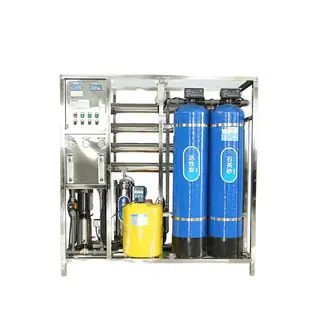
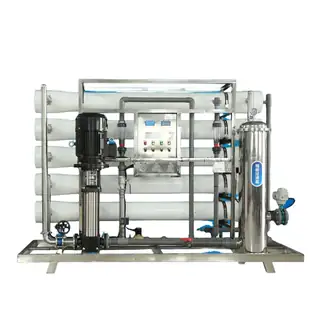
Your water is the base of every nutrient solution. High sodium or chloride accumulates in recirculating systems, high alkalinity makes pH hard to hold, and high natural EC leaves less room for fertilizer. Where source water is poor, a reverse osmosis unit such as the PLC groundwater desalination RO machine provides a clean starting point. Mars Vertical Farm supplies fertigation and water-treatment equipment, as well as complete hydroponic systems, from its ISO 9001 factory in Shanghai. Browse irrigation, fertigation and water treatment equipment, or send us your water analysis and crop plan for a dosing system recommendation and quotation.