Short answer
Deep water culture (DWC) is a hydroponic method in which plant roots hang in a deep, aerated nutrient solution while plants float on rafts or sit in lids above it. Commercial beds typically hold about 20–30 cm of water, kept near 18–22 °C with dissolved oxygen above roughly 6 mg/L. It suits lettuce, leafy greens and basil.
What is deep water culture?
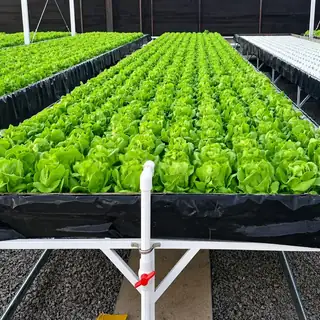
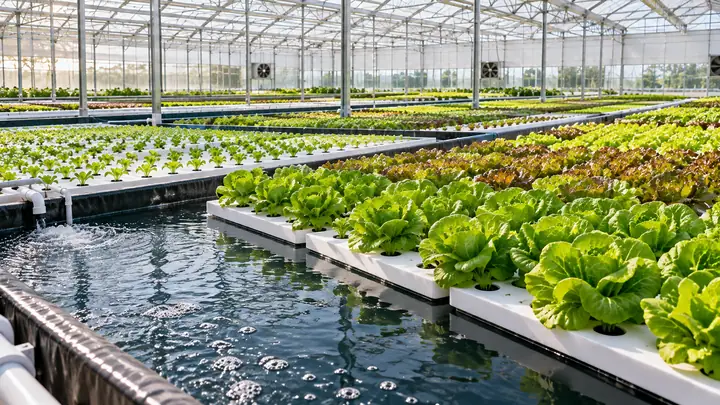
Deep water culture (DWC) is a hydroponic method in which plant roots hang directly in a deep, oxygenated nutrient solution, while the plants are held above it in floating rafts, net pots or lids. Instead of a thin film or a substrate, the roots live in a large body of water that is aerated with air diffusers or kept moving by circulation pumps.
The term covers two scales. Commercial growers use raft or pond systems: long, lined beds holding roughly 20–30 cm of solution, with polystyrene rafts floating on top. Small growers and trial sites use DWC bucket systems, where each plant or small group sits in its own aerated container. Both are forms of water culture hydroponics, and both rely on the same principle: plenty of water, plenty of oxygen.
This is a deep single-system guide. To weigh DWC against other methods, see our comparison of NFT vs. DWC vs. Dutch bucket systems and the companion NFT hydroponic system guide.
How does a DWC hydroponic system work?
A commercial deep water culture system has five parts:
- Grow beds or ponds: rigid frames or concrete or block walls with a food-safe liner, holding the nutrient solution.
- Floating rafts: sheets of closed-cell polystyrene or similar material with holes for net cups or plugs. They block light from the water, which limits algae.
- Aeration: air pumps feeding diffuser lines or stones along the bed floor, and in some designs venturi injectors on the return.
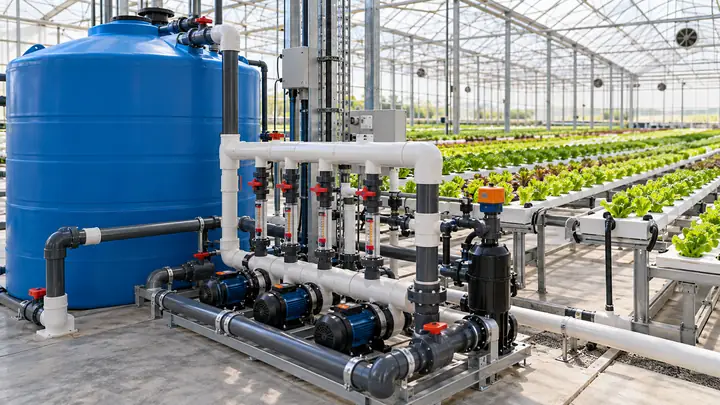
- Circulation and treatment: a pump moves solution through a filter, and often a chiller or heater, and back to the beds, so EC, pH and temperature stay uniform.
- Monitoring and dosing: EC, pH, temperature and dissolved oxygen sensors, with manual or automatic correction.
Rafts can be moved along the bed as plants grow, with transplanting at one end and harvesting at the other. This conveyor-style flow keeps labor in one place and makes deep water culture hydroponics efficient for continuous lettuce production.
What is recirculating deep water culture (RDWC)?
Recirculating deep water culture links several containers or beds to a central reservoir, so one tank sets EC, pH and temperature for the whole system. Commercial raft ponds are effectively recirculating systems. In bucket setups, RDWC means fewer individual reservoirs to check, at the cost of shared disease risk if one plant develops root rot.
What design numbers matter for a deep water culture system?
These are typical starting values for lettuce and leafy greens. Hotter climates, warmer crops and different raft spacing will shift them.
| Parameter | Typical range | Notes |
|---|---|---|
| Solution depth | Roughly 20–30 cm in commercial beds; extension sources describe 10–30 cm | Deeper water buffers temperature and EC but adds weight and cost. |
| Dissolved oxygen | Aim to stay above about 6 mg/L | Low oxygen is the most common cause of poor roots in DWC. |
| Water temperature | About 18–22 °C for lettuce | Above roughly 24 °C oxygen falls and root rot risk rises. |
| EC (lettuce) | Roughly 1.2–1.8 mS/cm | Lower for seedlings, higher for some herbs and greens. |
| pH | About 5.5–6.5 | Check daily; large volumes drift slowly. |
| Raft size | Often around 60 × 120 cm | Mature rafts become heavy; plan handling. |
| Floor load | About 200–300 kg/m² of water at 20–30 cm depth | Check slabs, mezzanines and container floors before choosing DWC. |
Why oxygen and temperature dominate DWC
Water holds less dissolved oxygen as it warms, while roots and microbes use more. That is why a DWC system that works well in a cool season can struggle in summer. Practical measures include insulating bed walls and floors, shading or cooling the growing area, using a chiller in hot regions, and spacing diffusers evenly along the bed so no zone goes short of air. Shallow edges and corners are where low-oxygen pockets usually form.
What crops grow best in deep water culture hydroponics?
- Lettuce: butterhead, romaine, oakleaf and multi-leaf types are the classic DWC crops. See our hydroponic lettuce guide for cultivar and climate notes.
- Salad greens: arugula, pak choi, tatsoi, mizuna, sorrel and similar fast crops.
- Herbs: basil does especially well, along with mint, cilantro and parsley.
- Fruiting crops such as tomatoes, cucumbers and peppers are occasionally grown in buckets or deep beds, but they need trellising and stable support that floating rafts cannot provide.
How do you set up a deep water culture system?
A deep water culture setup for a commercial or pilot site usually follows these steps:
- Check the floor and site. Confirm the slab or frame can carry the full water load, and that the area is level, drained and has power for pumps and blowers.
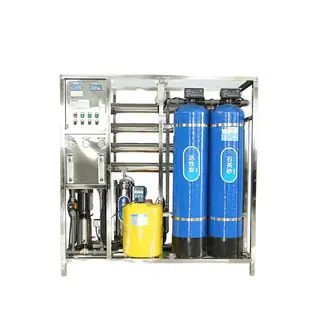
- Analyze source water. High alkalinity, sodium or chloride will make pH and EC hard to hold. Treatment by acid dosing or reverse osmosis, such as a PLC groundwater desalination RO machine, may be needed.
- Build and line the beds. Install frames or walls, add insulation underneath if temperature swings are likely, and fit a food-safe liner without sharp folds or punctures. Small leaks under a full bed are hard to find later.
- Install aeration and circulation. Lay diffuser lines along the bed floor, fit the circulation pump, filter and return, and add a chiller or heater if your climate requires one.
- Fill, test and run water only. Fill the beds, check for leaks, and confirm even bubbling and flow along the full length.
- Mix nutrients. Bring the solution to the crop's EC, then adjust pH. Record starting values.
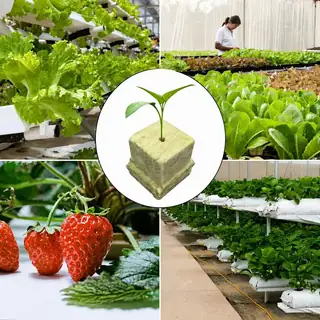
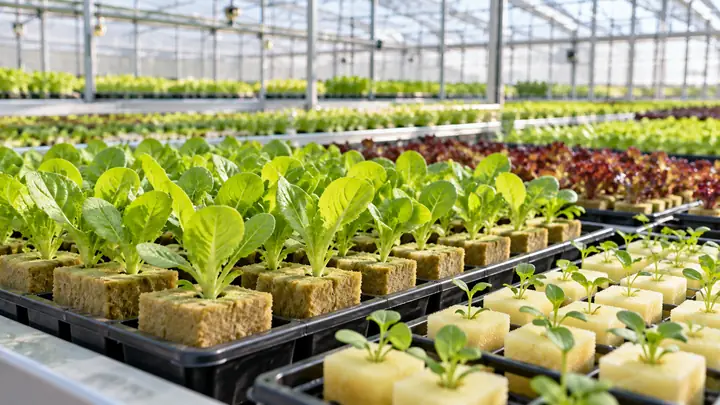
- Raise seedlings separately. Start plants in sponge or rockwool cubes in a nursery and transplant to rafts once roots emerge from the plug. Our square sponge nursery cubes fit standard raft holes; see the hydroponic growing media guide for alternatives.
- Set a monitoring routine. Log EC, pH, temperature and dissolved oxygen at least daily, and inspect roots weekly.
How do you manage deep water culture nutrients?
A large volume is DWC's main advantage: EC and pH change slowly, so the system forgives a missed check. The flip side is that a mistake, such as overdosing acid, takes a lot of water and fertilizer to correct. Make adjustments in small steps and let the solution mix before re-reading.
Top up with fresh water as plants drink, add A and B concentrate when EC falls, and correct pH last. Over weeks, ions the crop does not use, such as sodium, can accumulate; partial solution replacement or lab analysis tells you when to refresh. For crop-by-crop EC and pH targets, see the hydroponic nutrients, EC and pH guide. Commercial sites often add an automatic doser to hold targets around the clock.
What are the pros and cons of DWC hydroponics?
Advantages
- Buffer against failure. If a pump or power supply stops, plants keep drawing on a large volume of water; that buys hours rather than minutes, provided aeration is restored.
- Stable root-zone conditions. Temperature, EC and pH change slowly.
- Simple, few moving parts and no substrate to buy or dispose of.
- Efficient labor flow with moving rafts.
- Fast growth for leafy greens when oxygen and temperature are right.
Disadvantages
- Heavy. Water weight rules out many mezzanines and upper floors, and limits stacking in vertical farms.
- Cooling cost. Large volumes take energy to chill in hot climates.
- Shared water. Root pathogens such as Pythium can spread through a whole bed.
- Higher material cost per plant site for beds, liners, rafts and aeration.
What are common DWC problems and fixes?
| Problem | Likely cause | What to do |
|---|---|---|
| Brown, slimy roots, wilting | Warm water, low oxygen, Pythium | Lower temperature, increase aeration, remove affected plants, sanitize between crops. |
| Slow growth across the bed | Low dissolved oxygen or low EC | Measure DO; check diffusers for clogging; correct EC. |
| Algae on rafts and in water | Light leaks through empty holes or gaps | Fill or cover unused holes; keep rafts tight together. |
| pH keeps rising | High source-water alkalinity | Dose acid or treat water; recheck alkalinity. |
| Water level dropping unexpectedly | Liner puncture or fitting leak | Inspect seams and fittings; repair before refilling. |
What drives the cost of a deep water culture system?
Prices vary widely with scale, materials and local labor, so it is more useful to look at cost drivers than headline numbers:
- Bed construction: steel or aluminum frames, concrete or block walls, and liner thickness and quality.
- Rafts and plant sites: raft material, density of holes and how often rafts are replaced.
- Aeration and circulation: blowers or air pumps, diffuser lines, pumps and filters, sized to the total water volume.
- Climate control of the water: chillers or heaters, which can dominate running costs in very hot or cold regions.
- Water treatment and dosing: reverse osmosis where source water is poor, plus EC and pH controllers.
- Structure: floor reinforcement if the building was not designed for water loads.
Running costs are usually dominated by electricity for aeration, pumping and cooling, labor for transplanting and harvesting, seedlings and fertilizer. Because water is recirculated, water use per kilogram of lettuce is low compared with soil growing.
Is a DWC kit good for beginners or commercial growers?
For DWC hydroponics for beginners, a bucket kit with a lid, net pot, air pump and air stone is a low-cost way to learn root-zone management. Hydro DWC systems of this type are common in home growing; our home hydroponic systems guide covers them. When you judge the best DWC kits, look for opaque containers, a reliable air pump sized for the volume, and easy access for checking roots.
Commercial deep water hydroponic production is a different engineering task: bed dimensions that match your building, frame rigidity under load, liner quality, aeration layout and water treatment. A custom-sized system, such as our deep water culture floating grow beds, is designed around those numbers. Mars Vertical Farm builds these in its 2,000+ m² Shanghai factory and quotes in USD on EXW, FOB Shanghai or CIF terms. Browse hydroponic channels, benches and media, or send us your site size, climate and crop plan for a DWC layout and quotation.