Short answer
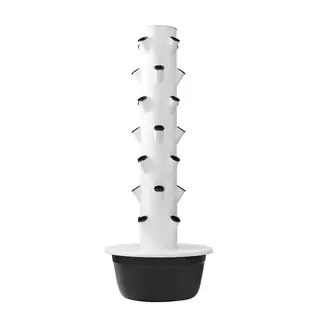
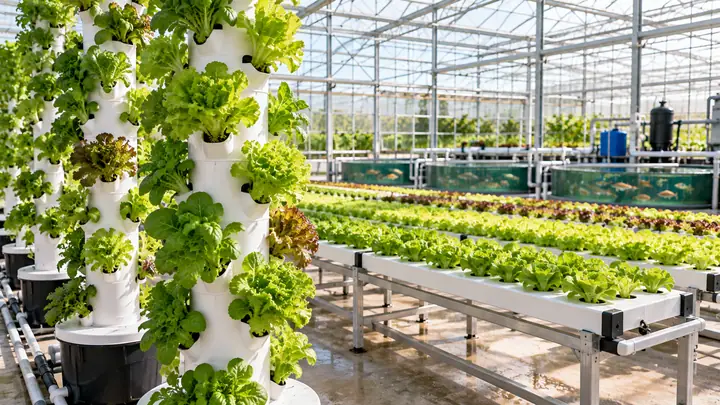
A hydroponic tower is an upright column with planting holes on its sides. A pump lifts nutrient solution from a reservoir at the base to the top, where it trickles or sprays down past the roots and drains back. Aeroponic towers mist roots hanging in air. Towers suit lettuce, leafy greens, herbs and strawberries, and work best with sunlight or vertical LED bars.
What is a hydroponic tower?
A hydroponic tower is an upright column with planting holes on its sides, where a pump lifts nutrient solution from a reservoir at the base to the top and lets it trickle or spray down past the roots before draining back. Hydroponic towers grow dozens of plants on roughly the floor area of one pot, without soil, and recirculate their water.
Towers are one of the simplest vertical hydroponic systems. They are used commercially in greenhouses, on rooftops and in retail displays, and at smaller scale as indoor garden towers. This guide explains how a hydroponic tower system works, how hydroponic and aeroponic towers differ, what grows well, how to lay out towers for commercial production and what to check before buying.
How does a hydroponic tower system work?
Every tower has the same basic parts:
- Reservoir. An opaque tank at the base holding nutrient solution. Opaque walls and a lid stop light reaching the water, which prevents algae.
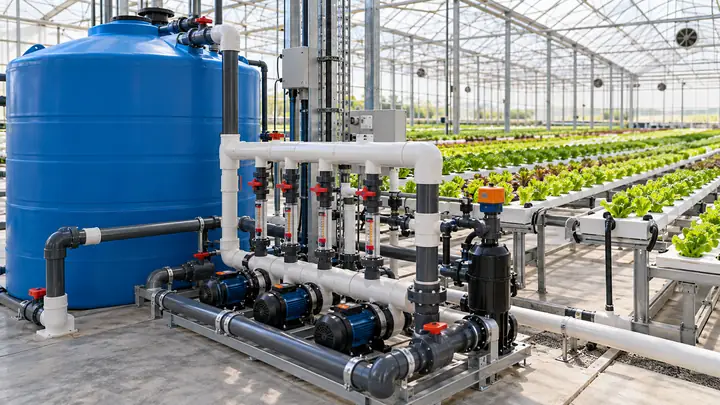
- Pump. A submersible or external pump sends solution up a central or side pipe, usually on a timer.
- Distribution head. A cap, spray ring or emitter at the top spreads the solution so it runs down the inside of the column evenly.
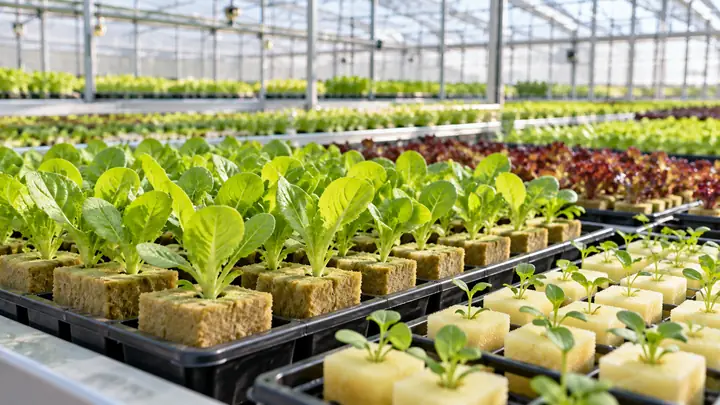
- Planting sites. Angled pockets, net pots or stacked pots hold plants in sponge plugs, rockwool or another light medium.
- Return path. Solution drains straight back into the reservoir, so the system is closed-loop.
Watering frequency depends on crop and design. A fact sheet from Oklahoma State University Extension on a gravity-fed vertical tower notes that lettuce can be watered continuously, while strawberries did better with intermittent one-hour cycles several times a day. EC, pH and water level are checked through an access lid in the reservoir.
Where are hydroponic towers used?
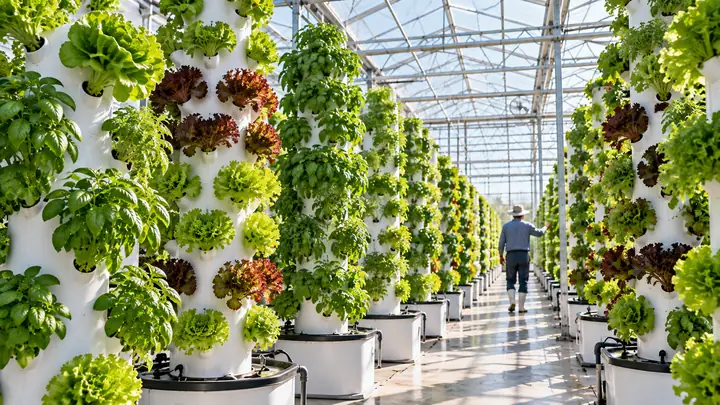
Commercial growers use towers in greenhouses and polytunnels to raise plants per square meter without building racks, on rooftops where weight and floor space are limited, and in garden centers or supermarkets where a living display helps sell produce. Schools, hotels and restaurants use smaller indoor vertical garden towers for herbs and salad greens. The same principle scales from a single vertical garden tower to hundreds of towers on a shared nutrient loop.
What is the difference between hydroponic and aeroponic towers?
The terms are often mixed up. In a hydroponic grow tower, solution flows as a film or trickle over the roots or through a medium. In an aeroponic tower, roots hang in the open center of the column and are wetted by spray or fine droplets, so they sit mostly in air.
| Feature | Hydroponic tower | Aeroponic tower |
|---|---|---|
| How roots get water | Trickle or film over roots or through media | Spray or droplets onto roots hanging in air |
| Root oxygen | Good | Very good |
| Tolerance to pump failure | Better; media hold some moisture | Lower; roots can dry within hours |
| Clogging risk | Low to moderate | Higher; spray heads need cleaning |
| Pump requirements | Moderate flow | Enough pressure for even spray |
| Typical use | Leafy greens, herbs, strawberries | Leafy greens and herbs where fast growth is the priority |
For a deeper look at the root-zone science, read aeroponics vs. hydroponics.
What tower designs are available?
- Column towers. A single tall tube with angled pockets, such as our Space Tree multilayer hydroponic tower. Simple to clean and easy to space in rows.
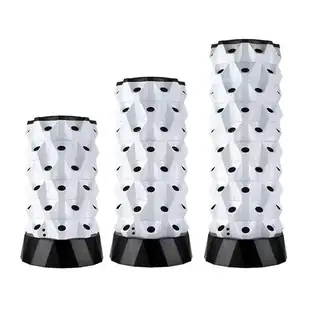
- Stacked-pot (pineapple) towers. Modular pots stacked on a central pipe, each with several planting sites. Height can be changed by adding or removing pots, as with the pineapple aeroponic greenhouse tower.
- PVC pipe towers. Vertical or zig-zag pipes with drilled holes, popular for DIY and small vertical garden systems.
- Wall-mounted vertical gardens. Panels or pockets on a wall for herbs and ornamentals; more about appearance than yield.
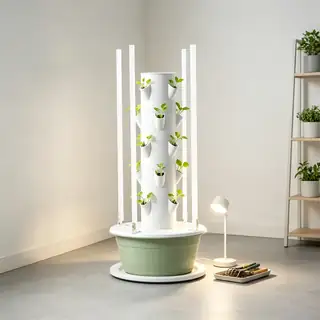
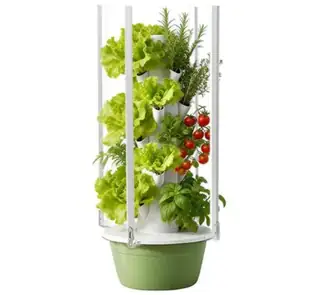
- Tower kits with lights. Self-contained towers with LED bars around the column for indoor use, like a smart hydroponic tower garden kit.
What grows best in a vertical hydroponic garden?
Towers suit compact, fast crops that do not need support:
- Lettuce and leafy greens. The classic lettuce tower crop: butterhead, leaf lettuce, kale, chard, spinach and Asian greens.
- Herbs. Basil, mint, parsley, cilantro, chives and oregano.
- Strawberries. Runners and fruit hang freely from the sides, which keeps fruit clean.
- Edible flowers and small ornamentals. For retail displays and vertical garden design projects.
Tall or heavy crops such as tomatoes, cucumbers and peppers are poorly suited because they need support and large root volumes. Grow them in Dutch buckets or substrate instead. See our hydroponic strawberries and tomatoes guide for the best vegetables for each vertical gardening method.
How do towers compare with racks and A-frames?
| System | Best setting | Light | Strengths | Limits |
|---|---|---|---|---|
| Hydroponic or aeroponic towers | Greenhouses, rooftops, retail, small rooms | Sunlight or vertical LED bars | Small footprint, simple, modular | Top plants can shade lower ones; uneven light indoors |
| A-frame systems | Greenhouses and tunnels | Sunlight | Very high density for strawberries and greens | Fixed frames; less flexible layouts |
| Multi-tier grow racks | Fully indoor plant factories | LED on each layer | Even light, highest density indoors | Higher equipment and energy cost |
| Flat NFT benches | Greenhouses | Sunlight | Easy access, proven for lettuce | Lowest plants per square meter |
Our A-frame vertical systems guide and vertical farming equipment guide cover the alternatives.
Should towers go indoors or outdoors?
Indoor vertical gardens need artificial light. A hydroponic tower with lights usually uses LED bars arranged around the column so every side receives light. Keep air moving to prevent humidity building up in the canopy.
Outdoor hydroponic towers and greenhouse towers use sunlight but face other risks. Plastics must be UV-stabilized, towers need anchoring against wind, and reservoirs should be shaded or insulated, because warm nutrient solution holds less oxygen and encourages root disease. Water temperature roughly in the high teens to low twenties °C is a common target for leafy greens.
How do I set up hydroponic towers commercially?
- Choose the crop and target harvest. Calculate plants per week and the number of planting sites needed.
- Plan spacing and orientation. In greenhouses, rows running north-south generally give more even light. Leave room between towers so lower sites are not shaded.
- Decide on individual or central reservoirs. Individual tanks are simple; a central tank with supply and return lines makes dosing and monitoring easier for many towers.
- Add fertigation. Use EC/pH dosing on the central tank, and test source water first. Our nutrients, EC and pH guide gives typical targets.
- Install filtration and backup. Filter the solution to protect emitters, and fit low-level and pump-failure alarms.
- Set up a nursery. Start seedlings in plugs so towers are always filled with plants of the same age.
- Write a cleaning routine. Clean and disinfect towers between crops, and rinse distribution heads regularly.
How do you build a hydroponic tower?
A basic DIY tower can be made from a food-grade vertical pipe or fence post with angled holes, a cap at the top to spread water, an opaque tank with a lid at the base, a small submersible pump, tubing and a timer. Oklahoma State University Extension publishes a step-by-step fact sheet for one such design holding 28 plants. Use food-safe, UV-stable materials, seal fittings against leaks, and fit splash guards so water does not wet leaves. Home-built PVC hydroponic towers are fine for learning, but commercial growers usually buy molded towers for consistent flow, durability and easier cleaning.
What maintenance do hydroponic towers need?
- Check EC, pH and water level several times a week, more often in hot weather.
- Top up with fresh solution and replace the reservoir completely at regular intervals.
- Clean spray heads and distribution caps to keep flow even down every side.
- Inspect roots for browning or slime, a sign of warm water or low oxygen.
- Disinfect towers between crop cycles.
What problems are common with hydroponic towers?
| Symptom | Likely cause | Fix |
|---|---|---|
| Plants at the bottom grow slower | Shading from upper plants or uneven light | Widen spacing, rotate towers, or add vertical LED bars indoors |
| Dry pockets on one side | Blocked or tilted distribution head | Clean the cap or spray ring and check the tower is plumb |
| Brown, slimy roots | Warm solution, low oxygen, root disease | Shade or cool the reservoir, clean the system, improve aeration |
| Leaf tip burn on lettuce | Low airflow, high humidity or fast growth limiting calcium supply | Increase air movement and moderate light and temperature |
| Algae in the reservoir | Light reaching the solution | Use opaque tanks and lids, and cover unused planting sites |
| Leaks at joints | Poorly seated pots or fittings | Reseat parts and seal with food-safe sealant |
Most of these problems come from uneven water or light distribution, so commercial vertical gardening systems are designed around even flow down every face of the column and enough space between towers.
What should I check before buying hydroponic towers?
When comparing hydroponic towers for sale or aeroponic towers for sale, the price depends mostly on height and number of planting sites, plastic quality and UV stability, pump and distribution design, whether lights and controls are included, and order quantity. Ask for the number of sites per tower, recommended spacing, reservoir volume, pump flow and material specification.
Mars Vertical Farm manufactures column and stacked-pot towers for commercial greenhouses and indoor farms, with ISO 9001 quality management and OEM/ODM options. Browse our vertical hydroponic towers and racks, or home grow systems for smaller indoor garden towers, and send us your crop and greenhouse layout for a tower plan and quotation.