Short answer
The nutrient film technique (NFT) is a recirculating hydroponic system in which a shallow film of nutrient solution flows continuously down sloped channels past plant roots, then returns to a tank. Typical designs use a slope of about 1–3%, a flow of roughly 1–2 liters per minute per channel and runs under about 12 meters. It suits lettuce, leafy greens, herbs and strawberries.
What is the nutrient film technique?
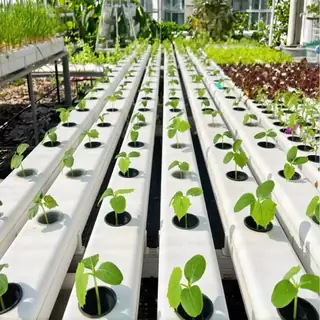
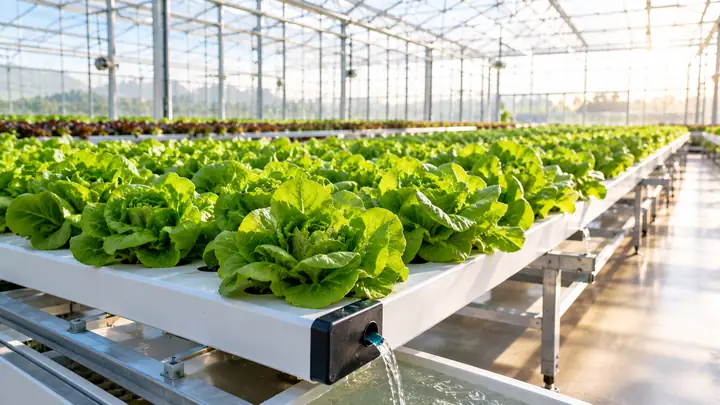
The nutrient film technique (NFT) is a recirculating hydroponic method in which a very shallow stream of nutrient solution flows continuously along a sloped channel, past the bare roots of plants held in holes in the channel lid. The roots sit partly in the moving film and partly in humid air, so they get water, nutrients and oxygen at the same time without any growing medium beyond a small starter plug.
A simple nutrient film technique definition: a thin film of solution, a gentle slope, and constant recirculation. Solution drains from the low end of each channel into a gutter, returns to a tank, is corrected for EC and pH, and is pumped back to the high end. Because nothing is run to waste, NFT hydroponics uses little water and fertilizer per kilogram of crop, which is why it is one of the most common systems for commercial lettuce, leafy greens and herbs.
This guide goes deep on NFT alone: how a nutrient film technique hydroponic system works, the design numbers that matter, how to set one up, and what goes wrong. If you are still choosing between systems, start with our comparison of NFT vs. DWC vs. Dutch bucket systems, or the wider overview of types of hydroponic systems.
How does NFT hydroponics work?
Every NFT system, from a small pipe rack to a multi-hectare greenhouse, has the same loop:
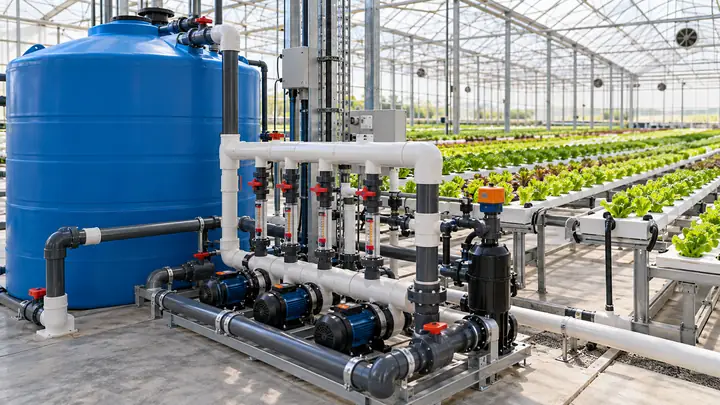
- Nutrient tank: holds the solution, with EC and pH sensors and, on commercial farms, automatic dosing.
- Supply pump and manifold: pushes solution through a filter and a header pipe, with one small feed line or emitter per channel.
- NFT channels: sloped gullies, usually food-grade PVC, with planting holes in a lid that blocks light.
- Catchment gutter: collects outflow from the low end of all channels.
- Return line: brings solution back to the tank by gravity, often through a screen or settling filter.
The key word is film. The solution should be only a few millimeters deep at the start. As plants grow, their roots form a mat on the channel floor; the upper part of the mat stays moist but exposed to air, which is how NFT avoids the need for air pumps. If the flow is too deep, the root mat sits underwater and oxygen supply falls. If it is too shallow, the far end of the channel dries out.
What design numbers matter for an NFT hydroponic system?
Most NFT problems trace back to a handful of parameters. The table below gives typical starting ranges for leafy greens; adjust for crop, climate and channel profile.
| Parameter | Typical range | Why it matters |
|---|---|---|
| Channel slope | Roughly 1–3% (1–3 cm drop per meter); 2% is a common default | Too flat and solution pools; too steep and the film thins and roots dry at the top end. |
| Flow per channel | Typically around 1–2 L/min for commercial channels; less for short pipe channels | Too little starves the far end; too much floods the root mat and lowers oxygen. |
| Channel length | Usually 12 m or less; shorter in hot climates | Dissolved oxygen falls and temperature rises along the run. |
| Solution temperature | About 18–22 °C for lettuce | Warm solution holds less oxygen and raises root-rot risk. |
| Plant spacing | Often 20–25 cm along the channel for head lettuce; tighter for herbs and baby leaf | Sets plant density and how many channels you need. |
| EC / pH (lettuce) | EC roughly 1.2–1.8 mS/cm; pH about 5.5–6.5 | Controls nutrient availability; see the nutrient section below. |
Choosing NFT channels
Hydroponic NFT channels come in two broad shapes:
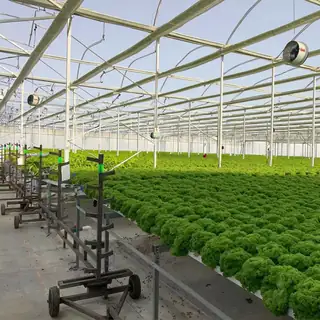
- Flat-bottomed rectangular or square gullies, commonly around 100 mm wide, which spread the film evenly under the root mat. These are the standard for commercial lettuce. Our square PVC NFT channels for leafy greens follow this profile.
- Round pipes, which are cheap and rigid but concentrate flow in a narrow strip at the bottom. They work for short runs, herbs and strawberries, and for decorative or vertical layouts.
Whatever the profile, look for food-grade, UV-stabilized PVC with a white or light exterior to reflect heat, an opaque body to stop algae, and removable lids so channels can be cleaned between crops.
Flat benches, A-frames and multi-tier racks
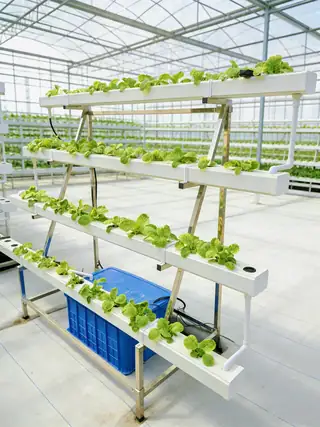
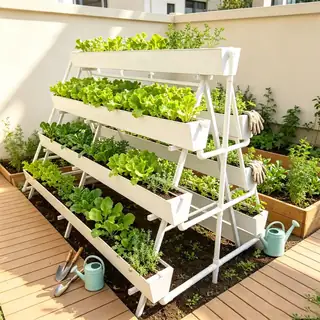
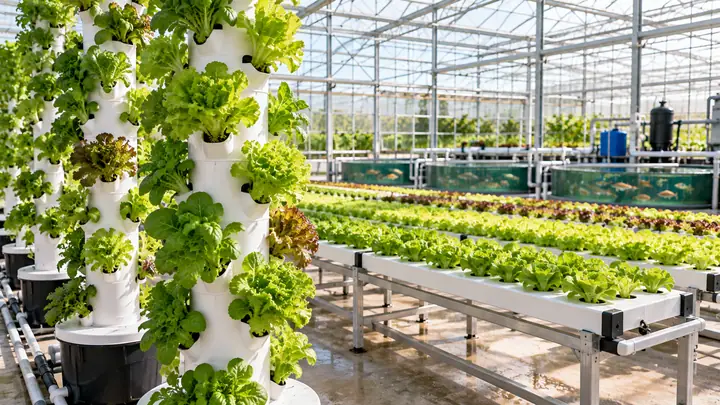
NFT systems can be laid out as flat benches at working height, as A-frames that stack channels on two sloping sides, or as multi-tier racks under LED lighting in a plant factory. A-frames roughly double the plants per square meter of floor in a greenhouse, but upper channels shade lower ones, so they suit sunny sites and low-light-tolerant crops. Our A-frame vertical systems guide covers that trade-off in detail, and the A-frame PVC NFT channel system for lettuce is one example.
What crops grow best in NFT systems?
NFT suits crops that are light, fast and shallow-rooted:
- Lettuce of all types: butterhead, romaine, oakleaf, multi-leaf. This is NFT's core crop; see our hydroponic lettuce guide.
- Leafy greens: spinach (with careful temperature control), arugula, pak choi, kale, Swiss chard, mustard greens.
- Herbs: basil, parsley, cilantro, mint, chives.
- Strawberries, in pipe or trough channels with some substrate support, usually in greenhouses or plant factories.
Heavy, long-season fruiting crops such as tomatoes, cucumbers and peppers can be grown in NFT, but the large root mass tends to block channels and the plants need separate support. Most commercial growers put those crops in substrate systems such as Dutch buckets instead.
How do you set up a nutrient film technique system?
A practical sequence for a commercial NFT system:
- Test your water. Measure source water EC, pH, alkalinity, and sodium and chloride levels. High alkalinity or salts may require acid dosing or reverse osmosis before you can hold a stable recipe.
- Size the tank. A larger volume buffers temperature and EC swings. Allow enough volume that the tank does not run low when all channels and pipes are full and draining.
- Build level supports, then set the slope. Install frames or benches on a firm floor, then set each channel to the target fall with a laser or level. Uneven supports cause sagging and puddles.
- Install supply and return plumbing. Fit a filter after the pump, a header with one feed per channel, and a gutter and return line large enough to carry full flow without backing up. Our guide to hydroponic pumps and plumbing covers pipe and pump sizing.
- Balance the flow. Run water only and check that every channel receives similar flow, measured with a jug and a stopwatch. Adjust valves or emitters until they match.
- Mix the nutrient solution and set EC and pH for the crop.
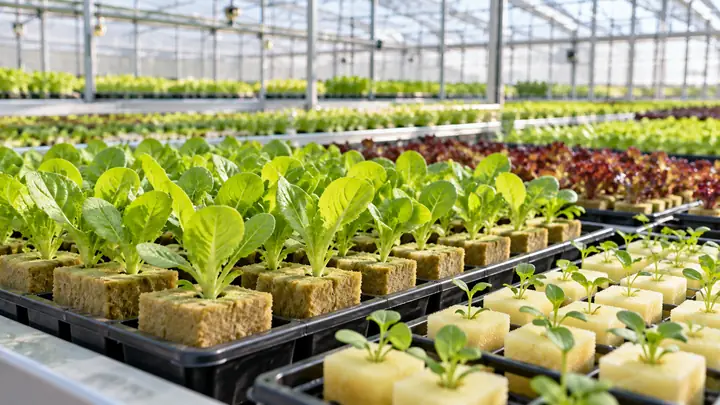
- Transplant seedlings raised in sponge, rockwool or similar plugs once roots emerge from the bottom of the plug, so they reach the film quickly.
- Add alarms and backup. Fit a low-flow or low-level alarm and plan for backup power or a spare pump.
How do you manage nutrients in NFT hydroponics?
Because the solution recirculates, NFT gives you tight control, but it also concentrates any mistake. Check EC and pH at least daily on small systems and continuously on commercial ones. Top up with fresh water or a weaker solution as plants drink, and add concentrate when EC falls. Many growers replace or partly dump the solution on a schedule, or when lab analysis shows ions such as sodium building up.
Keep calcium-based and sulfate- or phosphate-based fertilizers in separate A and B stock tanks, and dose them into the main tank, not into each other. For recipes, EC ranges per crop and pH control, see our hydroponic nutrients, EC and pH guide. On larger farms an automatic doser saves labor and holds targets more tightly; the smart fertigation machine with dosing pump is built for that job.
What are the advantages and disadvantages of NFT?
Advantages
- Low water and fertilizer use per kilogram of crop, because the system is closed.
- No substrate cost beyond a small plug, and little waste to dispose of.
- Light, modular hardware that is easy to lay out on benches, A-frames or racks.
- Clean harvest: heads lift out with roots attached, which suits living-lettuce packaging.
- Fast turnaround: channels can be cleaned and replanted quickly.
Disadvantages
- Little buffer against pump or power failure. Roots hold almost no water, so plants can wilt within a short time on a warm day if flow stops.
- Heat sensitivity. The small volume in each channel warms quickly in sun or under lights.
- Shared solution. Root diseases such as Pythium can spread through the whole system, so sanitation and water treatment matter.
- Root blockage in long-season or vigorous crops.
What are common NFT problems and fixes?
| Symptom | Likely cause | Fix |
|---|---|---|
| Wilting at the far end of channels | Flow too low, blockage, or channel too long | Rebalance flow, clear emitters, shorten runs. |
| Brown, slimy roots | Warm solution, low oxygen, root pathogens | Cool the solution, reduce flow depth, sanitize, consider UV or other water treatment. |
| Tipburn on lettuce | Calcium not reaching inner leaves, often from fast growth and low airflow | Improve air movement, manage EC and humidity. |
| Algae in channels | Light reaching the solution | Use opaque channels and lids; cover unused holes. |
| Puddles and uneven growth | Sagging channel or inconsistent slope | Add supports and re-level. |
Should you buy an NFT kit or a commercial system?
Small NFT hydroponics kits made from round pipes are fine for trials, classrooms and herbs. For production, the questions change: channel profile and wall thickness, UV stability, food-grade material, how channels join and drain, how the frame handles load, and whether the system can be expanded. A farm-scale layout, such as a farm-scale pipe NFT vegetable system or a flat-channel system, should be designed around your building, light source and target output.
Mars Vertical Farm has more than 20 years of production experience and manufactures channels, frames and complete NFT systems in its Shanghai factory under ISO 9001, with OEM/ODM options for distributors. Browse the full range of hydroponic channels, benches and media, or send us your greenhouse or building dimensions and target crop for an NFT layout and quotation.