

Short answer
Greenhouse plastic is UV-stabilized polyethylene film, typically 6 mil (about 150 microns) thick, made to cover greenhouses, hoop houses and high tunnels. Standard greenhouse-grade film lasts about 4 years and transmits roughly 85–90% of light when clear. Additives such as IR thermal, anti-drip and diffusion improve heat retention and crop quality, and a double inflated layer cuts heating energy by roughly 30–40%.
What is greenhouse plastic?
Greenhouse plastic is a UV-stabilized polyethylene film, usually around 6 mil (150 microns) thick, made specifically to cover greenhouses, high tunnels and hoop houses for several seasons. Unlike hardware-store sheeting, greenhouse plastic contains UV inhibitors and often extra additives for heat retention, light diffusion and anti-drip, so it stays clear and strong for roughly one to five years depending on grade.
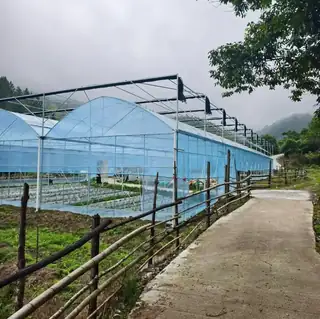
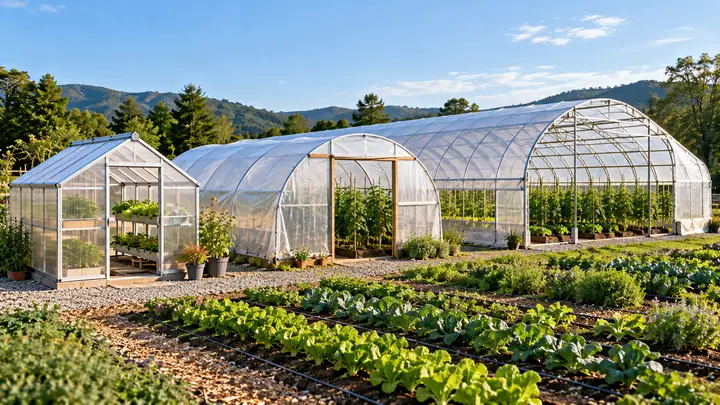
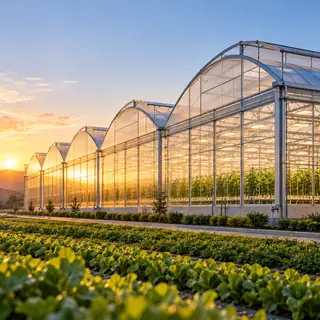
Polyethylene film is the most widely used greenhouse covering in the world because it is inexpensive, light and quick to install. This guide explains film types, thickness and lifespan, how to choose the best greenhouse plastic for your climate, how to install and insulate it, and where film fits against rigid panels. For a head-to-head with rigid glazing, see polycarbonate vs. glass vs. film greenhouse panels, and for the rigid alternative in depth, our guide to polycarbonate sheets and panels.
How is greenhouse film different from ordinary plastic sheeting?
Greenhouse film differs from construction or painter's sheeting in its UV stabilization, its additives and its multi-layer construction. Ordinary clear plastic sheeting can turn brittle and tear within a few months in full sun, while greenhouse-grade film is rated in years.
- UV stabilizers protect the polymer from sunlight. The rated life, for example "4-year film", reflects the stabilizer package.
- Co-extrusion: quality polyethylene film for greenhouse use is made in three to five layers, each with a job (strength, UV, additives), instead of one blended layer.
- Light quality: greenhouse film is formulated for high photosynthetically active radiation (PAR) transmission, typically around 85–90% for clear film.
- Additives such as infrared (IR) thermal, anti-condensate and diffusion, described below.
So when you buy clear sheeting for a greenhouse, check that the label states greenhouse grade, UV-stabilized and a rated life in years.
What types of greenhouse plastic film are there?
Greenhouse covers made from film come in several functional types, and many films combine two or three features. The table summarizes the main options.
| Film type | What it does | Best for |
|---|---|---|
| Clear UV-stabilized PE | Maximum direct light at the lowest cost | Season extension, cool and cloudy regions |
| Diffused (light-scattering) film | Spreads light evenly, reduces leaf scorch and hot spots | Tomatoes, cucumbers, peppers, flowers, sunny regions |
| IR thermal film | Holds back long-wave heat radiation at night | Heated houses, cold nights, high tunnel plastic in winter |
| Anti-condensate (anti-drip) film | Condensation runs down as a sheet instead of dripping | Crops sensitive to leaf wetness and disease |
| White or opaque film | Reduces light and heat | Hot climates, overwintering nursery stock |
| Woven or reinforced (armored) film | Scrim of woven strips for tear resistance | Windy sites, roll-up sides, heavy duty greenhouse covers |
| Photo-selective films | Filter specific wavelengths, for example UV-blocking to reduce some pests | Specialty crops and pest strategies |
Woven greenhouse plastic and armored greenhouse film are tougher but usually transmit less light than premium clear co-extruded film. They make sense for sidewalls, roll-up curtains, and hoop house replacement covers on exposed sites.
"Greenhouse fabric" usually means something different: woven or knitted shade cloth, insect netting or spun-bonded row cover. A greenhouse fabric cover breathes and does not hold heat like film. Shade fabrics are covered in our guide to greenhouse shade cloth and cooling.
What greenhouse plastic thickness should you use?
For most greenhouses and high tunnels, 6 mil (about 150 microns) greenhouse plastic is the standard; it is also the minimum that USDA NRCS specifies for polyethylene covers on high tunnels funded under its conservation programs. Thinner film suits short-term covers, and thicker film suits harsh sites.
| Thickness | Approx. microns | Typical rated life | Common use |
|---|---|---|---|
| 2–4 mil | 50–100 | Under 1 to about 2 years | Low tunnels, temporary covers, raised-bed covers |
| 6 mil | About 150 | About 4 years (greenhouse grade) | Greenhouses, high tunnels, hoop houses |
| 8–12 mil | 200–300 | 4–5+ years | Heavy duty greenhouse plastic, windy or hail-prone sites |
| Woven/reinforced, 10–14 mil | Varies | Often 3–5+ years | Sidewalls, roll-up curtains, storage covers |
Thickness alone does not decide life. A 6 mil, 4-year co-extruded film usually outlasts a thicker sheet with a weak UV package. Contact with hot metal or chemicals also shortens life, as explained in the installation section.
How do you choose the best greenhouse plastic?
The best greenhouse covering for you depends on climate, crop, whether you heat, and how often you want to recover. Work through these decisions:
- Single or double layer? In cold climates or heated houses, two layers of film inflated with a small blower save roughly 30–40% of heating energy compared with one layer, according to university extension sources.
- Clear or diffused? Choose diffused in sunny regions or for tall crops; choose clear where winter light is the limiting factor.
- IR thermal? Worth it in heated houses and anywhere with cold, clear nights.
- Anti-drip? Recommended for most food and flower crops to reduce leaf wetness.
- Rated life? A 4-year film balances cost and labor; longer-life films reduce how often you recover large roofs.
- Width and length. Order a greenhouse plastic roll wide enough to cover the arch in one piece, with about 1–1.5 m (3–5 ft) extra for fastening, plus extra length for end walls.
For a hoop house plastic cover on a standard 9 m (30 ft) wide tunnel, that usually means a roll around 12 m (40 ft) wide. Our hoop house vs. high tunnel guide explains the structures themselves.
How do you install greenhouse plastic sheeting?
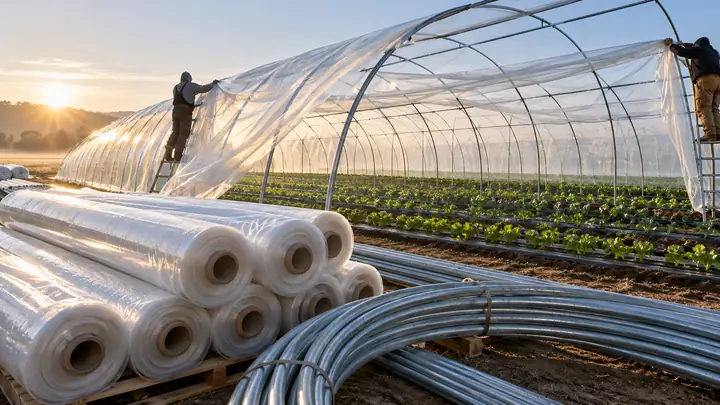
Install greenhouse plastic sheeting on a calm, mild day with a fastening system that grips evenly, so the film is tight without being overstretched. A typical sequence:
- Prepare the frame. Cover or tape any sharp edges, bolts and hot metal surfaces, and paint contact areas white or use foam tape so the film does not overheat where it touches the hoops.
- Fit the channel. Screw aluminum lock channel (base) along the end hoops, hip boards and baseboards.
- Unroll and pull over. Unroll the film along one side, check the correct side faces out (most films are printed "this side out"), and pull it over with ropes in low wind.
- Lock one end and one side. Secure with wiggle wire (spring lock), then tension toward the opposite side and end.
- Tension evenly. Work from the center outward to avoid wrinkles that flap and wear.
- Inflate the second layer if used, with a small blower at a low static pressure set as the manufacturer recommends.
- Trim and finish. Leave enough tail to re-tension later, and seal holes with greenhouse repair tape.
A note on PVC pipe greenhouse frames. A PVC pipe greenhouse is a popular DIY project, but PVC can interact with polyethylene film and shorten its life, especially where hot, sunlit pipe touches the plastic, so tape or paint contact points. PVC also has limited strength in wind and snow. For anything larger than a hobby structure, galvanized steel hoops are the durable choice; see greenhouse frames compared.
How do you insulate a greenhouse for winter?
The most effective greenhouse insulation for a film house is a second inflated layer of film, followed by night curtains and sealing air leaks. Options, roughly in order of impact:
- Double inflated film on the roof and sides.
- Energy or thermal curtains drawn at night inside the house.
- Horticultural bubble insulation fixed to walls in small hobby houses; it reduces heat loss but also blocks some light, so use it mainly on north walls or in winter only.
- Frost cloth over crops adds a few degrees of protection on the coldest nights.
- Sealing gaps around doors, vents and baseboards, and insulating the perimeter below ground.
Heating and ventilation equipment are covered in our greenhouse ventilation and heating guide.
How long does greenhouse film last, and when should you replace it?
Greenhouse film typically lasts as long as its rated life, about 4 years for standard 6 mil film, and sometimes longer in cloudy climates. Replace it when light transmission has dropped noticeably, the film is brittle or yellowed, or tears keep reappearing. Sulfur, chlorine and some pesticides can shorten film life and may void warranties, so check the film manufacturer's chemical guidance. Recycle old film where agricultural plastic recycling is available.
Covers for small greenhouses and raised beds
A plastic greenhouse cover for a mini greenhouse, walk-in kit or raised bed is usually a pre-sewn PE or PVC cover with zip doors. These are convenient, but many are thin, lightly stabilized film that lasts one to three seasons. When buying a replacement, check the greenhouse cover material (UV-stabilized PE is preferred), the thickness, whether reinforcing mesh is included, and that tie-downs or a skirt are provided to resist wind. For anything you plan to keep for years, a polyethylene greenhouse with a steel frame and roll-stock film is easier to maintain, because the cover can be replaced with standard film rather than a model-specific bag. Our small greenhouse guide compares mini and walk-in structures.
Where to buy greenhouse plastic depends on scale. Garden centers sell small cut pieces and greenhouse plastic covers for raised beds and mini houses. For high tunnels and commercial houses, buy full rolls from a greenhouse supplier or manufacturer, matched to your structure; all of our film and polycarbonate structures are listed under greenhouses and sunrooms. Cheap greenhouse plastic without UV stabilizers is a false economy: the labor of recovering a roof every season quickly costs more than the film.
Next steps
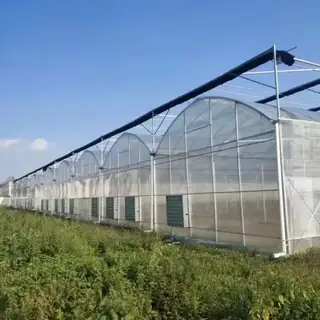
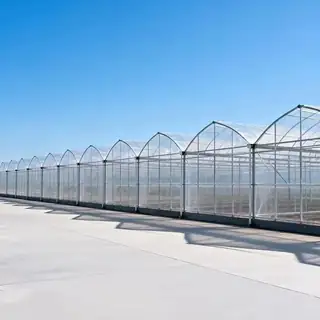
Choosing greenhouse plastic comes down to a UV-stabilized greenhouse-grade film, the right thickness (usually 6 mil), the additives your climate needs, and careful installation on a sound frame. Mars Vertical Farm manufactures film-covered tunnel and multi-span greenhouses, such as our customized multi-span steel frame film greenhouse, supplied factory-direct with covering, channels and wiggle wire to fit. Tell us your site, climate and size, and we can quote a complete structure or custom-sized replacement covers.