Short answer
Shade cloth for plants is UV-stabilized knitted or woven HDPE fabric that blocks a set share of sunlight, usually 30–90%. Most vegetables need 30–50% shade; ferns and orchids need 60–80%. White or reflective cloth cools better than black. Combined with ventilation and evaporative cooling, shading helps keep greenhouses near 21–27 °C (70–80 °F) by day for warm-season crops.
What is shade cloth for plants?
Shade cloth for plants is a woven or knitted fabric, usually UV-stabilized high-density polyethylene (HDPE), that blocks a set percentage of sunlight, typically 30–90%, to cut leaf temperature, sunscald and water stress. In greenhouses, shade cloth is the first and cheapest layer of a cooling strategy that also includes ventilation, evaporative cooling and good airflow.
This guide explains how to choose shade percentage, color and fabric, how to keep greenhouse temperature in the right range, and when to add fans, pads, misting or fogging. It focuses on shading and cooling; vents, fans and heaters are covered in detail in our greenhouse ventilation and heating guide.
Shade for plants in gardens and greenhouses
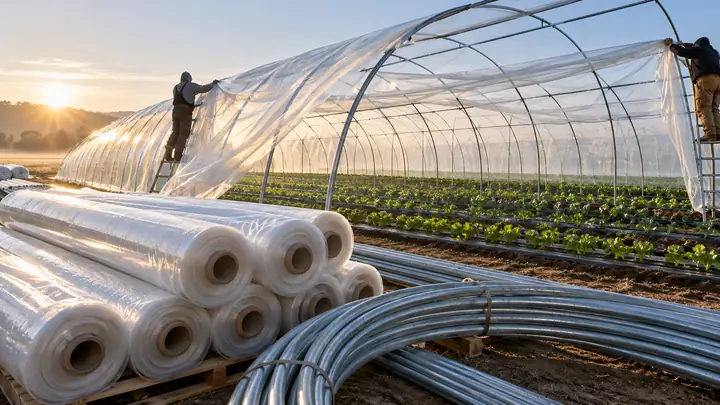
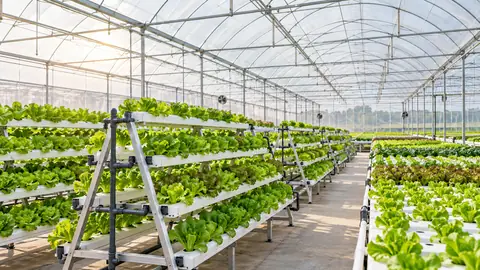
The same fabric is sold under many names, from garden sun shade to shade screen. In a backyard, shade cloth on hoops over lettuce or newly planted transplants prevents bolting and wilting during heat waves. In a greenhouse, shade fabric for plants is mounted over or under the roof and becomes part of the climate system. The fabric choices below, percentage, color and knit, apply to both, but commercial houses add motorized screens and controls.
What is the ideal greenhouse temperature and humidity?
The ideal greenhouse temperature for most warm-season vegetables is about 21–27 °C (70–80 °F) during the day and 16–18 °C (60–65 °F) at night, with relative humidity around 60–80%. Cool-season crops such as lettuce and spinach prefer roughly 15–21 °C (60–70 °F) by day and 7–13 °C (45–55 °F) at night. These are typical ranges from university extension guidance; your crop and variety may differ.
| Crop group | Day | Night | Stress begins around |
|---|---|---|---|
| Tomatoes, peppers, cucumbers | 21–27 °C (70–80 °F) | 16–18 °C (60–65 °F) | Above about 30–32 °C (86–90 °F); fruit set suffers |
| Lettuce, spinach, leafy greens | 15–21 °C (60–70 °F) | 7–13 °C (45–55 °F) | Above about 24–27 °C (75–80 °F); bolting and tipburn |
| Strawberries | 18–24 °C (65–75 °F) | 10–13 °C (50–55 °F) | Above about 30 °C (86 °F) |
| Seedlings and propagation | 21–24 °C (70–75 °F) | 18–21 °C (65–70 °F) | Hot, dry air dries plugs quickly |
Optimal greenhouse temperature is really a balance of temperature and humidity. Growers increasingly manage vapor pressure deficit (VPD), the drying power of the air; a common target for many crops is roughly 0.8–1.2 kPa. Too dry and plants close their stomata; too humid and diseases like botrytis and powdery mildew spread. Our guide to fungus gnats and powdery mildew control covers the disease side.
What shade percentage should greenhouse shade cloth be?
Choose greenhouse shade cloth by the crop's light needs and your summer sun: most vegetables do well under 30–50% shade, while shade-loving ornamentals need 60–80%. The table gives typical starting points.
| Shade rating | Typical crops and uses |
|---|---|
| 30–40% | Tomatoes, peppers, cucumbers, melons and most fruiting vegetables in hot summers |
| 40–50% | Lettuce, leafy greens, herbs, strawberries; general vegetable garden shade cloth |
| 50–60% | Many flowers and bedding plants, plant nursery shade cloth, hardening off transplants |
| 60–80% | Ferns, orchids, foliage plants, propagation of cuttings |
| 80–90% | Patios, parking and livestock shade; usually too dark for crops |
A 50% shade cloth is a common all-round choice for greenhouses in sunny regions, and it also suits lettuce and herbs in gardens in midsummer. In cloudy climates, start lower, because excess shading reduces yield: as a rough rule, every 1% of light lost can cost close to 1% of yield in light-limited crops.
What color shade cloth is best for a greenhouse?
White and aluminized (reflective) shade cloth usually keep a greenhouse cooler than black at the same shade rating, because they reflect sunlight instead of absorbing it. Black remains the most common and cheapest, and works well when mounted outside with an air gap.
- Black: durable and inexpensive; absorbs heat, so mount it outside the covering with space for air to flow.
- Green: green shade fabric blends visually into gardens; performance is similar to black.
- White: white shade cloth for greenhouse roofs reflects and diffuses light, giving even light under the canopy. White shade cloth for tomatoes is popular because it lowers temperature while keeping light diffuse.
- Aluminized: reflective knitted screens give the strongest cooling per percent of shade and can also hold heat at night when used inside.
Knitted vs. woven shade fabric
Knitted shade cloth for plants is the usual choice: it does not unravel when cut, is light, and can be fitted with grommets anywhere. Woven fabric is stiffer, can fray when cut and shrinks slightly, but is very durable for permanent installations. For both, check the stated shade cloth UV protection (UV stabilization), the warranty and the fabric weight in g/m². A greenhouse shade cloth roll is typically sold in widths of about 2–6 m (6–20 ft) and can be joined or ordered as finished panels with hemmed edges.
How do you install greenhouse shade?
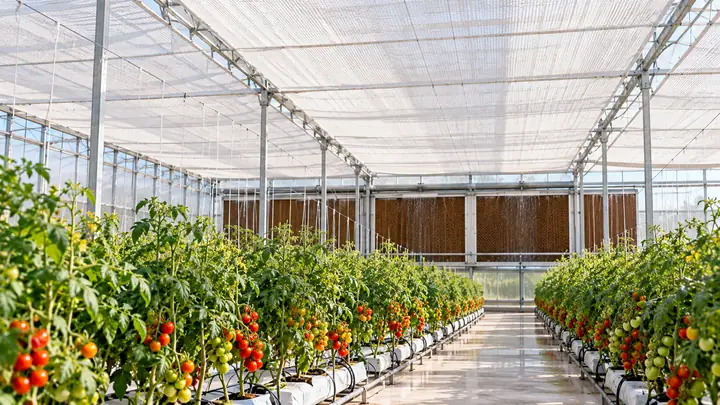
Greenhouse shade works best outside the covering, because it stops heat before it enters; inside screens are easier to automate. Common options are:
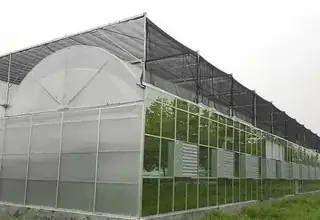
- External shade cover stretched over the roof with a gap of about 15–30 cm (6–12 in) for airflow. Simple and effective for small greenhouses and high tunnels.
- Retractable external screens on wires or a motorized system, opened on cloudy days so crops get full light.
- Internal shade and energy screens that double as night insulation in winter; standard in commercial greenhouses.
- Shading paint (whitewash) on glass or polycarbonate, applied in spring and washed off in autumn.
To fit a simple shade cloth for small greenhouse roofs:
- Measure the roof and sides you want to shade, and add about 30 cm (1 ft) per edge.
- Choose the shade percentage and color from the tables above.
- Order a hemmed panel with grommets every 60–90 cm (2–3 ft), or fit clips to a cut roll.
- Fix spacers or a wire frame so the cloth sits above the covering.
- Tie down with bungees or rope that allows some movement in wind.
- Remove or retract it in autumn when light becomes limiting.
How do you keep a greenhouse cool in summer?
To keep a greenhouse cool, combine shading with ventilation and, in hot climates, evaporative cooling. Shade cloth alone can lower temperatures several degrees, but it cannot remove heat that builds up in a closed house.
Ventilation and greenhouse fans
Natural ventilation through roof vents and roll-up sides is the cheapest cooling, while exhaust fans give reliable control. A greenhouse fan with thermostat is the simplest automated setup for a hobby house; commercial houses use staged fans run by a climate controller. Extension sizing guidance for fan-and-pad houses targets roughly one air change per minute, often expressed as about 8 cfm per square foot of floor area (about 2.4 m³/min per m²). A greenhouse solar ventilation fan suits off-grid hobby houses but rarely moves enough air for a commercial house. Horizontal airflow (HAF) fans keep air moving between plants to even out temperature and humidity.
Evaporative pads, misting and fogging
Evaporative cooling lowers air temperature by evaporating water, and works best in dry climates.
- Fan-and-pad systems: wet cellulose pads on one end wall, exhaust fans on the opposite wall. Air can be cooled by up to roughly 80% of the difference between dry-bulb and wet-bulb temperature. Pad-to-fan distance is typically kept under about 45–60 m (150–200 ft).
- Misting system for plants: low-pressure misting (a few bar) wets foliage and is mostly used in propagation.
- Greenhouse fogging system: high-pressure fog (around 70 bar, 1,000 psi) creates droplets fine enough to evaporate before they land, cooling and raising humidity without wetting leaves.
Greenhouse humidifiers serve the same purpose in smaller houses during dry periods. A greenhouse air conditioner is rarely economical except for small, closed research or high-value spaces, because greenhouses gain a lot of solar heat; for fully enclosed indoor rooms, see indoor farm HVAC and dehumidification.
Common shading and cooling mistakes
- Shading too heavily all season, which cuts growth on cloudy days; retractable screens avoid this.
- Laying black cloth directly on film, which heats the covering and shortens its life.
- Running pads without enough exhaust, which simply raises humidity.
- Closing vents too early in the evening, trapping humid air that favors disease.
- Measuring temperature in direct sun; use a shaded, aspirated sensor at crop height.
How should commercial growers plan shading and cooling?
For commercial greenhouse shade cloth and cooling, plan the system as a whole when you specify the greenhouse, rather than adding it later. A practical checklist:
- Climate data: summer peak temperature, humidity, solar radiation and wind.
- Crop targets: day and night temperature, humidity or VPD, and light needs.
- Shading: external or internal screens, percentage, and whether screens double as energy curtains.
- Ventilation area: roof and side vent openings sized for natural ventilation, with insect screens.
- Active cooling: fans, pads or fog sized for the house volume and climate.
- Controls: sensors and a controller that coordinate screens, vents, fans and irrigation.
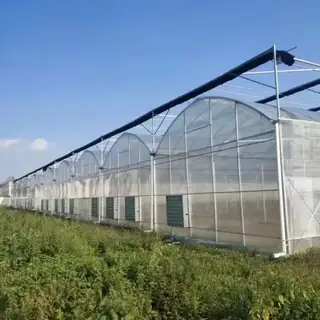
Buyers ordering shade net in volume should also compare UV stabilization, warranty, fabric weight and roll dimensions. Our large multi-span steel frame greenhouse and IoT polycarbonate gear greenhouse can be supplied with shade screens, fan-and-pad cooling and sensors. For the controller side, read IoT smart agriculture; for full project planning, our commercial greenhouse guide.
Getting a quote
The right shade cloth for plants, combined with good ventilation and evaporative cooling where needed, keeps greenhouse temperature in the range crops need through summer. Mars Vertical Farm supplies greenhouses factory-direct with shade screens, fans, cooling pads and controls sized to your climate. Share your location, crop and greenhouse size and we will suggest a shading and cooling package with custom sizing.