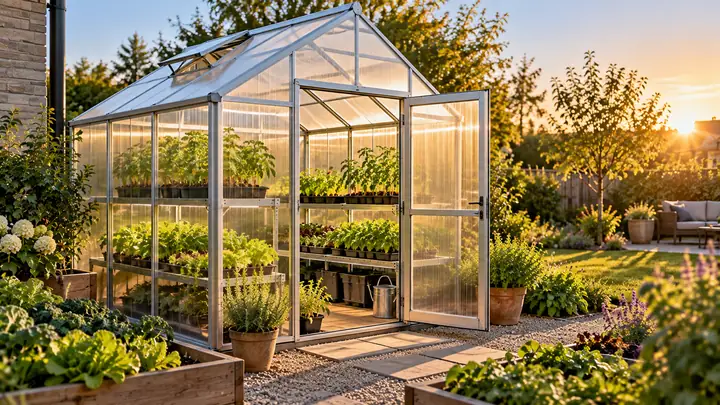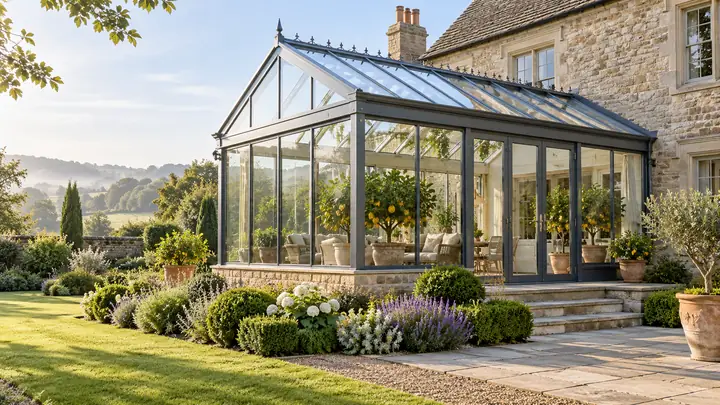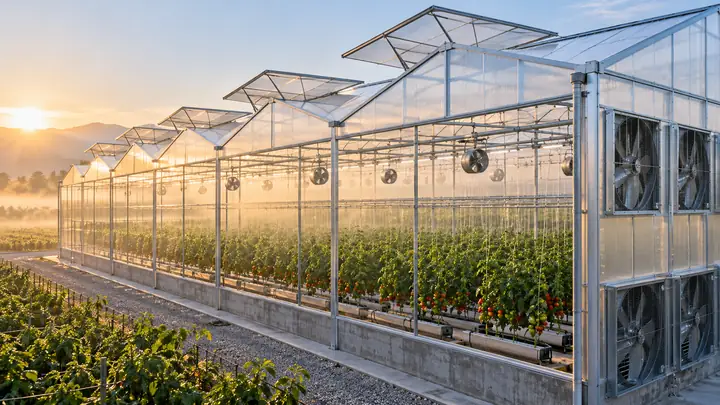
Short answer
Greenhouse ventilation exchanges inside air with outside air through roof and side vents or exhaust fans to remove heat and humidity. A common rule is about one air exchange per minute in summer and a quarter of that in winter. Size a greenhouse heater from heat loss: glazing area times the covering's U-value times the inside-outside temperature difference, plus a margin for air leakage.
What is greenhouse ventilation and heating?
Greenhouse ventilation is the controlled exchange of inside air with outside air, by roof and side vents or exhaust fans, to remove heat, humidity and stale air. Greenhouse heating replaces the energy a structure loses at night and in winter, so that the crop stays within its target temperature range. Together with cooling and air circulation they make up a greenhouse climate control system.
Most crop losses blamed on "bad weather" are really climate control failures: leaf scorch on a sunny spring afternoon with the vents shut, botrytis after a humid night with no air movement, or frost damage when a heater fails. This guide covers how to size vents and fans, how to choose and size a greenhouse heater, and how the two work together through the year. The same physics applies to a 20 m² hobby house and a multi-hectare range; only the equipment scale changes.
Do greenhouses need ventilation?
Yes, every greenhouse needs ventilation, including in winter. A closed house in sunshine heats quickly because glazing lets short-wave solar radiation in and traps the heat. On a clear day, inside temperatures can climb well past 35 °C even when it is cool outside. Ventilation also does three other jobs:
- Humidity control. Plants transpire large amounts of water. Without air exchange, relative humidity rises toward saturation, condensation forms on leaves and fungal disease follows.
- CO2 replenishment. In a sealed house, plants can draw carbon dioxide down below outside levels during the day, which slows growth.
- Uniformity. Moving air breaks up hot and cold pockets and reduces temperature layering between the roof and the crop.
What types of greenhouse ventilation systems are there?
A greenhouse ventilation system is either natural (passive), mechanical (fan-driven), or a combination of both.
Natural ventilation: roof vents and side vents
Natural ventilation uses the stack effect (warm air rising out of a greenhouse roof vent) and wind pressure to move air through openings. Typical arrangements are continuous ridge vents, hinged roof windows on gutter-connected houses, roll-up side walls on film houses, and louvre vents on smaller structures. Extension guidance commonly recommends that combined roof vent area and combined side vent area each be in the range of roughly 15–20% of floor area, and more in hot climates. It uses almost no electricity but depends on wind and on the inside-outside temperature difference.
Mechanical ventilation: exhaust fans and intake louvres
A greenhouse exhaust fan pulls air out at one end while motorised or gravity louvres admit air at the other. This gives predictable air exchange regardless of wind, at the cost of electricity, noise and the need for backup power.
Air circulation fans
Greenhouse circulation fans, often called horizontal airflow (HAF) fans, do not exchange air with the outside. They mix the air inside to even out temperature, dry leaf surfaces and reduce disease. They usually run when exhaust fans are off, particularly at night and in winter.
| Method | How it works | Strengths | Limitations | Typical use |
|---|---|---|---|---|
| Roof (ridge) vents | Hot air escapes at the highest point | Low energy, quiet, good in rain if well designed | Weak on still, humid days | Gutter-connected glass and polycarbonate houses |
| Roll-up or hinged side vents | Cross-flow from wind | Cheap, large opening area | Wind-dependent; drafts on crop | Tunnels and film multi-span houses |
| Exhaust fans + intake louvres | Negative pressure draws air through | Predictable airflow | Electricity, noise, needs backup | Hot climates, narrow houses, small greenhouses |
| Fan and pad cooling | Air pulled through wet pads cools by evaporation | Strong cooling in dry air | Water use; weaker in humid climates | Hot, dry regions |
| Circulation (HAF) fans | Mixes inside air | Uniform temperature, drier leaves | No heat removal on its own | All greenhouses, especially winter |
How do you size greenhouse ventilation fans?
Fan sizing starts with the volume of air you need to move per minute. A widely used extension rule of thumb is about one full air exchange per minute in summer and about a quarter of that in winter, calculated on floor area multiplied by an assumed height of about 2.4 m (8 ft).
- Measure floor area. Example: a 9.6 m × 30 m house = 288 m².
- Multiply by the design height. 288 m² × 2.4 m ≈ 690 m³.
- Apply the exchange rate. Summer: 690 m³ per minute, or about 41,000 m³/h. In very hot climates some designers use 1.25–1.5 exchanges per minute.
- Select fans at working static pressure. Read fan curves at roughly 25–30 Pa, not at zero pressure, because louvres, screens and pads add resistance.
- Split capacity across several fans or stages. Several smaller fans, or two-speed fans, let a controller match airflow to the season instead of running one big fan on and off.
- Size intake openings. Make the free intake area at least about 1.25 times the total fan opening area so the fans are not starved.
- Check fan spacing and air travel. Keep exhaust fans roughly no more than 7–8 m apart and avoid pulling air much more than about 45 m (150 ft) from intake to fan.
For a small greenhouse fan, the same method applies on a smaller scale: a 3 m × 4 m house needs roughly 29 m³ per minute in summer. Small greenhouse exhaust fans with a thermostat are a simple setup: the thermostat switches the fan at a set temperature, and a gravity louvre opens on the opposite wall.
For circulation, a common guideline is about 2 cfm per square foot of floor (roughly 0.6 m³ per minute per m²), delivered by fans spaced so that air moves in a loop down one side of the house and back along the other.
How does greenhouse cooling work beyond ventilation?
Ventilation can only bring inside temperature down toward outside temperature. When outside air is already hot, you need additional cooling:
- Shade screens. External shading is generally more effective than internal shading at keeping heat out. A screen percentage describes light reduction, not an equal drop in temperature.
- Fan and pad evaporative cooling. Exhaust fans pull air through wet cellulose pads on the opposite wall. In dry air this can reduce temperature by several degrees, in good conditions by roughly 5–10 °C. Extension guidance suggests on the order of 1 m² of pad per 20 m² of floor. It works poorly in humid coastal climates.
- High-pressure fog. Fine droplets evaporate before reaching leaves, cooling and humidifying the air. Fog needs clean water, so plan for filtration or reverse osmosis.
Are automatic greenhouse vent openers worth it?
Automatic ventilation for a greenhouse is worth it in almost every case, because temperature can rise faster than anyone can respond. There are two main types:
- Wax-cylinder auto vent openers. A sealed cylinder of wax expands as it warms and pushes a piston that lifts the vent. They need no power and suit small and hobby greenhouses. The opening temperature is adjustable within a range, but they cannot respond to humidity, rain or wind.
- Motorised vents. Rack-and-pinion or film roll-up motors driven by a climate controller. Commercial houses use these, linked to temperature, humidity, wind speed and rain sensors so that vents close in storms and open in steps.
If you fit insect screens over vents, remember they reduce airflow, so vent area may need to increase.
What are the main greenhouse heating systems?
The right greenhouse heater depends on the size of the house, the fuel available and how cold your design night is.
| Heating system | Fuel | Best for | Key points |
|---|---|---|---|
| Electric greenhouse heater (fan heater or panel) | Electricity | Small greenhouses, frost protection | Simple, clean, no combustion gases; running cost is high per unit of heat in most regions |
| Gas-fired unit heaters | Natural gas or propane | Most commercial houses | Fast response; should be vented to the outside with fresh combustion air |
| Infrared radiant tube heaters | Gas | High-roof houses, open-door buildings | Heat plants and surfaces directly rather than the air |
| Hot-water pipe (rail) heating | Boiler: gas, biomass, heat pump | Large, long-season greenhouses | Even heat at crop level; pipes can double as trolley rails; higher installed cost |
| Root-zone or under-bench heating | Hot water or electric | Propagation and pot crops | Lets you keep air cooler while roots stay warm |
| Solar, geothermal, biomass | Renewable | Sites with resources and capital | Low fuel cost but higher equipment cost; keep a conventional backup |
A warning about combustion: unvented gas or paraffin heaters release carbon monoxide, nitrogen oxides and ethylene, which can damage sensitive crops and endanger workers. Vented heaters are the safer choice for any greenhouse that people work in.
How do you size a greenhouse heater?
Heater output must at least equal heat loss on the coldest design night. The basic formula is Q = U × A × ΔT:
- A is the total area of glazing (roof, walls and gables), not the floor area. For a freestanding house it is often roughly 1.5–2 times the floor area.
- U is the heat-loss coefficient of the covering. Approximate values: single glass about 6 W/m²K, double inflated polyethylene about 4 W/m²K, twin-wall polycarbonate roughly 3.3–3.6 W/m²K. Manufacturer data should override these.
- ΔT is the difference between the inside setpoint and the design outside temperature. One extension approach is to take your area's average January minimum and subtract about 8 °C (15 °F) as a safety margin.
Example: 500 m² of double-poly covering, U = 4 W/m²K, inside 15 °C, design outside −5 °C (ΔT = 20 K). Q = 4 × 500 × 20 = 40,000 W, or 40 kW. Add roughly 10–25% for air leakage, depending on how tight the structure is, which brings the requirement to about 45–50 kW. Split this between at least two heaters so a single failure does not freeze the crop.
The same arithmetic tells you what a heater for a small greenhouse must deliver. A 3 m × 4 m polycarbonate house has around 40–45 m² of glazing; holding it 10 °C above outside needs roughly 1.5–2 kW, which is why a 2 kW electric greenhouse heater with a thermostat is a common choice for frost protection in small houses.
How should greenhouse temperature control be set up?
Good greenhouse temperature control is mostly about sensors and sequencing rather than equipment size.
- Place the sensor correctly. Mount it at crop height, in the middle of the house, inside a shaded and ventilated (aspirated) box. A sensor in direct sun or next to a heater gives wrong readings.
- Stage heating and cooling. Typical sequence on a warm day: open vents in steps, then start fans in stages, then add evaporative cooling. On a cold night: close vents, run circulation fans, then fire heaters in stages.
- Leave a dead band. Keep a gap of a couple of degrees between the heating setpoint and the venting setpoint so heaters and vents never fight each other.
- Add humidity control. A short burst of heating with vents slightly open lowers humidity at dawn, which reduces condensation on fruit and leaves.
- Install alarms and backup. A high/low temperature alarm, standby power for fans and controllers, and a manual override are cheap insurance.
For larger projects, an integrated controller that handles vents, fans, screens, heaters and irrigation together is worth the cost. Our IoT polycarbonate gear greenhouse is an example of a structure designed for this kind of sensor-based control.
How do greenhouses work in winter?
Greenhouses work in winter by capturing daytime solar energy, holding heat with a well-sealed and insulated covering, and topping up with heating when needed. Whether you need a heater at all depends on your climate and crop. In mild climates, an unheated house can protect hardy greens and overwintering plants from frost on most nights. In cold climates, year-round greenhouse production of warm-season crops such as tomatoes and cucumbers needs heating, and often supplemental lighting.
Features of a greenhouse built for winter and cold climates:
- Insulating glazing. Twin-wall or multi-wall polycarbonate, double inflated film or double glazing. See our comparison of polycarbonate vs. glass greenhouse panels.
- A frame rated for snow load, with steep enough roof pitch to shed snow. Galvanized steel and aluminum frames are covered in greenhouse frames: aluminum vs steel vs wood.
- Energy or thermal curtains that close at night to reduce heat loss through the roof.
- Tight construction: sealed doors, vents that close fully and minimal gaps at the base.
- Insulated north wall or a lean-to position against a heated building in small installations. See the lean-to greenhouse guide.
Portable greenhouses and pop-up film tents give some frost protection but lose heat quickly and are vulnerable to wind and snow. They suit season extension rather than true winter growing. For guidance on choosing a sturdy small structure, see our guide to small, mini and portable greenhouses.
How do structure choices affect ventilation and heating?
Ventilation and heating should be designed with the structure, not added afterward. Gutter height, roof vent layout, covering and span all change how much air you can move and how much heat you lose. Taller gutter heights give a larger buffer of air and more stable temperatures. Continuous roof vents on a multi-span polycarbonate greenhouse combine insulation with strong natural ventilation, while a film-covered multi-span steel greenhouse with roll-up sides and roof vents is a lower-cost option for warmer regions.
Mars Vertical Farm manufactures greenhouse structures in Shanghai and designs vent openings, wall heights and equipment mounting points to suit the client's climate; heaters and fans are specified to the project rather than sold as stand-alone products. Browse our greenhouses and sunrooms, read the commercial greenhouse guide for structure types, or send us your location, crop and planned size for a greenhouse layout and quotation.