Short answer
A greenhouse irrigation system delivers water and nutrients to crops under cover through filtration, a fertigation unit, zone valves and emitters or benches. Drip irrigation suits vegetables in soil or substrate, ebb-and-flow benches suit pot plants and seedlings, and booms suit seed trays. Design starts with a water test, peak demand and zone flow, then sizes pipes, pump, filters and controls.
What is a greenhouse irrigation system?
A greenhouse irrigation system delivers water, and usually dissolved nutrients, to crops under cover in measured amounts, on a schedule or on demand. A complete system includes a water source and treatment, filtration, a fertigation unit, valves and a controller, distribution pipework and the emitters, booms or benches that wet the root zone.
Because a greenhouse receives no rain, every litre the crop uses comes through the irrigation lines. That makes greenhouse irrigation both a risk and an opportunity: a poorly designed watering system causes uneven growth, disease and wasted fertilizer, while a well-designed one gives precise control over crop growth. This guide explains the main greenhouse watering system types, how to design one, how to automate it, and how to keep it running.
What types of greenhouse irrigation systems are there?
The right system depends on what you grow and how you grow it: in soil, in substrate, in pots on benches, or in hydroponic channels.
| System | How water is applied | Best for | Advantages | Limitations |
|---|---|---|---|---|
| Drip irrigation (drip line, drippers, stakes) | Low flow directly to each plant or row | Vegetables in soil or substrate, large pots | Precise, water-efficient, dry foliage | Needs good filtration; emitters can clog |
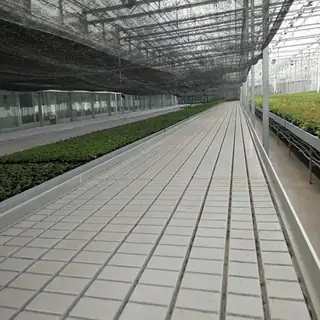
| Ebb-and-flow benches or flood floors | Solution floods the bench, then drains back to a tank | Pot plants, seedlings, nursery crops | Uniform, recirculating, low labour | Higher installed cost; needs disinfection of recirculated water |
| NFT and other hydroponic systems | Thin film or reservoir of nutrient solution | Leafy greens, herbs, strawberries | Recirculating, high yield per area | Pump or power failure affects roots quickly |
| Overhead booms | Travelling boom sprays from above | Seed trays, plugs, young plants | Even coverage across benches | Wets foliage; less efficient for mature crops |
| Overhead sprinklers and misting | Fixed nozzles above the crop | Propagation, cooling, cuttings | Simple, also raises humidity | Water waste, leaf wetness and disease risk |
| Capillary mats and troughs | Pots wick water from below | Small pot crops, retail greenhouses | Gentle, low cost | Algae and salt buildup need management |
Extension guidance generally identifies drip and subirrigation (ebb-and-flow, troughs, flood floors) as the most efficient methods, because they put water where the roots are and keep foliage dry. Subirrigation systems are commonly reported to cut water and fertilizer use substantially compared with overhead watering. For bench systems, see our guide to ebb and flow flood tables and the greenhouse tidal rolling bench with recirculation.
How does greenhouse drip irrigation work?
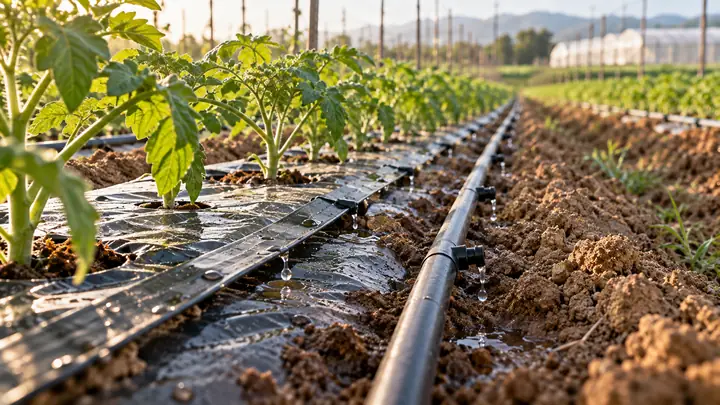
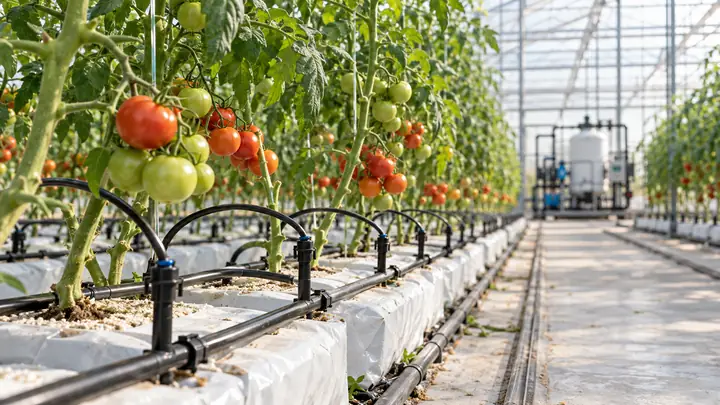
Greenhouse drip irrigation uses irrigation lines (laterals) along each row, with emitters either built into the line or plugged in and connected to stakes in each pot or slab. Water reaches the root zone drop by drop, so the soil or substrate stays moist without wetting leaves.
Key choices for a greenhouse drip system
- Pressure-compensating emitters. They deliver the same flow along long rows and on slopes, which is essential for uniform crops. Typical greenhouse dripper flows are roughly 1–4 L/h.
- Anti-drain (non-leak) emitters. They stop the line draining after each cycle, so every plant gets water at the same moment when the next short pulse starts. This matters most in substrate culture with many short irrigations per day.
- Emitter spacing. In soil beds, drip line with emitters every 20–30 cm is common. In substrate slabs and pots, one dripper per plant via a stake gives exact control.
- Drip line vs. drip tape. Drip tape is thin-walled and cheap but usually lasts one or a few seasons; heavier drip line lasts many years.
For component detail, read drip emitters and fittings.
How do you design a greenhouse irrigation system?
Greenhouse irrigation system design follows the same logic in a 200 m² hobby house and a multi-hectare range. Work through these steps in order:
- Test the water. Get an analysis of EC, pH, alkalinity (bicarbonates), sodium, chloride, iron and boron. Poor water may need reverse osmosis or acid dosing before it is usable.
- Estimate peak daily water demand. Mature greenhouse vegetables on a bright summer day can use several litres per square metre per day; the exact figure depends on crop, light and climate. Add the drain fraction you plan to apply in substrate culture, commonly in the region of 20–30%.
- Divide the greenhouse into irrigation zones. Each zone should contain one crop at one growth stage, so it can have its own schedule. Zone size is limited by the flow your water source and pump can deliver.
- Calculate zone flow. Number of emitters × emitter flow. For example, 3,000 drippers at 2 L/h = 6 m³/h.
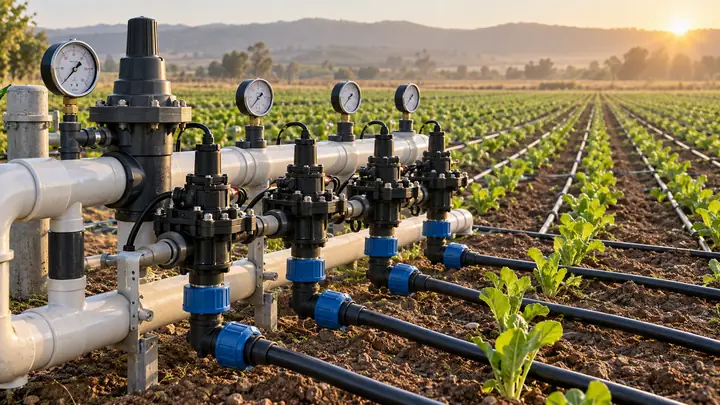
- Size pipes and the pump. Size mains and sub-mains so friction loss stays modest, and choose a pump that delivers peak zone flow at emitter pressure plus losses through filters, fertigation unit, valves and elevation.
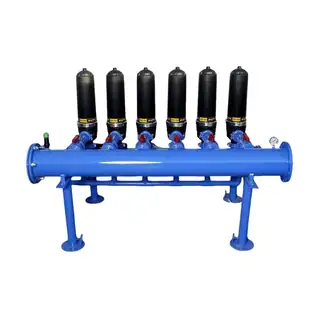
- Select filtration. Choose filters by water source and emitter sensitivity. Drippers commonly need filtration in the region of 120 mesh (about 130 microns) or finer. See the irrigation filters guide.
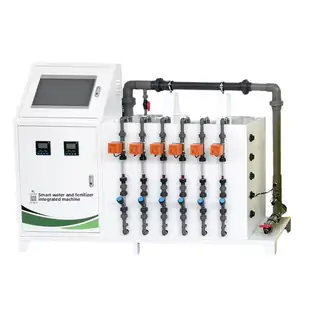
- Add fertigation. A dosing unit injects A and B fertilizer stocks and acid in proportion to flow, controlling EC and pH. Our guide on how to size a fertigation system covers the calculation.
- Plan drainage and recirculation. Decide whether drain water will be discharged, reused on another crop, or collected, disinfected and recirculated.
- Choose controls. Timers, a fertigation controller or a full climate computer with sensors.
Why is fertigation part of a greenhouse irrigation system?
Greenhouse fertigation is the injection of nutrients into irrigation water, and in protected cropping it is standard practice. Crops in substrate or hydroponics have almost no nutrient reserve, so every irrigation must carry a balanced feed. A fertigation unit measures EC and pH after injection and adjusts dosing in real time.
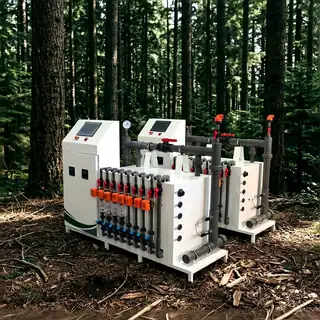
A smart fertigation machine with dosing pump sits between the filters and the zone valves and can also run the irrigation schedule. For a comparison of venturi injectors, proportional dosers and automatic units, read fertigation and fertilizer injectors.
How do you automate greenhouse watering?
An automatic greenhouse watering system replaces hand watering with valves opened by a controller. There are four common control strategies, from simplest to most precise:
- Timer-based. Fixed start times and durations. Simple and cheap, but it waters the same on cloudy and sunny days.
- Light-sum (solar radiation) based. A radiation sensor accumulates sunlight and triggers a cycle each time a set amount is reached. This links water to crop transpiration and is widely used for substrate vegetables.
- Substrate moisture based. Moisture or tension sensors in representative pots or slabs start and stop irrigation. Extension research has shown sensor-controlled drip can reduce runoff from pot crops dramatically.
- Drain and weight monitoring. Measuring drain volume and EC, or weighing a slab, lets growers fine-tune the schedule.
Whatever the strategy, automated watering systems for greenhouses should include flow or pressure monitoring and alarms, so a burst pipe or a blocked filter is noticed quickly. For controller options, see smart irrigation controllers.
What is the best small greenhouse watering system?
For a small greenhouse, a simple greenhouse drip irrigation kit with a pressure regulator, a screen filter, drip line or drippers on stakes and a battery or mains tap timer covers most needs. Add a small venturi or proportional injector if you want to feed through the drip line. Keep the parts list short:
- Backflow preventer at the tap
- Filter (screen or disc)
- Pressure regulator matched to the drippers
- 16 mm lateral lines with end caps or flush valves
- Drippers or drip line sized to plant spacing
- Timer or simple controller
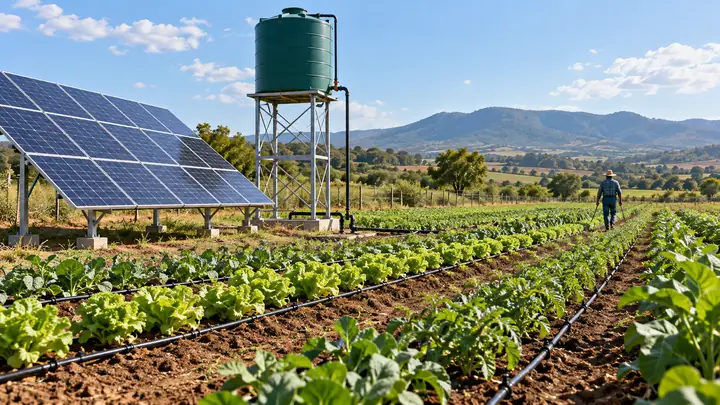
Where there is no mains power or water pressure, a solar powered greenhouse watering system with a small pump, a storage tank and a controller is practical. Size the pump and panel from daily water demand and dripper pressure, and keep a few days of storage for cloudy weather.
What irrigation works best for a nursery greenhouse?
Nursery irrigation must handle thousands of small containers with different water needs. Common solutions are overhead booms for seed trays and plugs, ebb-and-flow benches or flood floors for pot plants, and drip with multi-outlet stakes for larger containers. Grouping plants by container size and water need into separate zones is the most important design rule for nursery irrigation systems. Recirculating bench systems also reduce runoff, which matters where nutrient discharge is regulated.
How do you maintain greenhouse irrigation lines?
Most greenhouse irrigation problems come from clogging, pressure loss or wrong EC and pH. A simple maintenance checklist:
- Daily: check pressure gauges before and after filters, observe a few emitters in each zone, and compare EC and pH at the dripper with the setpoint.
- Weekly: clean or backwash filters, check drain volume and EC, and walk lines for leaks.
- Monthly: calibrate EC and pH sensors, flush lateral ends, and measure emitter flow on a sample to check uniformity.
- Between crops: clean lines with an approved acid or oxidiser treatment to remove scale and biofilm, then flush thoroughly.
Automatic self-cleaning filters reduce labour on larger sites. An automatic backwash disc water filter system cleans itself on pressure difference or time.
Where can you source greenhouse irrigation supplies?
For a commercial project, it pays to source the filtration, fertigation unit and growing system as one engineered package, so that flows, pressures and controls match. Mars Vertical Farm manufactures fertigation, filtration and water-treatment equipment alongside greenhouses and hydroponic benches in its Shanghai factory. Browse the irrigation, fertigation and water treatment range, or send us your greenhouse layout, crop and water analysis for a sized irrigation proposal.