Short answer
Choose an irrigation filter by water source first. Clean wells and municipal water usually need only a screen or disc filter; sandy wells need a sand separator before it; ponds, lakes and canals need sand media filters followed by a safety filter. Size the filter from peak flow with allowance for dirty water, and remove dissolved iron by oxidation before filtration.
What is an irrigation filter?
An irrigation filter removes sand, silt, algae, organic debris and other particles from irrigation water before it reaches pipes, valves and emitters. In drip and micro-irrigation, a correctly chosen irrigation filter is the single most important protection against emitter clogging, which reduces watering uniformity long before an emitter blocks completely.
This guide is about choosing a complete filtration setup for a farm or greenhouse: which irrigation water filters suit each water source, how a filter station is laid out, how to size it from flow and pipe size, and how to maintain it. For a detailed head-to-head of the three main filter technologies, see our companion article on disc vs. sand media vs. screen filters.
What types of irrigation filters are there?
Agricultural irrigation filters fall into five groups. Most farms combine two or more in a filter station.
- Hydrocyclone (sand separator): spins water so heavy particles such as sand drop into a collection chamber. It removes grit, not organic matter or fine silt, and is used ahead of the main filter on sandy wells and rivers.
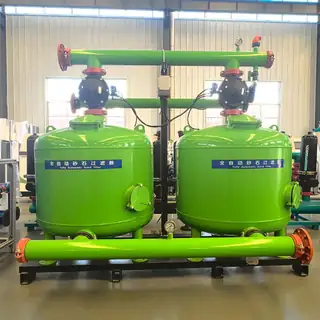
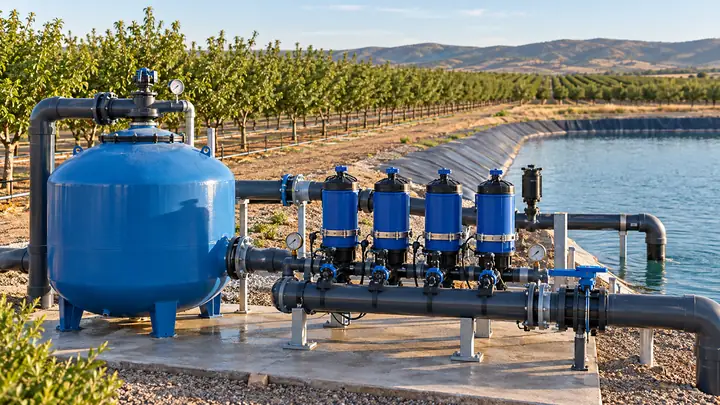
- Sand media filter: a pressure tank of graded silica sand that traps dirt through its depth. Multimedia sand filters with layered media are used in water treatment. Sand media filters are the standard for ponds, lakes, canals and other water with algae and organic load.
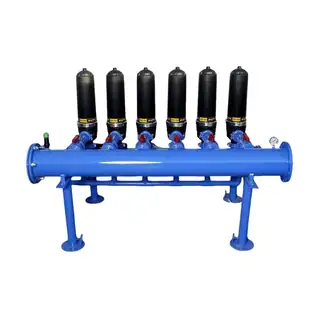
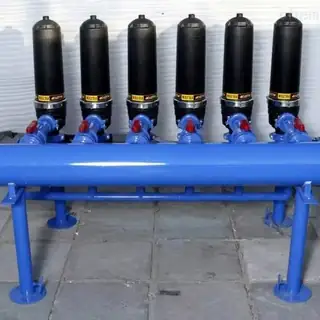
- Disc filter: stacks of grooved plastic discs give compact filtration with some depth effect, and automatic disc filter systems backflush in seconds. Disc filters for irrigation are the most common primary filter on modern farms.
- Screen filter: a stainless steel, metal or plastic mesh screen filter catches particles on its surface with a precise cut-off. Mesh screen filters are cheap and simple, and self cleaning screen filters with suction scanners or brushes suit large flows of fairly clean water.
- Intake and suction filters: coarse screens on pump suction lines and floating intakes, used as an irrigation pump filter to keep debris, fish and weeds out of the pump on lakes and ponds.
Which irrigation filter should you use for each water source?
Water source matters more than farm size. Start with a water analysis covering suspended solids, organic load, iron and manganese, and hardness, then use this table as a starting point.
| Water source | Typical contaminants | Recommended filter station | Notes |
|---|---|---|---|
| Municipal or treated water | Pipe scale, occasional sediment | Screen or disc filter | Backflow prevention is usually required by the water utility |
| Clean well | Fine sand, mineral particles | Disc or screen filter | A screen is often sufficient where only mineral particles are present |
| Sandy well | Sand and grit | Hydrocyclone, then disc or screen filter | Grit wears discs, seals and pump parts if not removed first |
| Well with iron or manganese | Dissolved iron that oxidizes in drip lines | Oxidation (aeration or chemical), settling, then media or disc filter | Filtration alone cannot remove dissolved iron |
| Pond, lake, reservoir or canal | Algae, organic matter, silt, debris | Intake screen, sand media filter battery, then disc or screen as safety filter | Load changes by season; size for summer algae peaks |
| River | Silt, sand, variable organics | Settling or hydrocyclone, then media or disc filter | Turbidity can spike after rain |
| Treated wastewater or recycled drainage | Fine solids, organics, biofilm | Media or disc filter with fine rating, plus disinfection | Disc filters are widely used in wastewater filtration; follow local reuse rules |
For lake irrigation, a floating intake with a coarse lake screen filter keeps the pump suction away from bottom sediment and surface scum, which reduces the load on the main filter.
How is an irrigation filter station laid out?
A farm-scale irrigation filter system is more than one filter. A typical layout, in flow order, is:
- Intake screen or suction strainer to protect the pump.
- Pump, with a check valve and air release valve on the discharge.
- Hydrocyclone where sand is present.
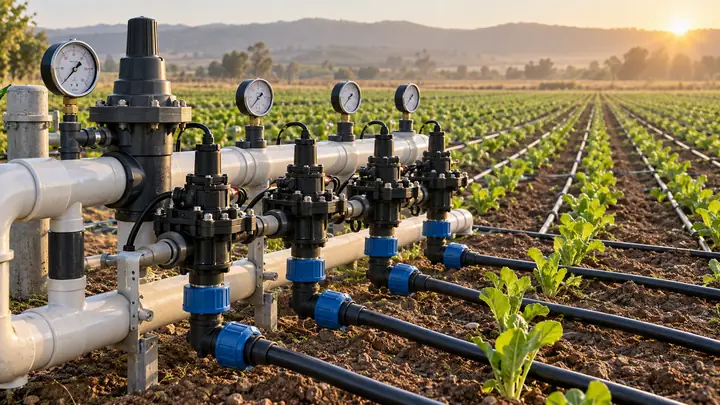
- Primary filter battery: sand media or disc units in parallel, with automatic backflush valves and a controller triggered by pressure differential and time.
- Pressure gauges or transmitters before and after the battery, so differential pressure is always visible.
- Fertilizer injection point, after the main filter. See fertigation and fertilizer injectors.
- Secondary safety filter, usually a screen or disc filter, to catch fertilizer residue, media carry-over or anything released during backflush.
- Main valve, flow meter and pressure regulation to the zones. The irrigation valves guide covers control, pressure reducing and relief valves.
On small systems, the same logic shrinks to a combined drip irrigation filter and pressure regulator: a backflow preventer, an inline irrigation filter of around 120–150 mesh and a pressure regulator at the start of the drip line.
What filtration rating do drip systems need?
The emitter manufacturer's recommendation always comes first. Without it, drip irrigation filters are commonly specified somewhere between about 120 mesh (roughly 130 µm) and 200 mesh (roughly 75 µm), with finer filtration for low-flow drippers and misting nozzles. A widely used rule is to remove particles larger than about one-seventh to one-tenth of the emitter's smallest passage. The filter comparison article includes a mesh-to-micron table, and our guide to drip emitters and fittings explains how passage size differs between emitter types.
How do you size an irrigation filter?
Filters are sized by flow, not by pipe size. Pipe size is only a quick check.
- Find peak system flow in m³/h for the largest zone or combination of zones that run at once. The method is in how to size a fertigation system.
- Apply a water quality factor. Manufacturer flow ratings usually assume clean water. For dirty surface water, choose a larger filter or more units, often derating capacity by a quarter to a half.
- Check clean pressure loss. A clean filter should typically lose only a small fraction of a bar at design flow, leaving room for the loss to rise before backflush.
- Check backflush conditions. Automatic disc and screen filters need a minimum inlet pressure during flushing, and media filters need enough backwash flow per tank. Size the battery so the remaining units can supply the backwash flow.
- Add capacity for expansion with a modular manifold.
Connection size gives a rough guide only. A 2 inch irrigation filter for drip service often handles somewhere in the range of 10–25 m³/h depending on type, rating and water quality, while larger farms use batteries of 3 or 4 inch units. Always confirm on the supplier's flow and pressure-loss curves.
When do you need farm water treatment beyond filtration?
Filters remove particles. They do not remove dissolved substances. Agricultural water treatment systems are needed when a water test shows:
- Dissolved iron or manganese: the best iron filter for an irrigation system is really a treatment train of aeration or chemical oxidation, a settling stage and then media or disc filtration.
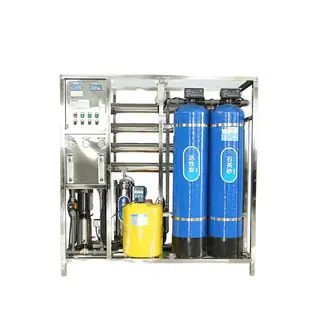
- High salinity, sodium, chloride or boron: reverse osmosis, often blended with raw water, such as a PLC groundwater desalination RO machine for greenhouse and hydroponic use.
- Hard water and carbonate scale: acid injection to lower pH, not filtration.
- Bacterial slime and algae in lines: periodic line treatment, such as chlorination where permitted, alongside good filtration.
Which filter equipment fits which farm?
- Surface water with algae: a backwash sand filtration system as the primary stage, followed by a disc or screen safety filter.
- Wells and mixed sources in greenhouses: an automatic backwash disc water filter system that flushes on pressure differential.
- Field systems with sand and silt: a centrifugal disc filter that combines sand separation with disc filtration.
Is an automatic or manual irrigation filter better?
Manual filters cost less and have no controller or flush valves to maintain, which makes them a sensible choice for small drip systems on clean water where someone checks the gauges at every irrigation. Their weakness is people: a manual filter left uncleaned during a busy week loads up, pressure falls at the emitters and uniformity suffers.
Automatic filters backflush on a pressure differential setpoint, with a timer as backup, so they keep working through algae blooms and unattended night irrigations. They are usually worth the extra cost when flow exceeds a few m³/h, when the water source is a pond or river, or when irrigation runs automatically from a controller. They do need a reliable minimum inlet pressure and, for most models, a small power supply for the controller.
How do you maintain irrigation filters?
- Every irrigation: read the pressure gauges before and after the filter. A rising differential means the filter is loading up.
- Manual filters: clean screens and discs when the differential rises by roughly 0.3–0.5 bar over the clean reading, or as the supplier specifies.
- Automatic filters: check that backflush cycles actually happen, that flush valves seal, and that inlet pressure stays high enough during flushing.
- Monthly: inspect screens for tears, discs for scale or biofilm, and seals for wear. Soak scaled discs in a suitable acid solution where recommended.
- Yearly or by condition: check sand media depth and condition, and top up or replace media as needed.
- Always: flush the ends of drip laterals regularly, because fine particles that pass any filter settle there.
What information do you need to buy irrigation filters?
- Water source and a recent water analysis
- Peak flow and operating pressure
- Emitter type and the manufacturer's required filtration rating
- Manual or automatic cleaning, and available power for controllers
- Space, pipe connection sizes and any plans to expand
Mars Vertical Farm builds disc, sand media and RO water-treatment equipment in its Shanghai factory under ISO 9001. Browse the irrigation, fertigation and water treatment range, or send us your water analysis and peak flow for a filter station recommendation.