Short answer
A smart irrigation controller decides when and how long to irrigate from data instead of a fixed clock. It adjusts run times from weather and evapotranspiration, soil moisture or greenhouse light sums, opens zone valves, starts the pump, and logs flow. For farms, flow monitoring, offline operation and suitable communication, such as cellular or long-range radio, matter more than app features.
What is a smart irrigation controller?
A smart irrigation controller is a timer that decides when and how long to irrigate from data rather than from a fixed clock schedule. It adjusts run times using weather, evapotranspiration (ET), soil moisture or flow readings, and it can usually be monitored and changed from a phone or computer.
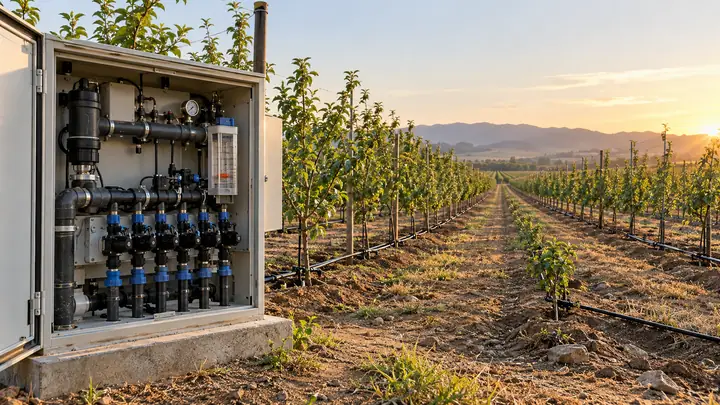
On a farm, in an orchard or in a greenhouse, the controller is the brain of an automatic irrigation system. It opens and closes zone valves, starts the pump, triggers fertilizer injection and records what actually happened. A basic timer only repeats a program. A smart controller changes the program when conditions change, stops irrigation when something goes wrong, and keeps a log you can use to plan water and fertilizer.
This guide explains how smart irrigation systems work, which sensors are worth paying for, how Wi-Fi, cellular and radio connections compare in the field, and how to choose a controller for irrigation system zones on a commercial site.
How do smart irrigation systems work?
Most smart irrigation technology follows the same loop: measure, decide, act and record.
- Measure. The controller reads inputs such as local weather data, a rain sensor, soil moisture sensors, a flow meter and pressure switches.
- Decide. It compares those inputs with the crop's water need. Weather-based units estimate daily water use from ET. Sensor-based units irrigate when soil moisture drops below a set threshold, or skip a scheduled cycle when the soil is still wet.
- Act. It energizes solenoid valves zone by zone, starts the pump or opens a master valve, and signals the fertigation unit to dose.
- Record. It logs run times, volumes and alarms. Cloud-connected models send this to an irrigation app so growers can see every block from one screen.
The US EPA's WaterSense program groups landscape smart controllers into two families: weather-based controllers and soil moisture-based controllers. Agricultural controllers use the same two principles, but they add pump control, fertigation outputs, flow monitoring and many more zones.
Weather-based vs. sensor-based control
| Control method | How it decides | Strengths | Limits | Best fit |
|---|---|---|---|---|
| Fixed timer | Runs the same program every day | Simple, cheap, reliable | Overwaters in cool or rainy periods, underwaters in heat waves | Small plots, backup control |
| Weather / ET-based | Adjusts run time from temperature, humidity, solar radiation, wind and rain data | Covers a whole farm with no buried sensors | Depends on the accuracy of the weather source and crop coefficients | Open fields, orchards, vineyards |
| Soil moisture-based | Starts or skips irrigation at a moisture threshold | Responds to what the roots actually see | Readings are local; sensors need careful placement and maintenance | Orchards, high-value field crops, substrate growing |
| Substrate / drainage-based | Triggers on accumulated light (radiation sum), substrate weight or drain percentage | Matches irrigation to plant transpiration under glass | Needs calibration per crop and substrate | Greenhouse tomatoes, cucumbers, strawberries |
| Hybrid | Combines ET, sensors and flow data with rules | Most robust; catches sensor faults | Higher cost and setup effort | Large farms with many zones |
Which sensors should a smart irrigation controller use?
Sensors are where most of the value comes from. Add them in this order on a commercial site:
- Flow meter. The most useful single sensor. It confirms that water actually reached each zone, detects burst laterals (high flow) and clogged emitters or closed valves (low flow), and gives you the volume per block for fertilizer accounting.
- Pressure sensor or switch. Protects the pump from running dry or against a closed valve, and helps diagnose dirty filters.
- Rain sensor for irrigation system shut-off. A simple rain sensor or a tipping-bucket rain gauge cancels or shortens cycles after rain. In open fields it is cheap insurance; under a greenhouse roof it is not needed.
- Soil moisture sensor for irrigation system scheduling. Capacitance or tensiometer-type sensors installed in the active root zone. In orchards, place them at two depths (for example around 30 and 60 cm) near a representative tree to see both the main root zone and deep drainage.
- Weather station or weather feed. An on-farm station gives better ET estimates than a distant public station, especially in valleys or near the coast.
- EC and pH sensors. Needed when the controller also manages fertigation. See our guide to fertigation and fertilizer injectors.
Soil moisture sensor irrigation only works well when sensors sit in a representative spot. Avoid placing them right under a single dripper, at the edge of a block, or in a low wet patch. For drip-irrigated trees, a common practice is to install sensors roughly 20–30 cm from an emitter, inside the wetted zone.
Wi-Fi irrigation controller or cellular? Choosing the connection
A WiFi irrigation controller is convenient near a house, packhouse or greenhouse office where a router already exists. In open fields it is usually the wrong choice, because Wi-Fi range is short and outdoor routers need power and protection. Match the connection to the site:
| Connection | Typical range | Power need | Good for |
|---|---|---|---|
| Wi-Fi | Tens of meters, more with outdoor access points | Mains power | Greenhouses, nurseries, sites next to buildings |
| Cellular (4G / LTE-M / NB-IoT) | Anywhere with mobile coverage | Mains or solar plus battery | Remote pump stations, scattered fields |
| Long-range radio (e.g. LoRa) | Often several kilometers in open terrain, depending on obstacles | Battery or small solar panel at each node | Large farms with many valve and sensor points |
| Wired (24 VAC or two-wire decoder) | Limited by cable length and voltage drop | Central controller power | Greenhouses, compact orchard blocks |
A good rule: put the main controller where there is reliable power and signal, usually at the pump and filter station, and use radio nodes or two-wire decoders to reach distant valves. A smart WiFi irrigation controller in the greenhouse office and a cellular gateway at the field pump can then report to the same platform. A WiFi drip irrigation controller is fine for a single greenhouse; a multi-site farm normally needs cellular or radio.
What does a smart irrigation system in agriculture include?
Smart irrigation systems in agriculture are more than a timer. A typical automatic irrigation system for a farm or greenhouse has these parts:
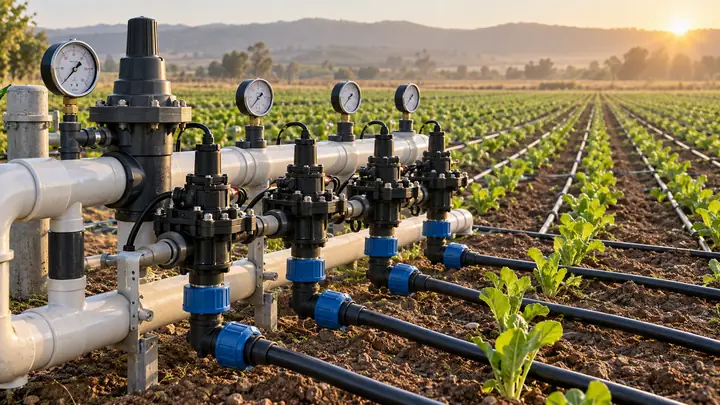
- Controller with enough zone outputs, pump start and master valve relays, and inputs for flow, pressure and sensors.
- Valves: solenoid or hydraulic valves, one per zone. DC latching solenoids are used where valves run from batteries or solar power. Our irrigation valves guide covers types and sizing.
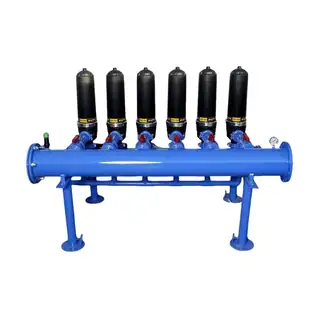
- Pump and filter station with automatic backwash, which the controller can trigger by time or pressure difference. Units such as an automatic backwash disc filter system are usually wired to the same controller.
- Fertigation unit with dosing channels and EC/pH control, often integrated into the controller.
- Distribution network: mains, sub-mains, drip lines or micro-sprinklers.
- Software: local display plus an irrigation app or web dashboard for scheduling, alarms and reports.
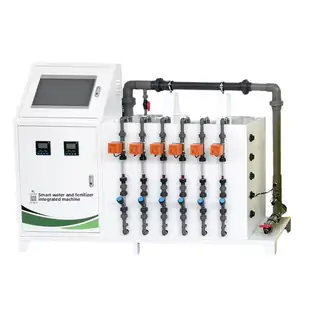
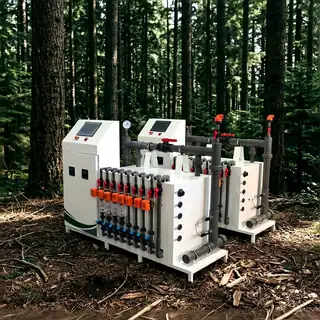
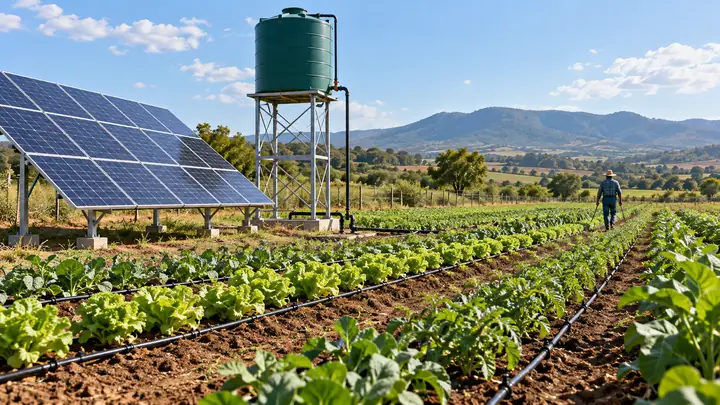
Integrated machines combine several of these. A smart fertigation machine with dosing pump handles zone scheduling and nutrient dosing in one cabinet, while an IoT farmland irrigation and fertilization system adds remote monitoring for open fields. For sites with no grid power, see solar-powered irrigation systems.
Do timers for drip irrigation systems need special settings?
Yes. Timers for irrigation systems were often designed for sprinklers, which run for minutes. Drip runs longer at lower flow, and it benefits from short, repeated pulses on light soils and in substrate. When choosing timers for drip irrigation systems, check that the controller can:
- Run several start times per day (pulse irrigation), and short cycles of a few minutes for substrate crops.
- Sequence zones so the pump always runs within its efficient flow range.
- Delay fertilizer injection until the lines are full, and stop it before the end so lines are flushed with clean water.
- Handle a master valve and pump start relay with adjustable delays.
- Shut a zone down on a high-flow or low-flow alarm.
Battery-operated tap timers and the simple automatic irrigation system electronic water timer sold for gardens can work for a trial plot, but they lack flow monitoring and pump control. For more on scheduling drip, read our drip irrigation system guide.
How do I choose the best smart irrigation controller for a farm?
The best smart irrigation controller for a commercial grower is the one that fits the hydraulics and the connectivity of the site, not the one with the most app features. Work through this checklist:
- Count zones and plan for growth. List every valve you will run now and in the next few years, and add roughly 20–30% spare outputs or choose an expandable system.
- Define the control method. Decide between ET, soil moisture, radiation sum or a hybrid, based on crop and climate.
- Check valve compatibility. Confirm voltage (24 VAC, 12 V DC or DC latching), maximum number of valves open at once, and cable distances.
- Plan the communication. Wi-Fi near buildings, cellular or radio in the field, wired in greenhouses.
- Require pump and safety logic. Pump start relay, master valve, flow and pressure alarms, and dry-run protection.
- Decide on fertigation integration. Either the controller runs the dosing unit directly, or it sends a start signal to a separate fertigation controller.
- Check power. Mains, solar with battery, or engine-driven pump stations each need a different setup.
- Insist on local control. The controller must keep running its program if the internet or cloud service is down.
- Look at data export and service. You should be able to export logs, and get spare parts and firmware support for many seasons.
Top-rated WiFi irrigation controllers in consumer reviews are usually judged on app design and ease of setup. For a farm, reliability, offline operation, alarm handling and spare parts matter far more.
How does control differ in greenhouses, orchards and open fields?
Greenhouses
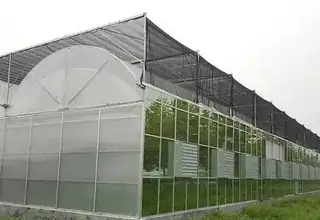
Greenhouse crops in substrate are irrigated many times per day in small doses. Controllers usually start irrigation from accumulated solar radiation, with a minimum and maximum interval, and use drain percentage or substrate weight to fine-tune. Climate and irrigation control are often combined, as in an IoT polycarbonate gear greenhouse. Our greenhouse irrigation system guide goes deeper.
Orchards and vineyards
Blocks are large and irrigation is less frequent. ET-based scheduling combined with soil moisture sensors at two depths is a common approach, together with flow monitoring to catch leaks from damaged laterals. See drip irrigation for orchards and fields.
Open fields
Field crops need robust hardware, long-range communication and rain sensing. Mobile pump and fertigation units are often moved between plots, so the controller should be easy to reconfigure.
What are common mistakes with automatic irrigation controllers?
- Setting a summer program and never adjusting it, which is exactly what smart control is meant to avoid.
- Relying on one soil moisture sensor for a large, variable block.
- Running without a flow meter, so leaks and blocked zones go unnoticed for days.
- Buying a WiFi irrigation system for a field kilometers from the nearest router.
- Forgetting lightning and surge protection on long field cables.
- Not training staff to read alarms and override safely.
Planning a controller for your site
Mars Vertical Farm has 20+ years of production experience and supplies CE-marked irrigation and fertigation equipment from its Shanghai factory. Browse the irrigation, fertigation and water treatment range, or send us your zone list, water source and crop plan for a controller and fertigation proposal.