Short answer
Size a fertigation system from the peak flow of your largest irrigation zone: count emitters, multiply by emitter flow, and add a margin. Then choose dosing channels that can inject each stock solution at that flow divided by your stock concentration ratio, usually two fertilizer channels (A and B) plus one acid channel for pH, with roughly 25–50% spare capacity.
What sets the size of a fertigation system?
A fertigation unit mixes concentrated fertilizer stock into irrigation water so that the water leaving the unit has the target EC (electrical conductivity, a proxy for nutrient concentration) and pH. Its size is set by three numbers:
- Peak flow of the largest zone that irrigates at one time, in m³/h.
- Stock concentration ratio, such as 1:100, which tells you how much stock to inject per liter of water.
- Number of separate stock solutions you need to keep apart, which sets the number of dosing channels.
Total farm area matters only indirectly. A 5-hectare farm irrigated in ten small zones can use a smaller unit than a 2-hectare greenhouse irrigated in two large ones.
Step 1: How do I calculate peak zone flow?
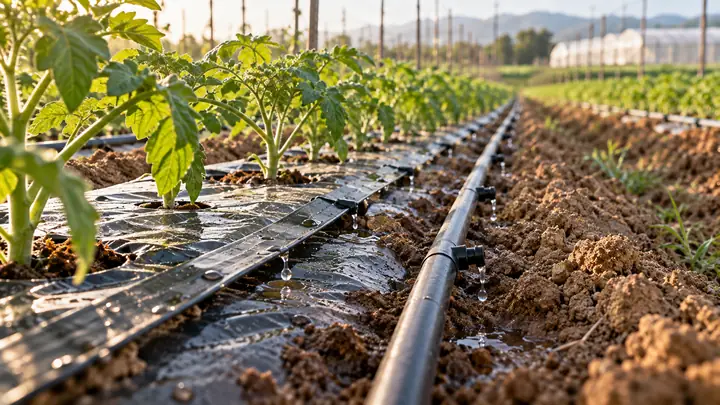
Multiply the number of emitters in the largest zone by the emitter flow rate.
Example: a greenhouse zone has 2,000 drippers at 2 L/h each, which gives 4,000 L/h, or 4 m³/h. Add about 10% for emitter variation and flushing, and design for roughly 4.4 m³/h.
For NFT or recirculating systems, use the pump flow to the channels or the make-up water flow into the nutrient tank, whichever the dosing unit treats. Our guide to NFT, DWC and Dutch bucket systems gives typical channel flows.
Step 2: How much stock solution must each channel inject?
Divide zone flow by the stock concentration ratio.
- At 4.4 m³/h (4,400 L/h) and a 1:100 stock, each fertilizer channel must inject about 44 L/h.
- At 1:200, it drops to about 22 L/h, but the stock is more concentrated and harder to dissolve, especially in cold water.
Choose injectors so normal operation sits at roughly 50–80% of their maximum. That leaves room to raise EC as plants grow and to irrigate larger zones later. In this example, a channel rated around 60–80 L/h would be a sensible choice at 1:100.
Step 3: How many dosing channels do I need?
Most commercial systems use three to five channels:
- Channel A: calcium nitrate and iron chelate.
- Channel B: phosphates, sulfates (such as magnesium and potassium sulfate) and micronutrients.
- Acid channel: nitric or phosphoric acid to lower pH and neutralize bicarbonate alkalinity.
- Optional C channel: an extra fertilizer, such as potassium for fruiting stages, or a second recipe for another crop.
- Optional base channel: potassium hydroxide where water is very soft and pH must be raised.
A and B are kept apart because calcium reacts with sulfate and phosphate in concentrated form and forms insoluble precipitates that clog emitters and waste nutrients. Once diluted in irrigation water, they mix safely.
Which injector type should I choose?
| Injector type | How it works | Strengths | Limits | Typical fit |
|---|---|---|---|---|
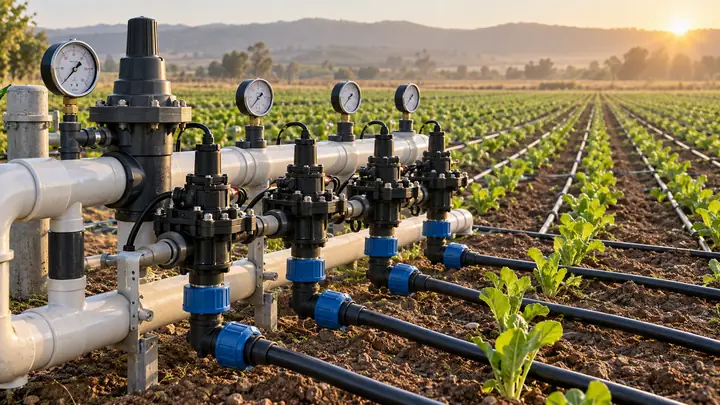
| Venturi | Pressure difference draws stock into the main line | No moving parts, low cost | Causes pressure loss; rate shifts with line pressure unless controlled | Field units, smaller greenhouses with automatic valves on each channel |
| Water-powered proportional | Water flow drives a piston that injects a fixed ratio | No electricity; ratio follows flow | Fixed ratio per unit; limited flow range | Small sites, simple recipes |
| Electric dosing pump | Diaphragm or piston pump controlled by EC/pH controller | Accurate, easy to automate | Needs power and maintenance of valves and diaphragms | Greenhouses, plant factories |
| Batch mixing tank | Fertilizer mixed into a tank, then pumped out | Simple to understand, stable EC | Large tanks; slow to change recipes | Recirculating systems, small farms |
Step 4: How should EC and pH be controlled?
Start with a lab analysis of your source water. Two values matter most:
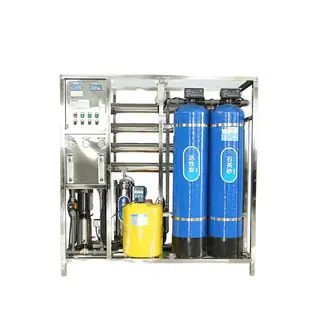
- Source water EC. Fertilizer adds to it. If your target is EC 2.0 mS/cm and the water is already 0.5, fertilizer can only add 1.5. If source EC is high, or sodium, chloride or boron are high, consider treatment such as an industrial RO unit and blend RO water with raw water.
- Alkalinity (bicarbonates). This, not starting pH, decides how much acid you need. Hard, alkaline water needs a larger acid channel.
For control, place EC and pH sensors after a mixing point, either a mixing tank or an inline static mixer, so readings reflect fully mixed water. Use dual sensors on critical lines, set high and low alarms that stop irrigation, and calibrate on a fixed schedule, commonly weekly for pH and every one to two weeks for EC.
What EC and pH targets are typical by crop?
| Crop | Typical EC (mS/cm) | Typical pH |
|---|---|---|
| Lettuce and leafy greens | 1.2–1.8 | 5.5–6.2 |
| Basil and herbs | 1.0–1.6 | 5.5–6.5 |
| Strawberry | 1.2–2.0 | 5.5–6.2 |
| Cucumber | 1.8–2.5 | 5.5–6.2 |
| Tomato | 2.0–3.5 | 5.5–6.5 |
These are starting ranges. Adjust for variety, growth stage, light level and drainage readings.
Step 5: How do I size the pump and pressure?
The irrigation pump must deliver peak zone flow at a pressure that covers:
- Emitter operating pressure (often roughly 1–2 bar for drip; check the emitter data sheet)
- Friction loss in mains, sub-mains and laterals
- Elevation change between pump and the highest emitter
- Losses across filters (allow for a dirty filter, not a clean one) and valves
- Injector losses, which are significant for venturi designs
Place filtration before the injection point to protect the injectors, and add a fine screen after injection to catch any precipitate. See disc vs. sand media vs. screen filters for choosing the main filter.
Which equipment fits which farm?
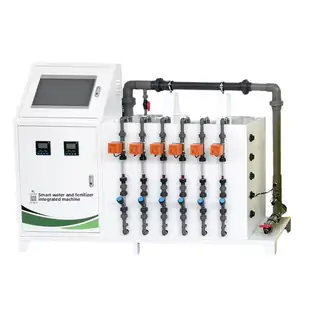
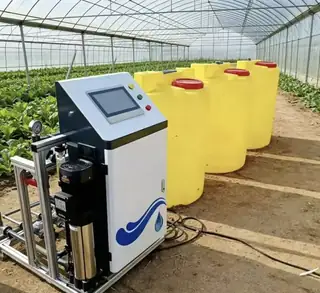
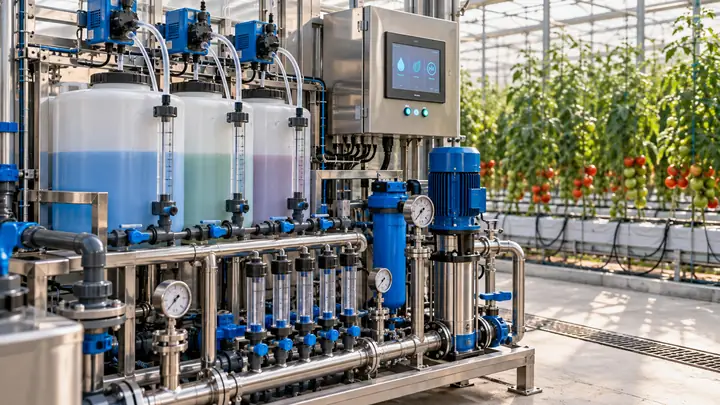
- Greenhouses and plant factories: an automatic unit with dosing channels, EC/pH control and zone scheduling, such as our smart fertigation machine with intelligent dosing.
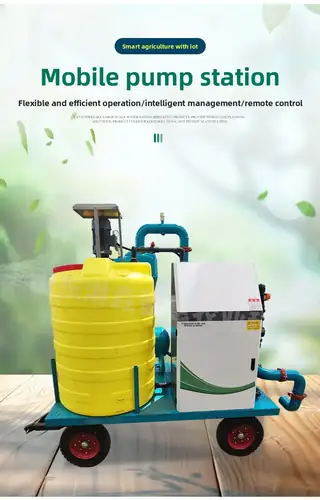
- Open fields and orchards with several plots: a mobile integrated water-fertilizer unit that can be towed between pump points.
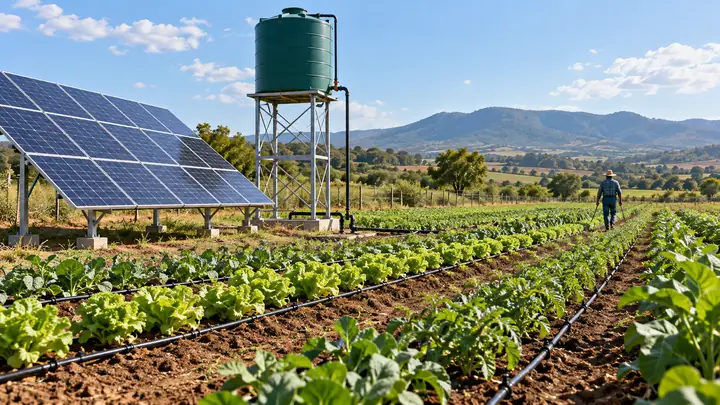
- Sites without grid power: an engine-powered irrigation and fertilization system.
See the full irrigation, fertigation and water treatment range, or send us your zone layout, emitter type and water analysis for a sized proposal.