Short answer
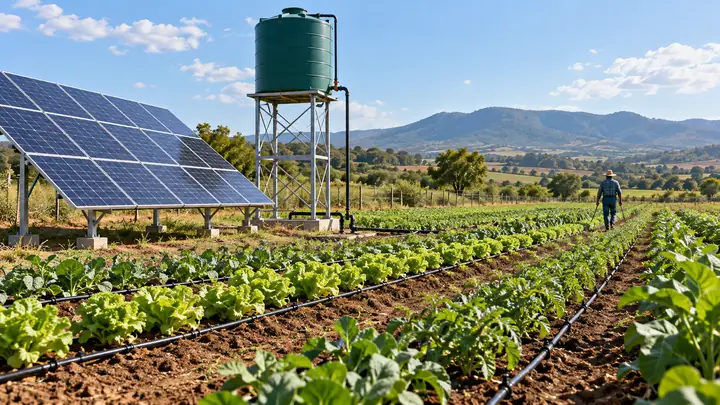
A solar irrigation system uses PV panels to power a pump that delivers water to crops, usually through drip lines. Size it from peak daily water demand, total head and the worst month's sun hours. Many farms pump into an elevated tank and irrigate by gravity, which stores water instead of electricity but needs low-pressure drip components.
What is a solar irrigation system?
A solar irrigation system uses photovoltaic (PV) panels to power a water pump that lifts water from a well, river, pond or tank and delivers it to crops, usually through drip irrigation. Because it runs on sunlight, it removes fuel costs and grid dependence, which makes it attractive for remote fields, smallholder farms and regions with expensive or unreliable power.
Solar pumping pairs naturally with drip irrigation: both work best with steady, moderate flows, and drip's high efficiency means a smaller pump and fewer panels for the same crop. Where the terrain allows, solar pumping is often combined with an elevated tank and gravity drip irrigation, so plants can be watered when the sun is not shining. This guide explains how a solar powered drip irrigation system works, how to size one, and when gravity fed irrigation or rain barrel irrigation is enough on its own.
How does a solar powered drip irrigation system work?
A typical solar drip irrigation system has six parts:
- PV array: panels sized to the pump's power demand, mounted to face the sun, sometimes on a manual or automatic tracker to extend pumping hours.
- Pump controller or inverter: matches the variable output of the panels to the pump. Many solar pump controllers vary pump speed with sunlight and include dry-run and tank-full protection.
- Solar water pump: a submersible pump for boreholes, or a surface pump for shallow wells, ponds and canals. DC pumps suit small systems; AC pumps with a solar inverter are common above a few kilowatts.
- Storage: an elevated or ground tank that stores water instead of storing electricity, or a battery bank where irrigation must run at night.
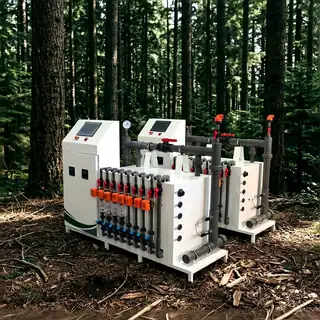
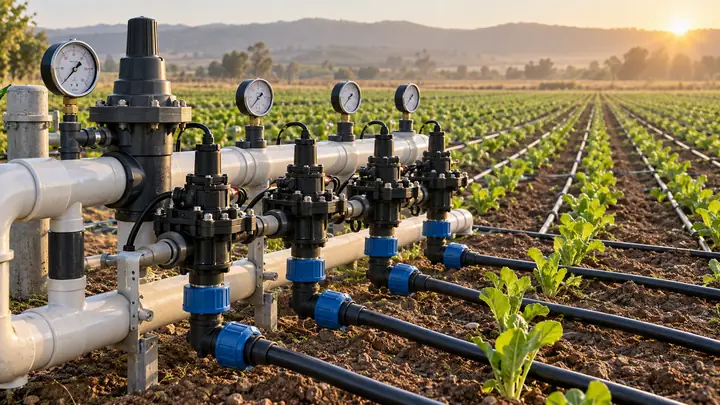
- Head unit: filter, optional fertilizer injector, pressure regulator and valves.
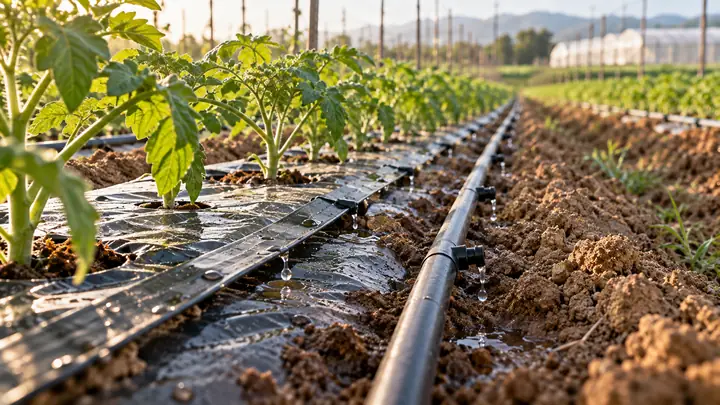
- Distribution: mains, sub-mains and drip lines or drip tape.
Which solar irrigation configuration should you choose?
There are three common layouts. The choice depends on how much pressure your drip system needs, the field size and whether you must irrigate outside sunny hours.
| Configuration | How it works | Strengths | Limits | Best fit |
|---|---|---|---|---|
| Direct pumping to drip | The pump feeds the drip system directly while the sun shines | Simplest and cheapest; no tank | Flow and pressure vary with sunlight; irrigation only by day | Pressure-compensating drip on small to medium plots in sunny climates |
| Solar pump to elevated tank, then gravity drip | The pump fills a tank; drip runs by gravity | Water storage replaces batteries; irrigate any time | Low pressure limits zone size; tank and stand cost | Smallholdings, vegetables, sloping sites |
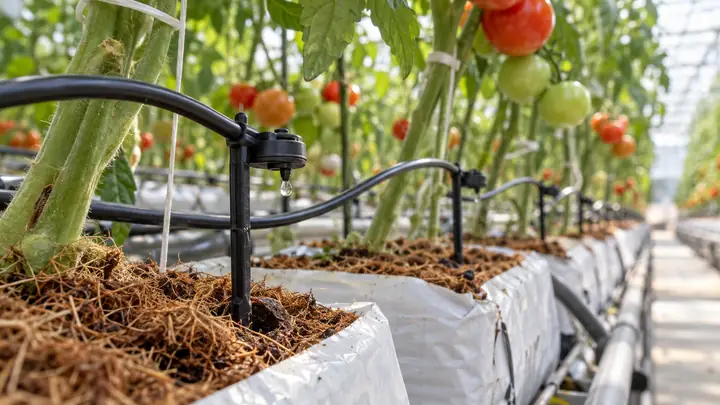
| Solar pump with battery or hybrid supply | Batteries or grid/generator back up the PV array | Stable pressure; irrigation on any schedule | Highest cost; batteries need replacement | Greenhouses, high-value crops, automated fertigation |
For most open-field drip systems, storing water in a tank is cheaper and longer-lasting than storing electricity in batteries.
How do you size a solar water pump irrigation system?
Sizing works backwards from the crop's water demand on the hottest days. A simplified method:
- Estimate peak daily water need. Multiply area by the peak crop water use. As an illustration, 0.5 ha of vegetables using roughly 5 mm per day needs about 25 m³ per day. Local crop evapotranspiration data from an extension service gives better figures.
- Find the total dynamic head. Add the vertical lift from the water level (at its lowest seasonal point) to the tank or field, friction losses in pipes and fittings, and the pressure the drip system needs (roughly 10 m of head per bar).
- Divide by effective pumping hours. Peak sun hours vary by location and season, often about 4–6 hours. At 5 hours, 25 m³ per day means a pump delivering about 5 m³/h.
- Calculate pump power. Hydraulic power is flow times head times water density times gravity. For 5 m³/h at 40 m of head, that is roughly 0.55 kW. Divide by a realistic wire-to-water efficiency, which depends heavily on pump type and size, to get the electrical input.
- Size the PV array. Panels rarely deliver their nameplate rating in the field because of heat, dust and angle, so arrays are typically oversized by around 20–50% over the pump input. In this example, that leads to an array in the region of 1.5–2 kWp.
- Check the worst month. Size for the month with the highest water demand relative to sunshine, not for the annual average.
Choosing efficient drip irrigation reduces every number in this chain. Our guide on how to design a drip irrigation system covers zone flows and lateral layout in more detail.
What is gravity drip irrigation?
Gravity drip irrigation uses the height of a water tank, rather than a pump, to push water through drip lines. Each meter of height gives roughly 0.1 bar (about 1.4 psi) of pressure, so a tank on a 2 m stand provides only about 0.2 bar at the outlet before friction losses. That is far below the 1 bar or so that many standard drippers are designed for.
A gravity fed drip irrigation system therefore needs components designed for low pressure:
- Low-pressure drip tape or emitters with larger passages that perform at low head; ordinary pressure-compensating drippers often do not open properly below their minimum pressure.
- Short laterals and generous pipe diameters to keep friction small, because every bit of lost pressure matters.
- Low-loss filters, cleaned often, since a partly blocked filter can consume most of the available head.
- Level or gently sloping fields; downhill laterals gain pressure, uphill ones lose it.
A gravity fed irrigation system is simple, silent and very reliable. Its limit is area: one tank and low pressure can only supply a modest number of emitters at a time, so larger farms divide the field into small zones irrigated in turn. For crop-specific layouts, see drip irrigation for vegetables and small farms.
Does rain barrel drip irrigation work?
Rain barrel irrigation is gravity drip at the smallest scale. A barrel collecting roof runoff, raised on blocks, can feed a short drip line or soaker line for a few beds. It works best when:
- the barrel is raised as high as practical and the beds are close by;
- a fine screen is fitted at the outlet, because roof water carries grit and organic debris;
- the drip components are rated for low pressure, or a small rain barrel drip irrigation pump boosts pressure.
A small solar powered water pump for garden irrigation, combined with a solar water irrigation timer, turns a rain barrel drip system into an automatic one. For commercial growers, the same principle scales up to rainwater ponds and tanks feeding a solar pump.
How do filtration and fertigation work with solar and gravity systems?
Low-pressure systems are less tolerant of losses, so the head unit needs care:
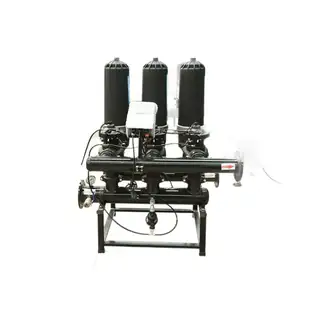
- Filtration: pond and rainwater sources usually need disc or media filtration ahead of the drip lines, and the filter's pressure loss must fit within the available head. Automatic backflushing filters need a minimum inlet pressure, which gravity systems may not provide. See the irrigation filters guide, and for solar-pumped systems with enough pressure, a unit such as an automatic gear disc filter.
- Fertigation: venturi injectors need a significant pressure difference, which can be scarce in solar-direct and gravity systems. Fertilizer can instead be mixed in the storage tank, or injected with a small proportional or electric dosing pump. Our article on fertigation and fertilizer injectors compares the options.
- Control: solar-compatible controllers and battery-powered valve timers can automate zones without mains power. See smart irrigation controllers for features that matter, such as low-power operation and tank-level inputs.
What are the advantages and limits of solar powered irrigation?
Advantages:
- No fuel cost and low running cost once installed.
- Works far from the grid and avoids fuel logistics.
- Pumping peaks on hot, sunny days, which is when crops need the most water.
- Few moving parts compared with an engine pump; low noise and no exhaust.
Limits:
- Higher upfront cost than an engine pump, driven by panels, pump, controller, mounting and any tank or batteries.
- Output falls on cloudy days and in winter, so storage or backup may be needed.
- Panels need security against theft and regular cleaning in dusty areas.
- Cheap pumping can encourage over-extraction of groundwater. FAO recommends pairing solar irrigation with water management plans so that low running costs do not lead to aquifer depletion.
Where sunshine is limited, demand is very high or pumping must run around the clock, an engine-driven unit such as an engine-powered IoT irrigation system, or a hybrid with solar, may be more practical.
Can solar pumps run greenhouse and hydroponic irrigation?
Yes, but with caution. Greenhouse drip and recirculating hydroponics need water on a fixed schedule, often several times a day and sometimes after dark. A solar powered water pump for hydroponics therefore normally needs battery storage or a grid connection as backup. A pump failure in an NFT channel on a hot afternoon can damage a crop within hours, so redundancy is more important than in field irrigation.
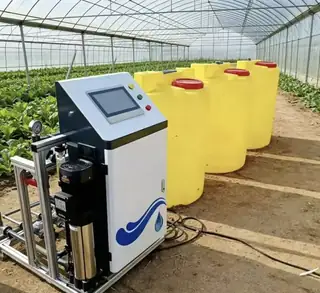
For multi-zone farms that want scheduling, fertigation and remote monitoring in one package, an integrated head unit such as our IoT farmland irrigation and fertilization system can be supplied by a solar or hybrid power source if its power demand is included in the PV sizing.
Solar and gravity irrigation planning checklist
- Water source type, seasonal water level and recovery rate of the well
- Peak daily water need for the crop and area
- Total dynamic head, including drip operating pressure
- Local peak sun hours in the worst month
- Whether irrigation must run at night or on cloudy days
- Available tank height and capacity for gravity drip
- Filtration and fertigation needs, and their pressure losses
- Local permits for water abstraction
Mars Vertical Farm supplies drip irrigation head units, filters and fertigation equipment from its Shanghai factory and exports to markets including Brazil, South Africa, Saudi Arabia, Vietnam and Australia. Browse the irrigation, fertigation and water treatment range, or send us your field size, water source and head for a matched head-unit proposal.