Short answer
An irrigation valve starts, stops or regulates water flow and pressure. Drip systems typically use a manual main shut-off valve, solenoid or hydraulic control valves for each zone, a pressure reducing valve to keep emitters within their rated pressure, a relief valve against surges, a check or backflow valve, and air and flush valves. Size each valve by flow, not pipe size.
What is an irrigation valve?
An irrigation valve is a device that starts, stops or regulates the flow and pressure of water in an irrigation system. Valves divide a farm into zones, protect pipes and emitters from excess pressure, prevent backflow into the water source and let air in and out of the pipe network.
A typical drip system uses several kinds: a main shut off valve, automatic irrigation control valves for each zone, a pressure reducing valve, a pressure relief valve, air valves and flush valves. Choosing the right irrigation system valve for each job, and sizing it by flow, makes the difference between even watering and burst laterals or starved zones. This guide explains each type, where it goes, how to size it, and how to fix common problems.
What types of irrigation valves are there?
| Valve type | What it does | Typical location | Operation |
|---|---|---|---|
| Manual shut-off (ball, gate, butterfly) | Isolates the system or a section for maintenance | After the pump, before filters, at each zone | Hand lever or wheel |
| Solenoid control valve | Opens and closes a zone on command | Zone manifold or head of each block | Electric solenoid with controller or timer |
| Hydraulic control valve | Opens and closes or regulates using line pressure and command tubes | Large mains and field blocks | Hydraulic command, often with a solenoid pilot |
| Pressure reducing or regulating valve | Holds downstream pressure at a set value | After the zone valve or at the head of laterals | Automatic, spring or pilot controlled |
| Pressure relief valve | Releases water when pressure exceeds a set point | Pump discharge, mains, before sensitive equipment | Automatic, spring loaded |
| Check valve and backflow preventer | Stops reverse flow toward the pump or water supply | Pump discharge and upstream of fertilizer injection | Automatic |
| Air release and vacuum relief valve | Lets air out on filling and in on draining | High points, after the pump, ends of mains | Automatic float |
| Flush valve | Opens at the end of laterals or sub-mains to clear sediment | Line ends | Manual or automatic |
How does an irrigation solenoid valve work?
Most automatic zone valves are pilot-operated diaphragm valves. A rubber diaphragm separates the inlet from the outlet. A small bleed hole lets inlet water fill the chamber above the diaphragm; because the area above is larger, the pressure holds the diaphragm closed. When the controller energizes the solenoid, a plunger lifts and vents the upper chamber to the outlet side. Pressure above the diaphragm drops, line pressure pushes it up, and water flows. When power stops, the plunger reseals and the valve closes.
Key irrigation valve parts and features to understand:
- Solenoid: commonly 24 V AC on mains-powered controllers. DC latching solenoids need only a short pulse to open or close, which suits battery, solar and wireless irrigation valve controllers.
- Diaphragm and bonnet: the main wear parts; debris on the diaphragm seat is the most common cause of leaks.
- Flow control handle: limits how far the diaphragm opens, useful for throttling or for slowing closing to reduce water hammer.
- Manual bleed: an external bleed screw or internal bleed lever lets you open the valve without the controller for testing.
- Minimum flow and pressure: pilot valves need some pressure difference to close reliably. Small drip zones with very low flow need a valve rated for low flow, or the valve may chatter or fail to close.
Solenoid valves for an irrigation system are typically installed in globe or angle patterns, in plastic for small zones and in reinforced plastic or metal for larger mains.
Do you need a pressure reducing valve for drip irrigation?
In most cases, yes. Drip emitters and drip tape are designed for a limited pressure range, often roughly 0.5–2.5 bar depending on the product, while pumps and municipal mains can deliver much more. Excess pressure blows fittings off, splits thin-walled tape and makes non-compensating emitters over-water the first part of each line.
- Preset pressure regulators are simple, inexpensive and have a fixed outlet pressure. They suit small drip zones and garden systems, often combined with a filter in one assembly.
- Adjustable pressure reducing valves let you set the downstream pressure and handle larger flows. Pilot-operated versions hold pressure accurately over a wide flow range.
- Combined control valves integrate on/off control and pressure regulation in one hydraulic or solenoid valve, which is common on field blocks.
Place the pressure reducing valve after the zone valve and filter, so that it regulates pressure only for the zone that is running. On sloping fields, each block may need its own irrigation pressure regulating valve to keep pressure even. Our guide on how to design a drip irrigation system shows how pressure targets feed into lateral length and zone layout.
What does an irrigation pressure relief valve do?
A pressure relief valve opens and releases water when pressure rises above a set point, then closes again when pressure falls. It protects pipes, filters and fittings from pressure surges caused by valves closing quickly, a pump starting against a closed line, or a regulator failing.
Set the relief valve somewhat above normal operating pressure but below the pressure rating of the weakest component downstream. Install it at the pump discharge and, on long mains, near points where surges build up. A relief valve is not a substitute for a pressure reducing valve: one lowers working pressure continuously, the other only acts in an emergency.
Where do valves go in a drip irrigation system?
A typical sequence from water source to emitters looks like this:
- Pump discharge: check valve, pressure relief valve and air release valve.
- Main irrigation valve: a manual shut off valve for the whole system, so it can be isolated for repairs.
- Backflow preventer where required, upstream of any fertilizer injection.
- Filter station with isolating valves around each filter. See the irrigation filters guide.
- Fertilizer injector or fertigation unit. See fertigation and fertilizer injectors.
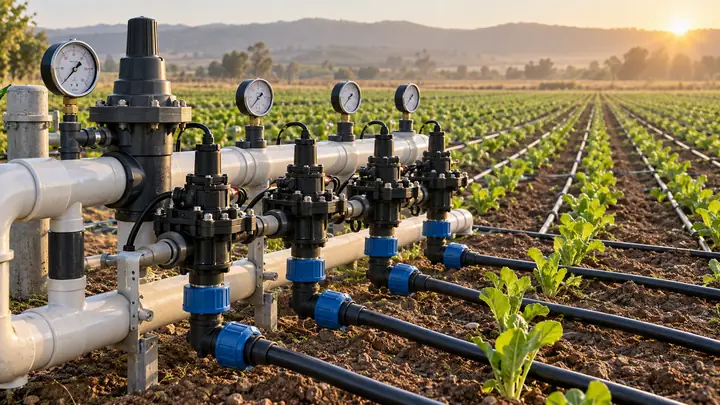
- Zone control valves: one solenoid or hydraulic irrigation control valve per zone, ideally grouped on a manifold with a manual isolation valve ahead of each.
- Pressure reducing valve after each zone valve, where needed.
- Air and vacuum relief valves at high points of sub-mains, and flush valves at the ends of laterals or sub-mains.
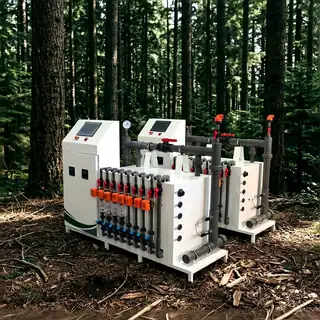
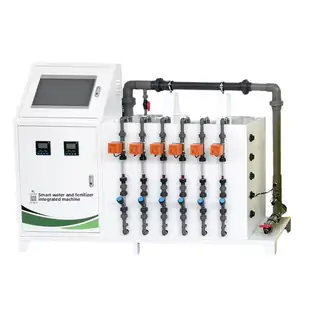
In greenhouses, the head unit often bundles filtration, fertigation and zone valves in one skid, such as our smart fertigation machine with dosing pump, with zone valves controlled by the same unit. The greenhouse irrigation system guide shows typical greenhouse layouts.
How do you size an irrigation valve?
Size valves by flow and pressure loss, not by matching the pipe size. A valve that is too large for the flow can fail to close reliably or regulate poorly; one that is too small wastes pressure.
- Calculate zone flow from emitter count and emitter flow.
- Check the valve's flow range, including its minimum. Low-flow drip zones are a common case where a 1 inch irrigation valve on a 1 inch pipe is still too large for the flow.
- Read the pressure-loss curve. Many designers aim to keep loss across a control valve to a small fraction of a bar at design flow, but the acceptable figure depends on how much pressure the system has to spare.
- Add the regulator's loss if a pressure reducing valve is fitted, because regulators need a minimum pressure difference to work.
- Match materials and pressure ratings to the water, fertilizer and acid in the line.
As a broad guide, 3/4 and 1 inch valves serve small drip and greenhouse zones, 1 1/4 to 2 inch valves serve larger zones and sub-mains, and 3 inch and above are used on field mains. Always confirm against the manufacturer's data for the specific valve.
Are wireless and smart irrigation valves worth it?
Wireless, wifi and bluetooth irrigation valves remove the need to trench control cables to each zone. Battery or solar powered units with DC latching solenoids receive commands by radio or a gateway, and many report flow or valve status back. They are useful for remote blocks, orchards with long distances between zones, and retrofits where cabling is impractical.
Points to check are radio range across your terrain, battery life, how the valve fails if communication is lost (it should close) and integration with your controller. Larger farms often combine cabled valves near the head unit with wireless irrigation solenoid units on distant blocks. The smart irrigation controllers guide covers scheduling and sensor options, and multi-zone farms can use an integrated IoT farmland irrigation and fertilization system to control valves, fertigation and monitoring together.
How do you troubleshoot an irrigation valve that will not open or close?
Valve will not close
- Debris trapped under the diaphragm or in the bleed port: isolate, open the bonnet and clean.
- Manual bleed screw or lever left open.
- Torn or hardened diaphragm: replace it.
- Flow below the valve's minimum, or valve installed backwards: check the flow arrow and the rating.
- Controller still sending power: disconnect the solenoid wire to test.
Valve will not open
- No power at the solenoid: check voltage with a meter at the valve and the controller output.
- Failed solenoid coil: test resistance against the supplier's specification or swap with a known good one.
- Flow control handle closed down too far.
- Isolation valve upstream closed, or a blocked filter starving the zone.
What maintenance do irrigation valves need?
- Exercise manual shut-off valves a few times per season so they do not seize.
- Inspect zone valves for weeping, and clean diaphragms and filters on the pilot circuit as needed.
- Check pressure regulators with a gauge at the start of the season; replace those that drift.
- Test relief valves by watching the gauge during start-up surges.
- Drain valves and pipes, or blow them out, where freezing is a risk.
- Keep valve boxes clear of soil and insects, and keep spare diaphragms and solenoids for the most common sizes.
Mars Vertical Farm supplies complete irrigation head units with filtration, fertigation and zone valves from its Shanghai factory. Browse the irrigation, fertigation and water treatment range, or send us your zone list and pressure data for a valve and head-unit proposal.