Short answer
Drip emitters are small devices that release water from a pressurized line at a slow, set rate, usually about 0.5 to 8 liters per hour. Inline emitters are built into drip line or tape; online emitters are punched into blank tubing. Pressure compensating emitters keep flow constant on slopes and long rows, and anti-drain emitters keep lines full between cycles.
What are drip emitters?
Drip emitters, also called drippers, are small devices that release water from a pressurized line at a slow, controlled rate, usually between about 0.5 and 8 liters per hour. They do this by forcing water through a narrow, labyrinth-shaped path that absorbs pressure, so each emitter delivers a predictable flow directly to the root zone.
Emitters are the working end of every drippers irrigation system. The right drip irrigation emitter, matched to crop, soil, water quality and pressure, gives even watering for years. The wrong one clogs, drips unevenly or keeps leaking after the pump stops. This guide covers drip irrigation emitter types, flow rates, pressure compensating and adjustable models, emitters for trees and pots, and the fittings that connect everything.
What are the main drip irrigation emitter types?
Drip system emitters fall into two physical groups, inline and online, and several functional types.
Inline emitters
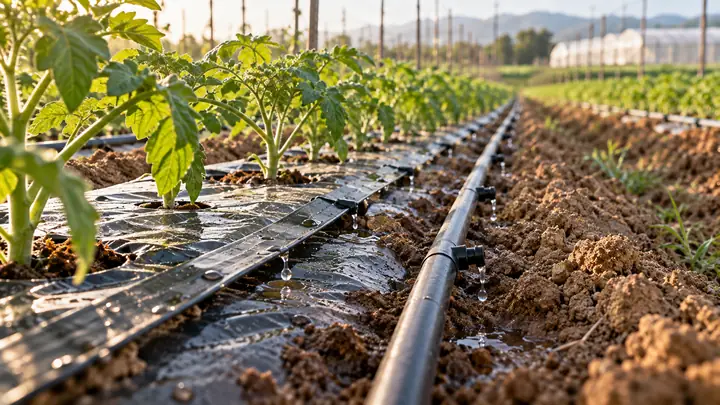
Inline drip emitters are built into the tubing during manufacture, at fixed spacing. Drip line and drip tape both use inline emitters. They are fast to install, protected inside the pipe and the most economical choice on large blocks with regular plant spacing. Our drip tape vs. drip line guide compares the two lateral types.
Online (button) emitters
Online emitters are pushed into holes punched in blank drip emitter tubing, exactly where needed. They are used for trees, containers, nursery beds and hydroponic substrate systems. They can feed a micro tube leading to a stake, so one lateral can water plants on both sides of a row.
Functional types
- Non-compensating (turbulent-flow) emitters: flow rises with pressure. Cheaper; fine on flat ground with short runs.
- Pressure compensating (PC) emitters: a flexible diaphragm keeps flow nearly constant across a pressure range, commonly from around 0.5–1 bar up to about 3.5–4 bar. Essential on slopes, long runs and wherever every plant must get the same volume.
- Anti-drain or check-valve (CNL) emitters: close below a set pressure so lines stay full after shutdown. They prevent puddles at low points and make short pulse irrigation in substrate accurate.
- Adjustable drip emitters: a cap or vortex lets you vary flow from near zero to a high rate. Handy for mixed plantings, but less uniform and harder to standardize on commercial blocks.
- Multi-outlet emitters: one emitter splits into several micro tubes, useful for large pots or trees.
- Dripper stakes: an emitter or labyrinth stake pushed into the substrate of a pot, bag, slab or bucket, fed by a micro tube.
Drip emitter types compared
| Emitter type | Flow vs. pressure | Typical flow | Clog resistance | Best use |
|---|---|---|---|---|
| Inline non-PC (drip line / tape) | Rises with pressure | 0.6–4 L/h | Good with turbulent labyrinth | Flat fields, short rows, vegetables |
| Inline PC | Nearly constant in rated range | 0.6–4 L/h | Good; many are self-flushing | Orchards, slopes, long rows, greenhouses |
| Online PC button | Nearly constant | 1–8 L/h (about 0.25–2 gph) | Good | Trees, pots, buckets, irregular spacing |
| Online PC + anti-drain | Constant; closes at low pressure | 1–8 L/h | Good | Substrate, pulse irrigation, hanging gutters |
| Adjustable | Set by hand; varies with pressure | 0–60+ L/h | Fair; easy to open and clean | Small mixed plantings, trial plots |
| Dripper stake (labyrinth) | Depends on emitter feeding it | 1–4 L/h per stake | Good with filtration | Coir slabs, grow bags, Dutch buckets |
Which emitter flow rate should I use?
The most common flows are about 1, 2, 4 and 8 L/h. In US units these correspond roughly to 1/4, 1/2, 1 and 2 gph. Note that 2 gph is about 7.6 L/h, so "2 gallon drip emitters" are high-flow emitters, typically used for trees or very sandy soil.
- Low flow emitters (around 0.5–1.6 L/h) suit clay soils, where water soaks in slowly, and substrate where small, frequent pulses are best.
- Medium flows (around 2–4 L/h) are the general-purpose choice for row crops, greenhouses and loam soils.
- High flows (around 4–8 L/h and above) suit trees and sandy soils, usually several per plant.
Total water delivered is flow × run time × number of emitters. Choosing between flows changes how fast water is delivered and how it spreads in the soil, not the total. For the full calculation, see how to design a drip irrigation system.
What are the best drip emitters for trees?
Drip emitters for trees should wet a large enough part of the root zone, not just a spot by the trunk. Practical guidance:
- Use several emitters per tree rather than one large one; extension guidance commonly suggests splitting flow between three or four emitters around the trunk near the canopy edge.
- Choose pressure compensating emitters so trees at the far end of the row receive the same water as those near the valve.
- For young trees, start with one or two emitters near the root ball and add more as the canopy grows.
- For mature orchards, consider drip line with inline PC emitters, in one or two lines per row.
- Keep emitters away from the trunk itself to reduce the risk of crown and collar rots.
More on layouts in drip irrigation for orchards and fields.
Which drippers suit greenhouses and hydroponic substrate?
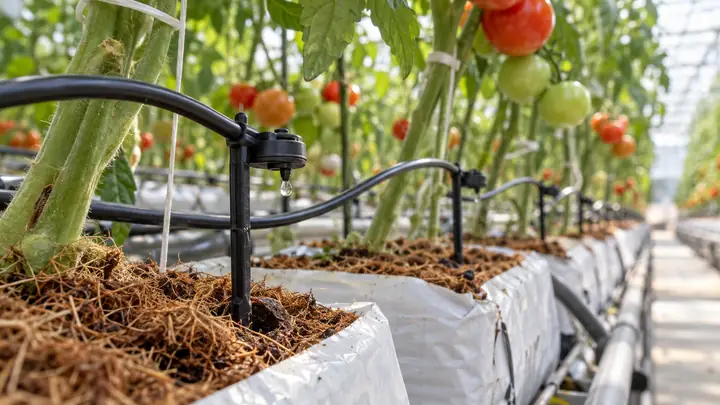
In greenhouses, the usual setup is a PE lateral with PC anti-drain button drippers, each feeding one or more micro tubes and dripper stakes. Typical rates are one stake per plant at 1–4 L/h. The anti-drain function matters because substrate crops are irrigated in many short pulses, and lines that empty between pulses deliver uneven doses.
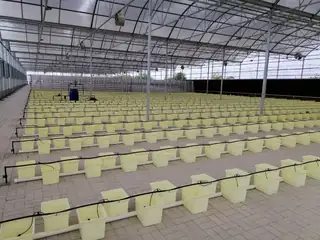
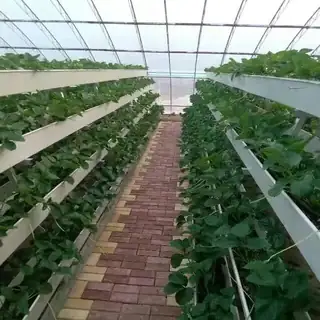
This is the standard way to irrigate tomatoes, cucumbers and peppers in coir or rockwool, strawberries in troughs, and bucket crops in a Dutch bucket planting system. Drip-fed racks such as a greenhouse A-frame for coir-slab strawberries use the same components. See the greenhouse irrigation system guide for scheduling.
What fittings does a drip irrigation system need?
Dripper irrigation parts can be grouped by job. Match every fitting to the outside diameter and wall thickness of your tubing.
| Fitting | What it does | Notes |
|---|---|---|
| Start connector / takeoff | Connects a lateral to a PE, PVC or lay-flat sub-main | With grommet, saddle or lock ring; mini-valve versions isolate single rows |
| Coupling | Joins two laterals or repairs a cut | Barbed, compression or lock-ring types |
| Tee and elbow | Branches or turns a lateral | Use compression fittings on higher-pressure lines |
| End closure | Closes the lateral end | Figure-8 end, plug or automatic flush valve |
| Micro tube and stakes | Carries water from an online emitter to a plant | Commonly 4–6 mm tube |
| Goof plug | Seals an unwanted hole in tubing | Keep a supply for repairs |
| Air/vacuum relief valve | Lets air out on filling and in on draining | Stops soil being sucked into emitters, important for buried lines |
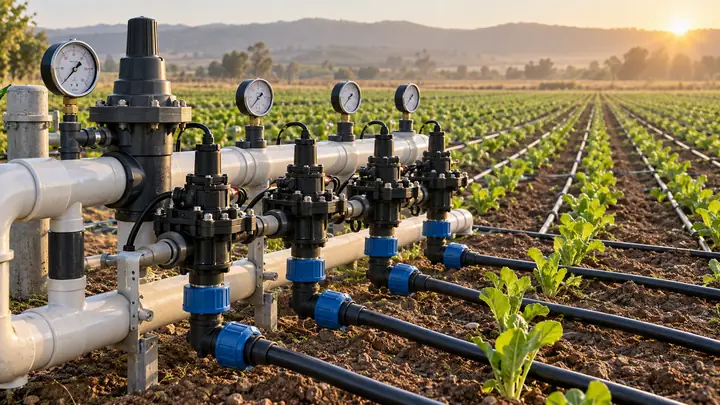
| Pressure regulator | Holds zone pressure in the emitter range | Size by flow; install after filter and valve |
| Punch tool | Makes clean holes for emitters and takeoffs | Clean holes prevent leaks |
Valves, filters and regulators are covered in more depth in our irrigation filters guide, and in our companion articles on irrigation valves and pressure regulation.
How do you install online drip emitters?
Installing online emitters on blank tubing is simple, but small mistakes cause leaks and uneven flow. A reliable routine for crews:
- Lay the tubing in the sun for a while so it softens and lies straight, then fix it in place.
- Flush the tubing before installing emitters so debris is not trapped behind them.
- Punch a clean, straight hole with the punch size recommended for the emitter barb; do not use nails or drills that tear the wall.
- Push the emitter in firmly until the barb seats fully, keeping the outlet facing the plant or slightly up to reduce sediment entry.
- Attach micro tubes and stakes if used, cutting all tubes to the same length so flows stay even.
- Run the zone, check every emitter for leaks around the barb, and measure flow at a few points along the lateral.
Keep spare emitters, couplings and goof plugs on hand; most damage in the field is repaired in minutes if parts are ready.
How do I stop drip emitters from clogging?
Clogging is the main reason irrigation emitters fail. Causes are physical (sand, silt, organic matter), chemical (calcium carbonate, iron and manganese precipitates, fertilizer reactions) and biological (algae, bacterial slime). Prevention checklist:
- Test the water before choosing emitters and filters.
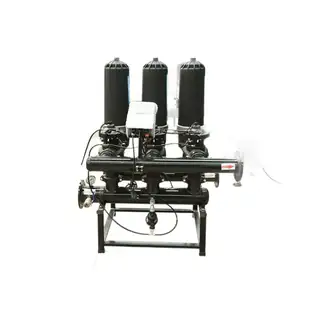
- Filter to the emitter manufacturer's recommendation, often around 120–150 mesh for drip. A self-cleaning unit such as an automatic gear disc filter cuts labor.
- Choose emitters with wide, turbulent labyrinths and self-flushing features for poor-quality water.
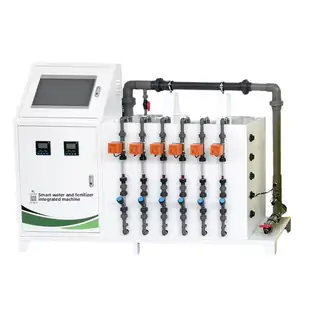
- Keep incompatible fertilizers apart and filter after the injection point; see fertigation and fertilizer injectors.
- Flush lateral ends regularly.
- Use acid treatment for carbonate scaling and chlorination for biological growth where needed, following product guidance and never mixing the two.
- Monitor zone flow; a gradual drop usually means clogging.
How to choose the best drip irrigation emitters for your farm
- Flat field, short rows, annual crop: drip tape or non-PC drip line.
- Slopes, long rows or orchards: PC drip line or PC online emitters.
- Substrate, pots and buckets: PC anti-drain button drippers with stakes.
- Poor water quality: larger flow paths, self-flushing designs, stronger filtration.
- Mixed small plantings: adjustable drip irrigation emitters can be practical, but standardize where you can.
Mars Vertical Farm supplies drip-fed hydroponic systems, filters and fertigation units, with CE-marked products and OEM/ODM options for distributors. See the hydroponic channels, benches and media range, or tell us your crop and layout and we will quote a matching drip and fertigation package.