Short answer
Bug zappers work on insects strongly attracted to ultraviolet light at night, such as many moths, beetles and planthoppers. They are poor at controlling mosquitoes, which find people by carbon dioxide and body heat; in one University of Delaware study biting insects were about 0.2% of the catch. They help against flies mainly indoors or in shaded buildings.
Do bug zappers work? The short answer
Bug zappers work, but only on insects that are strongly attracted to light, and mostly at night. They kill large numbers of moths, beetles, midges and other night fliers, but they are poor at controlling biting mosquitoes and only moderately useful against flies outdoors.
So whether bug zappers work for you depends on which insect you are trying to control and where. For a grower trying to reduce night-flying moth pests in an orchard, a well-placed light trap can be a useful part of integrated pest management. For a homeowner hoping to stop mosquito bites on a patio, the same device will disappoint. This article explains why, insect by insect, so you can judge whether a zapper is the right tool before buying one.
How does a bug zapper work?
A bug zapper has two parts: an attractant and a killing mechanism.
- Attractant: an ultraviolet (UV-A) lamp, typically with peak output around 350–400 nm. Many night-flying insects navigate by light and are drawn to sources rich in UV, a behaviour called positive phototaxis.
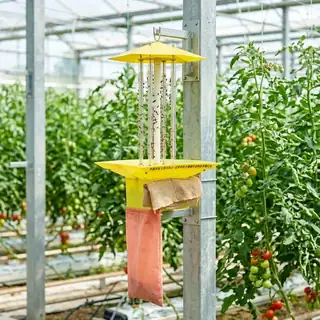
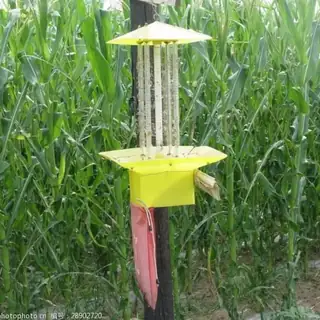
- Killing mechanism: two interleaved wire grids carrying a high voltage at very low current. When an insect bridges the gap between the grids, the current passes through it and kills it, producing the familiar snap. Some designs use a suction fan and catch bag instead, or sticky glue boards.
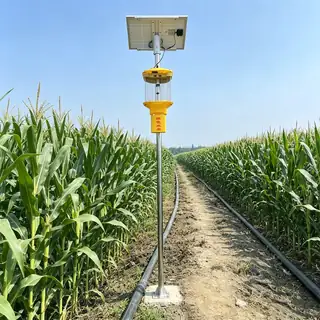
Mains-powered units transform household voltage up to the grid voltage; solar units run from a battery charged by a panel. Either way, the lamp is what does the selecting: a zapper can only kill what its light pulls in. That single fact explains almost every result below.
How effective are bug zappers on different insects?
The table summarises typical field performance. It reflects general entomology and grower experience rather than a single test, and results vary with species, season, site and lamp spectrum.
| Insect group | Attracted to UV light? | Typical zapper effectiveness | Better or complementary method |
|---|---|---|---|
| Night-flying moths (armyworm, cutworm, borer and fruit moths) | Strongly | Good; this is the main agricultural use | Pheromone traps for monitoring; crop scouting |
| Beetles (chafers, scarabs, some weevils) | Strongly for many species | Good, especially with higher-voltage grids or suction | Soil larva management |
| Planthoppers and leafhoppers | Moderately to strongly | Fair to good in rice and field crops | Resistant varieties, field hygiene |
| House flies and stable flies | Moderately, mainly indoors or in shade | Fair in enclosed spaces; weak outdoors in daylight | Sanitation, manure management, fly traps with bait |
| Mosquitoes (biting females) | Weakly | Poor | Removing standing water, carbon dioxide-baited traps, repellents |
| Bees and bumblebees | Mostly inactive at night | Low catch if the lamp runs only after dark | Timers, placement away from flowers |
Do bug zappers kill mosquitoes?
They kill some, but not enough to matter in most situations. Female mosquitoes, the ones that bite, find hosts mainly by following exhaled carbon dioxide, body heat, moisture and skin odours. Light plays a much smaller role. So when people ask "do bug zappers work on mosquitoes?", the evidence points to no, not as a control method.
The best-known evidence comes from a University of Delaware study of an electric light trap run through a summer in a suburban yard. Of nearly 14,000 insects killed, biting flies (including mosquitoes) made up about 0.2%, while harmless aquatic insects from nearby streams made up almost half the catch, and predatory and parasitic insects, which are natural enemies of pests, accounted for over 13%. Do bug zappers attract mosquitoes? A few, but a person sitting nearby is usually a far stronger lure.
If mosquitoes are the problem, see our outdoor mosquito zapper and trap guide, which compares UV zappers with carbon dioxide and attractant traps and explains why source reduction comes first.
Do bug zappers work on flies?
Partly. House flies are attracted to UV light, which is why light traps are widely used in food processing and hospitality. But in those settings the trap competes only with indoor lighting. Outdoors in daylight, the sun is overwhelmingly brighter than any lamp, so a zapper has little pull.
That answers the common question "do bug zappers work on flies during the day?": not well outdoors. Will a bug zapper kill flies at all? Yes, some, especially at dusk, in shaded barns and under roofs. In livestock buildings, light traps help most as a supplement to manure removal, drainage and good ventilation, which cut fly breeding at the source. For housed animals and farm buildings, read insect light traps for farms and greenhouses.
Do bug zappers work on moths and beetles?
Yes, and this is where light traps earn their place in agriculture. The adult stage of many caterpillar pests is a night-flying moth. Removing egg-laying females before they lay can reduce the next larval generation, and the trap catch shows when a flight starts, which helps time sprays or other interventions. Extension entomologists have long used blacklight traps to track moth flights for this reason.
Two cautions apply. First, light traps are often better at telling you a pest is flying than at controlling it on their own; most growers combine them with other measures. Second, the area a lamp influences is limited, so field coverage depends on lamp spacing and power. Our solar insect-killing lamp guide covers coverage per hectare and layout.
Do bug zappers kill bees?
Bees are active in daylight and return to the hive before dark, so a zapper that runs only at night kills relatively few of them. The risk rises if the lamp runs in daylight, at dawn, or right next to flowering crops and hives. Will bug zappers kill bees in your setup? To keep the answer close to no:
- Use a light sensor and a timer so the lamp runs only for a few hours after dusk.
- Mount lamps away from flowering hedges, orchards in bloom and apiaries.
- Choose a lamp spectrum designed to reduce attraction of beneficial insects where available.
Are bug zappers bad for the environment?
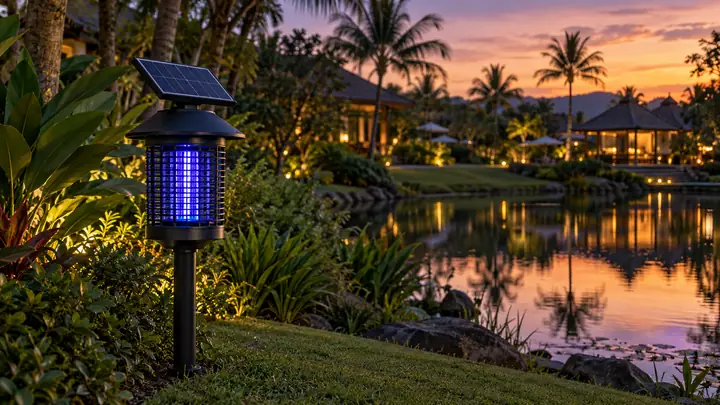
They can be, when used carelessly. A zapper running all night, every night, in a garden mostly kills harmless and beneficial insects, including the aquatic insects and moths that birds, bats and fish feed on. In agriculture, the trade-off is different: a targeted programme can reduce pesticide use, which also has environmental costs.
The responsible approach is to run light traps only where a light-attracted pest is confirmed, only during the pest's flight period, and only for the first hours after dusk, when many pest species fly most actively. Periodically examine the catch: if most of it is non-target insects, adjust timing, spectrum or placement, or stop.
What makes a bug zapper more effective?
When the target insect is light-attracted, a handful of design and setup factors separate a trap that works from one that only looks busy:
- Lamp power and spectrum. A stronger UV source draws insects from a wider area. Agricultural lamps typically use 10–30 W, compared with a few watts in patio units, and some combine UV with visible bands tuned to particular pests.
- Grid strength and spacing. Larger beetles can bounce off a weak grid. A higher grid voltage, appropriately guarded, kills them more reliably.
- Capture design. A suction fan catches insects that circle the lamp without touching the grid and keeps them intact for identification. Our waterproof solar insect suction lamp uses this approach.
- Darkness around the trap. Nearby floodlights, street lights or a bright moon reduce catches noticeably.
- Height. In crops, a lamp just above the canopy usually catches more of the pests that fly there.
- Reliable power. A solar unit that runs out of battery by midnight after a cloudy day misses part of the flight.
Checklist: will a bug zapper work for your problem?
- Identify the pest. Name the insect causing the damage or nuisance, not just "bugs".
- Check its behaviour. Is it active at night and attracted to light? Moths and many beetles are; biting mosquitoes and daytime flies largely are not.
- Check the setting. Indoors or in shade, light traps compete less with ambient light. Open sunlit areas favour other methods for day-active pests.
- Size the device. A small patio unit cannot protect a field. Match lamp power, grid strength and number of units to the area.
- Plan placement. Put the lamp between the insect source and the area to protect, away from people, flowers and competing lights.
- Set run times. Use dusk sensors and timers to target the pest flight window.
- Inspect the catch. After one to two weeks, sort a sample. If the target pest is rare in the catch, the zapper is not working for you.
What kind of bug zapper should a farm or business use?
Professional sites need units that run every night of the season without attention. Off-grid solar lamps are popular on farms because they avoid trenching cables across fields. Options range from a solar electric shock IoT insect killer for moth and beetle pressure in fields, to suction-type lamps that preserve specimens for counting. Compare classes in our solar bug zapper buying guide and commercial bug zapper guide, or browse the full solar pest control range.
Mars Vertical Farm has 20+ years of production experience and builds CE-marked solar insect-killing lamps in Shanghai. If you know your target pests and site size, send us the details and our engineers will suggest a lamp type and layout.