Short answer
Hydroponic grow media are inert materials, such as rockwool, coconut coir, perlite, expanded clay or foam plugs, that anchor roots while the nutrient solution feeds the plant. Choose by system: plugs only for NFT and deep water culture, perlite or clay for Dutch buckets, and rockwool or coir slabs for drip-fed tomatoes, cucumbers and strawberries.
What is hydroponic grow media?
Hydroponic grow media are the inert or low-nutrient materials that hold a plant's roots in place in a soilless system while the nutrient solution supplies everything the plant eats. The right grow medium for hydroponics gives roots water, air and physical support at the same time, without adding diseases, salts or unpredictable pH.
Unlike potting soil or bagged soilless potting media sold for containers, a soilless growing medium in hydroponics is not meant to feed the crop. It is a scaffold. That is why the same nutrient recipe can behave very differently in rockwool, coconut coir, perlite or expanded clay: each material holds a different amount of water and air after irrigation, and each reacts differently with the solution. Choosing hydroponic media is therefore an engineering decision tied to your system type, crop, irrigation frequency and water quality.
Some systems need almost no medium. In NFT channels and deep water culture rafts, a small sponge plug or rockwool cube only anchors the seedling, and the roots grow straight into the moving solution. In drip-fed bag, slab and bucket systems, the substrate is the root zone for the whole crop, so its properties matter a great deal.
What does a good hydroponic planting medium need to do?
Whatever the material, a good hydroponic planting medium should:
- Hold enough water to carry roots between irrigations, without staying waterlogged.
- Leave enough air-filled pore space for roots to breathe. Roots in a saturated, airless medium suffocate and become prone to root rot.
- Be clean and consistent, free of pathogens, weed seeds and salts, and uniform from batch to batch so that irrigation settings stay valid.
- Be chemically predictable, with a stable or easily corrected pH and low or known cation exchange capacity.
- Fit the hardware: the plug must fit the net pot or channel hole, and slabs must fit the gutter or trough.
- Be practical to dispose of or reuse at the end of the crop.
No single material scores best on every point, which is why most commercial farms use two: one for propagation (cubes or plugs) and one for the production stage (slabs, bags or buckets), or none at all in water-culture systems.
Which hydroponic mediums are most common?
The table below compares the hydroponic mediums growers use most often. Values are typical ranges; individual products vary with density, fiber length and processing.
| Medium | Water holding | Air space | Starting pH | Typical use | Main drawback |
|---|---|---|---|---|---|
| Rockwool (stone wool) | High | Good | Alkaline; needs pre-soaking | Seed starter cubes, propagation blocks, tomato and cucumber slabs | Not biodegradable; dust and fibers during handling |
| Coconut coir | High | Good, depends on chip/fiber mix | Slightly acidic to neutral | Strawberry and tomato grow bags, slabs, mixes | Must be washed and buffered to remove sodium and potassium |
| Perlite | Low to medium | Very high | Neutral | Bag culture, Dutch buckets, blended mixes | Light, floats and washes out in flood systems; dusty |
| Expanded clay pebbles | Low | Very high | Near neutral | Dutch buckets, net pots, ebb and flow | Heavy; drains fast; needs cleaning before reuse |
| Polyurethane / foam sponge plugs | Medium | Good | Neutral | Seedling plugs for NFT and DWC | Only for propagation and anchoring |
| Peat-based plugs | Very high | Medium | Acidic, usually limed | Seedling plugs, transplant blocks | Can hold too much water; sustainability concerns |
Rockwool cubes and slabs
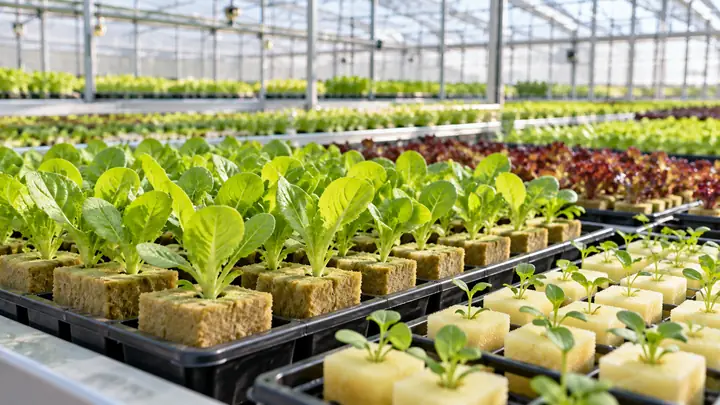
Rockwool is spun from molten basalt rock into fibers and pressed into rockwool cubes, blocks and slabs. It is sterile when new, very uniform, and holds a lot of water while still draining freely, which is why rockwool grow cubes and rockwool planting cubes are the standard propagation medium in many greenhouses. Its weak points are a high starting pH and the fact that it does not break down, so used slabs need a disposal or recycling route.
Coconut coir
Coir is processed coconut husk, sold as loose fiber, chips, pith or compressed slabs and grow bags. It holds water well, re-wets easily and is renewable. Raw coir can carry high sodium, potassium and chloride, so buy coir that has been washed and buffered, or plan to rinse it with a calcium-rich solution before planting.
Perlite and expanded clay
Perlite and clay pebbles are the "airy" end of the range. They drain quickly and keep roots well oxygenated, so they suit crops irrigated many times a day, such as tomatoes in Dutch buckets. They hold little water, which means a pump failure shows up quickly in the crop.
Sponge cubes and foam plugs
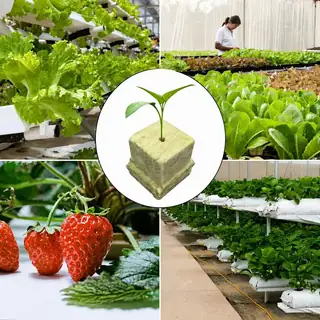
For leafy greens grown in NFT or rafts, many farms use pre-cut sponge or foam hydroponic cubes as their grow cubes for hydroponics, sown in a plug tray and kept on a propagation bench until transplant. They are clean, cheap per plant, easy to handle in a seeding line and fit standard net pots. Our square sponge nursery cubes and custom-size sponge plugs are examples of this format.
How to use rockwool cubes in hydroponics
Using rockwool in hydroponics is straightforward once you correct its pH and avoid overwatering. A typical routine for rockwool starter cubes and other hydroponic seed starter cubes:
- Pre-soak the cubes for several hours, or overnight, in water adjusted to about pH 5.5. Some guides pre-charge with a weak nutrient solution of roughly 1.0 mS/cm EC.
- Drain the cubes by letting them drip or giving a gentle shake. Do not squeeze them, because that crushes the fiber structure.
- Sow one or two seeds per cube, a few millimeters deep, and cover the tray to keep humidity high until germination.
- Water from below with a weak nutrient solution once true leaves appear, letting the cube lighten between waterings.
- Transplant when roots show through the bottom and sides. Place the rockwool seed starter cube in a net pot, on a block, or straight onto a slab.
- Manage slabs by weight and drain: in production, irrigate until a set drain percentage is reached, and monitor drain EC and pH to steer the crop.
The most common mistake with rockwool cubes for seeds is keeping them soaking wet. Rockwool holds so much water that seedlings can sit in a saturated cube for days, which invites damping-off. Let the cubes dry back slightly between waterings.
Which grow medium for hydroponics suits each system?
Match the medium to how water moves through your system.
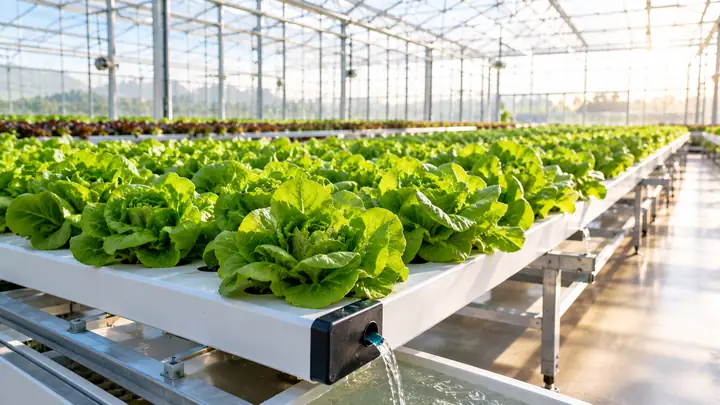
- NFT channels: a sponge plug or rockwool cube only. A thick medium blocks the thin nutrient film and can cause pooling. See our NFT system guide.
- Deep water culture rafts: sponge or rockwool plugs in net pots for hydroponics, held in floating boards. The roots hang in aerated water.
- Ebb and flow benches: rockwool blocks, peat plugs or clay pebbles. Perlite tends to float and drift during floods. Our ebb and flow guide covers bench design.
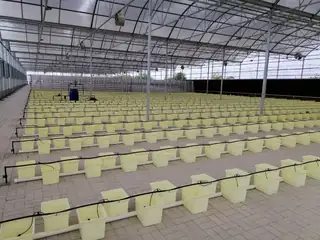
- Dutch buckets: perlite, clay pebbles or coir-perlite mixes. They drain freely, so frequent short drip cycles work well.
- Grow bags, slabs and gutters: coir or rockwool, drip-fed with drain-to-waste or recirculation. This is the standard for tomatoes, cucumbers, peppers and strawberries.
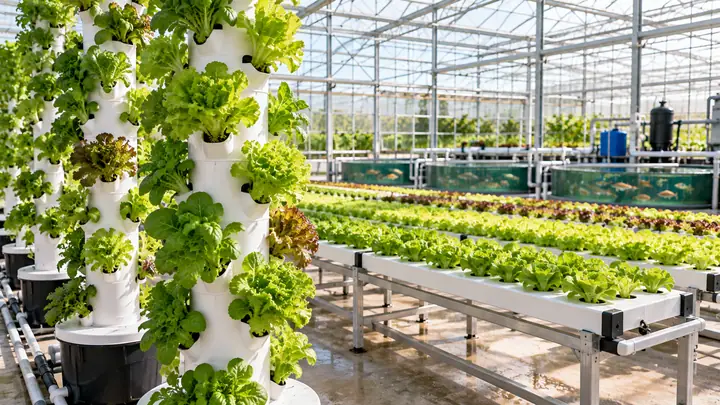
- Vertical towers: usually a plug in a net cup with no loose medium, because loose media can wash into the reservoir and clog pumps.
For a side-by-side look at system types, read NFT vs DWC vs Dutch bucket.
What size net pots and hydroponic baskets should you use?
Net pots, also called hydroponic baskets or hydro net pots, hold the plug and medium in a channel, raft or tower hole. The right hydroponic pots depend on crop size and spacing:
- Roughly 25 to 50 mm (1 to 2 in) for lettuce plugs, herbs and microgreen-style crops in NFT and rafts.
- Roughly 50 to 75 mm (2 to 3 in) for larger leafy greens, basil and tower crops.
- Buckets or bags of about 8 to 12 L for fruiting crops grown in substrate, such as tomatoes and peppers.
Choose hydroponic grow pots in food-safe, UV-stabilized plastic, and check that the outer lip seats firmly in the channel hole so that light cannot reach the solution and grow algae.
What about hydroponic pods and seed pods?
Hydroponic pods, also sold as hydroponic seed pods or garden pods, are pre-filled plugs, often peat or coir in a mesh or biodegradable sleeve, with seed already inside. They are designed for compact hydroponic planters indoors and countertop systems built around indoor garden pods, where convenience matters more than cost per plant. For a commercial farm, buying empty plugs and seeding them in-house is usually far cheaper and allows any variety. For distributors supplying home systems, the key questions are whether the pod format fits the planter, whether the medium is free of pathogens, and how long the seeds stay viable in storage. Our indoor herb garden guide covers the home and countertop side in more detail.
What is the best hydroponic medium?
There is no universal best hydroponic medium, only the best fit for a crop, system and site. As a starting point:
- Leafy greens and herbs in water culture: sponge or rockwool plugs.
- Tomatoes, cucumbers and peppers: rockwool or coir slabs, or perlite in Dutch buckets.
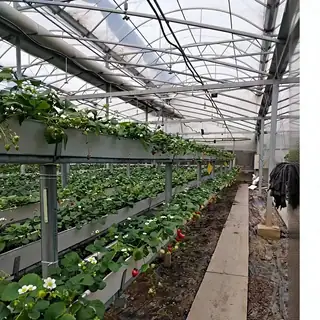
- Strawberries: coir grow bags or coir slabs in gutters or A-frame troughs, such as our A-frame strawberry trough for coir slabs.
- Seedling production: rockwool cubes, peat plugs or foam plugs on flood benches.
Also consider local supply and disposal. Coir is easy to source in many tropical regions and can be composted. Rockwool offers very consistent performance but needs a disposal plan. Clay pebbles and perlite can be cleaned and reused, but the labor involved is real.
How do you buy and qualify soilless growing media?
Before committing to a supplier of soilless growing media, run this short checklist:
- Ask for a specification sheet that covers density, water-holding capacity, air-filled porosity, pH and EC.
- For coir, ask for the sodium and potassium levels and whether the product has been washed and buffered.
- Run a trial on one bench or row and compare drain EC, pH and root development with your current medium.
- Confirm that plug and slab dimensions match your trays, net pots and gutters.
- Check how the material is stored and shipped. Compressed coir needs rehydration, and rockwool must be kept dry and clean.
- Plan for end-of-life: composting, recycling, reuse after sterilization, or landfill.
Whatever you choose, your nutrient program has to match it. Media with high cation exchange capacity, such as coir, can hold calcium and magnesium early in the crop. Our hydroponic nutrients, EC and pH guide explains how to set and correct the solution.
Planning a soilless system?
Mars Vertical Farm has more than 20 years of production experience and builds NFT channels, Dutch bucket systems, tidal benches and A-frames from its Shanghai factory, along with the plugs and trays that go with them. Browse our hydroponic systems, or send us your crop and greenhouse size for a matched system and media recommendation with a quotation.