Short answer
Commercial hydroponic systems are production-scale soilless installations, mainly NFT channels, deep water culture rafts, Dutch bucket or slab drip systems, tidal benches and vertical racks, combined with pumps, filtration, fertigation and climate control. NFT and DWC suit leafy greens, drip substrate suits tomatoes and cucumbers, and tidal benches suit seedlings. Cost depends mostly on structure, lighting, climate control and automation.
What are commercial hydroponic systems?
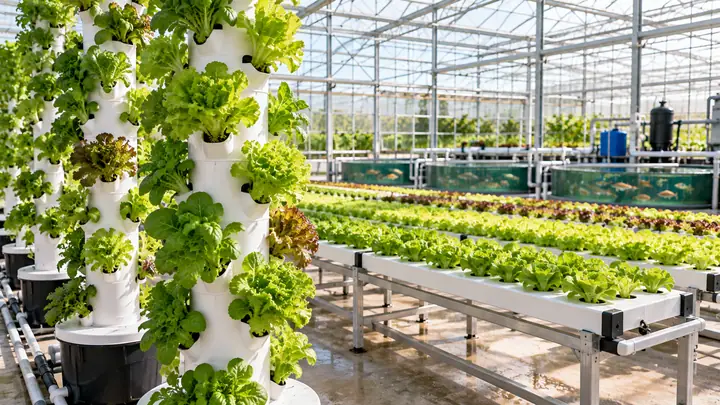
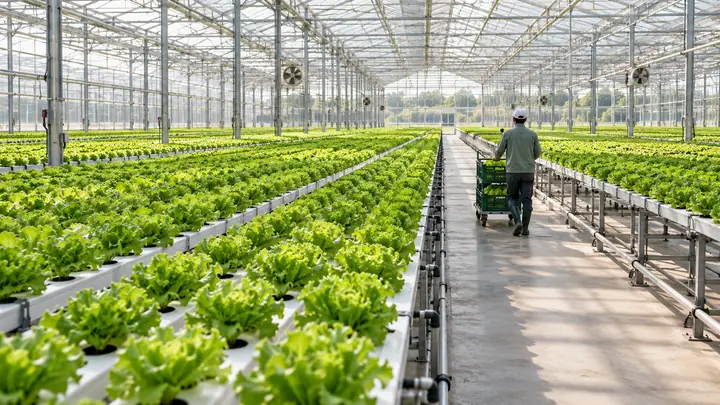
Commercial hydroponic systems are production-scale soilless growing installations, such as NFT channel lines, deep water culture raft beds, Dutch bucket and slab systems, tidal benches and vertical racks, designed to grow crops for sale with consistent yield and quality. They pair the growing hardware with pumps, filtration, fertigation and climate control so that a hydroponic farm can run every day of the year.
The difference from hobby kits is not just size. Commercial hydroponics equipment uses food-grade, UV-stabilized materials, is engineered for daily cleaning and long service life, and is sized around a production plan: crop, plants per square meter, harvest cycle and target output. This guide covers the main system types, the equipment list for a hydroponic farm, cost drivers, and how to evaluate a hydroponics equipment supplier.
Which commercial hydroponic systems suit which crops?
Large scale hydroponics is built around a few proven methods. Our comparison of NFT vs DWC vs Dutch bucket goes deeper; the table summarizes the main options.
| System | Main crops | Typical setting | Strengths | Watch-outs |
|---|---|---|---|---|
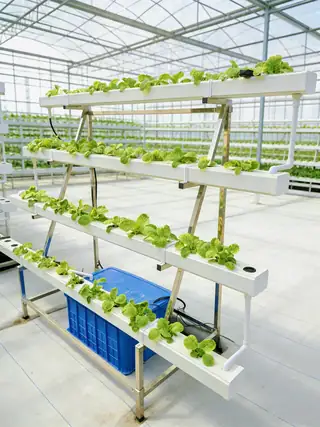
| NFT channels | Lettuce, herbs, leafy greens, strawberries | Greenhouse benches, A-frames, indoor racks | Low water volume, light, easy to automate harvest | Little buffer if pumps stop |
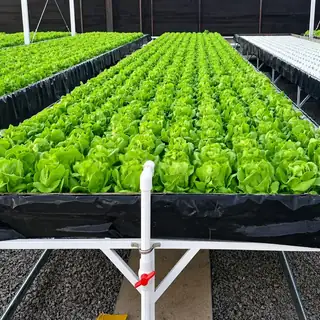
| Deep water culture (raft) | Lettuce, basil, leafy greens | Greenhouse ponds and beds | Stable temperature and EC, simple to run | Heavy, needs strong aeration |
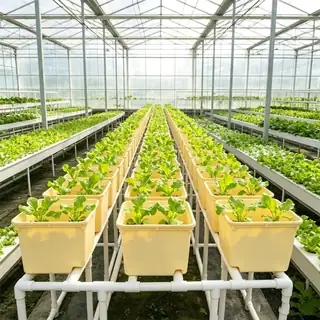
| Dutch bucket / slab drip | Tomatoes, cucumbers, peppers, eggplant | High-wire greenhouses | Supports long-cycle vine crops | Needs fertigation and drain management |
| Tidal (ebb and flow) benches | Seedlings, potted plants, flowers | Nurseries and propagation areas | Even bottom watering, dry foliage | Bench and drain design matter |
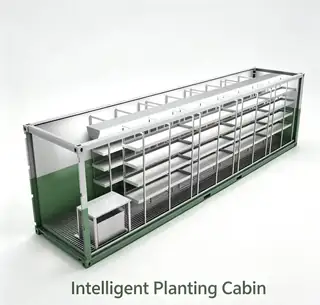
| Vertical racks and plant factories | Leafy greens, microgreens, herbs, strawberries | Warehouses, containers | Very high output per floor area | Energy for lighting and cooling |
Example equipment includes the farm-scale pipe NFT vegetable system, deep water culture floating grow beds and large commercial Dutch bucket lines for greenhouse vine crops.
What equipment does a commercial hydroponic farm need?
A complete list of hydroponic farming equipment usually includes the following. Buyers often forget the items lower down, which is why budgets overrun.
- Structure: a greenhouse, insulated building or container. See our commercial greenhouse guide.
- Growing system: channels, raft beds, gutters, buckets, benches or vertical racks, with supports and end caps.
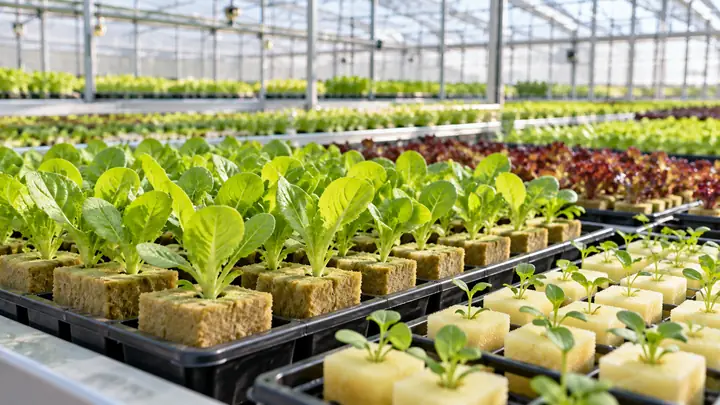
- Propagation: seedling trays, sponge or rockwool plugs, germination area or cabinets, and tidal benches.
- Water treatment: filtration and, where source water is hard or saline, reverse osmosis.
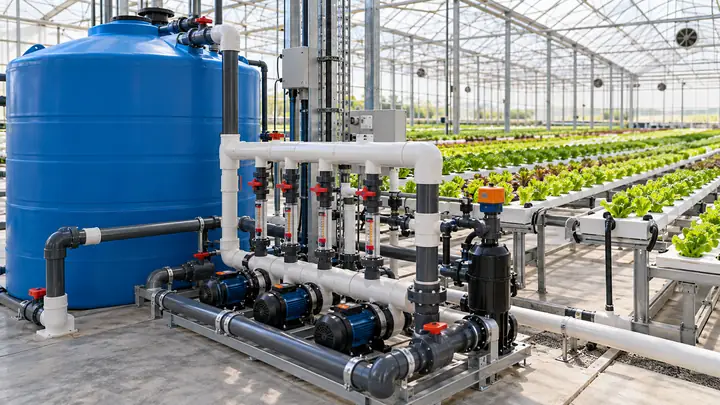
- Fertigation and dosing: stock tanks, dosing pumps, EC and pH sensors and a controller. Our guide on how to size a fertigation system walks through the calculation.
- Pumps and plumbing: supply and return lines, valves, nutrient tanks and, for closed systems, return disinfection (UV, ozone or filtration).
- Climate control: ventilation, heating, cooling, shading and, indoors, dehumidification and air circulation.
- Lighting: supplemental LEDs in greenhouses, or full sole-source LEDs indoors.
- Monitoring and automation: sensors, alarms and a central controller, ideally with remote access.
- Post-harvest: harvesting carts, washing, cold storage and packing.
- Backup power for pumps and controls, especially for NFT and aeroponic systems.
A customized PLC hydroponic system can tie dosing, pumps and sensors into one control cabinet.
What are the benefits of hydroponic systems for commercial farming?
- Higher, more predictable yields per square meter, because plants get exactly the nutrients and water they need.
- Water efficiency. Recirculating systems lose water mainly through plant uptake, a major advantage in dry regions.
- Year-round production in greenhouses and indoor farms, which supports supply contracts with retailers and food service.
- Cleaner product with fewer soil-borne pests and no soil on the leaves, which reduces washing and waste.
- Proximity to market. Indoor hydroponic farms can operate near cities, cutting transport time.
- Labor efficiency, with waist-height work, mobile benches and automated dosing.
The trade-offs are higher capital cost, dependence on power and the need for trained staff. Advantages of hydroponic farming only turn into profit when the crop, market and system are matched carefully.
How much does a commercial hydroponic system cost?
The cost of hydroponics varies so widely that a single number is misleading. Hydroponics cost per square foot (or per square meter) for a simple NFT or raft system in an existing greenhouse is a small fraction of the cost of a fully enclosed vertical farm with lighting and HVAC. The main cost drivers are:
- Structure: using an existing greenhouse versus building a new one, a warehouse fit-out or containers.
- System type and density: single-layer benches cost less per square meter than multi-tier racks, but produce less per square meter of floor.
- Climate and lighting: sole-source LED lighting, cooling and dehumidification dominate indoor farm costs, both upfront and in electricity.
- Automation level: manual dosing and handling versus PLC control, automated seeding, moving gutters and harvesting.
- Water quality: poor source water adds filtration or reverse osmosis.
- Materials: food-grade PVC, ABS or galvanized steel and UV stabilizers cost more than generic plastics but last longer.
- Logistics and installation: freight, import duties, local labor and commissioning.
A hydroponic system manufacturing cost breakdown from a supplier normally separates the growing hardware, the water and fertigation equipment, the control system and the accessories, so you can compare quotes line by line. When importing, add freight, insurance, duties and local installation; our guide to importing agricultural equipment from China explains Incoterms and landed cost.
How do you plan a commercial hydroponic farm?
- Define the market first: buyers, crops, volumes, price and delivery frequency.
- Choose crop and system together. Lettuce and herbs point to NFT, DWC or vertical racks; vine crops point to Dutch buckets or slabs. See our hydroponic lettuce guide for leafy green specifics.
- Test water and assess the site: water quality, power supply, climate, access and drainage.
- Calculate production: plants per square meter, cycle length and harvest per week, then work back to the growing area.
- Design the layout: propagation, growing, nutrient room, packing and cold storage, with clear workflow.
- Request specifications and quotes from more than one supplier, on the same layout.
- Plan training and commissioning, and start with a pilot section if the team is new to hydroponics.
For indoor projects, our guide on how to start a vertical farm covers the extra decisions around lighting and HVAC.
Greenhouse or indoor hydroponic farm: which is right?
Most commercial hydroponic farming happens in greenhouses, where sunlight provides most of the energy for growth. An indoor hydroponic farm in a warehouse or container replaces the sun with LEDs and controls the whole climate. The choice shapes both cost and crop list.
| Factor | Greenhouse hydroponics | Indoor hydroponic farm |
|---|---|---|
| Main energy source | Sunlight, with supplemental lighting in dark seasons | Electric LED lighting all year |
| Crop range | Leafy greens, herbs, vine crops, strawberries, flowers | Mainly leafy greens, herbs, microgreens, strawberries |
| Layout | Mostly single layer, some A-frames and gutters | Multi-tier vertical racks |
| Climate risk | Exposed to heat waves and cold snaps | Stable, but depends on HVAC and power |
| Capital cost per m² of floor | Lower | Higher |
| Best locations | Good light, available land | Cities, extreme climates, limited land |
In practice, many growers combine both: propagation in a controlled indoor room or cabinet, production in a greenhouse.
Climate also matters. In hot, dry regions, greenhouse hydroponics needs strong cooling and shading but gains most from water savings. In cold, dark winters, supplemental lighting and heating become the main operating costs, and an insulated indoor farm can sometimes compete for leafy greens. Run the energy numbers for your own site before deciding.
What mistakes do buyers make with commercial hydroponic equipment?
- Buying the growing system before the market is secured. Equipment is the easy part; consistent sales are harder.
- Undersizing the nutrient and water system. Reservoirs, pumps and dosing need capacity for the full farm plus expansion.
- Ignoring source water quality. High alkalinity, sodium or iron can upset nutrient recipes and clog emitters.
- No propagation plan. A production area only runs at full capacity if seedlings arrive on schedule.
- Skipping redundancy. A single pump or controller without backup is a single point of failure for the whole crop.
- Comparing quotes that are not like for like. Check materials, wall thickness, accessories and control scope, not just the headline price.
How do you choose a hydroponics equipment supplier?
Whether you buy from a local hydroponic supply store, a wholesale distributor of hydroponic supplies or directly from a manufacturer, use these criteria:
- Manufacturing capability: does the supplier make the channels, benches and racks, or resell them? Factory-direct buying gives more control over specifications.
- Materials and standards: food-grade plastics, UV stabilization, galvanizing thickness, CE marking for electrical equipment and a quality system such as ISO 9001.
- Engineering support: layout drawings, slope and flow calculations, and a clear bill of materials.
- Customization: channel lengths, plant spacing, rack heights and OEM/ODM for distributors.
- Export experience: packing, documentation and quoting on recognized Incoterms.
- Spare parts and after-sales: availability of pumps, sensors, end caps and fittings.
Distributors and retailers stocking hydroponic kits for sale should also check packaging size, assembly instructions and how easily end users can find replacement parts.
Sourcing commercial hydroponic systems from Mars Vertical Farm
Mars Vertical Farm has 20+ years of production experience, a 2,000+ m² factory in Shanghai with three production lines, and ISO 9001 certification. We supply NFT, DWC, Dutch bucket and tidal systems from our hydroponic channels, benches and media range, and complete container and indoor plant factories, quoting in USD on EXW, FOB Shanghai or CIF terms. Send us your crop, site plan and target output for a layout and quotation.