Short answer
Use NFT (nutrient film technique) for fast, short leafy greens and herbs when you want high plant density and low water volume. Use DWC (deep water culture, or raft beds) for leafy greens when you want a large nutrient buffer that keeps roots alive through pump or power interruptions. Use Dutch buckets for long-cycle vining crops such as tomatoes, cucumbers and peppers that need a substrate and strong support.
How does each system work?
NFT (nutrient film technique)
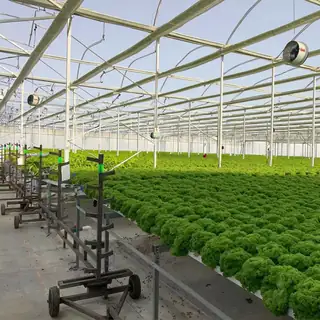
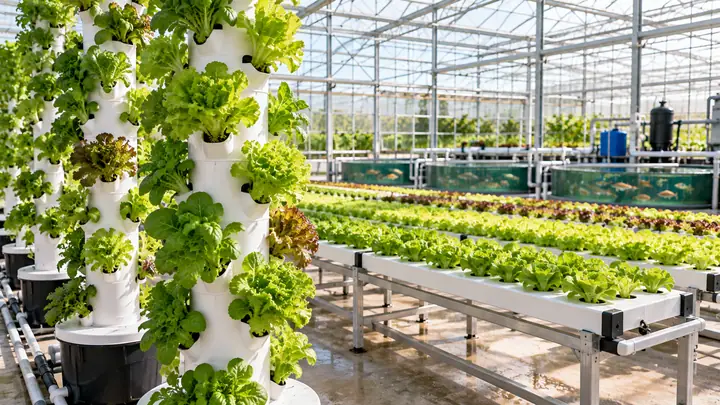
Plants sit in holes along shallow, sloped channels. A pump delivers a thin film of nutrient solution to the high end; it flows past the roots and drains back to the tank. Roots get oxygen from the air above the film. Because the film is shallow, total water volume is small and the system responds quickly to changes in EC and pH.
DWC (deep water culture, raft system)
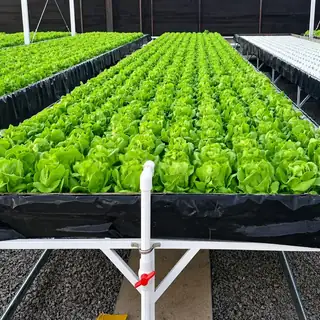
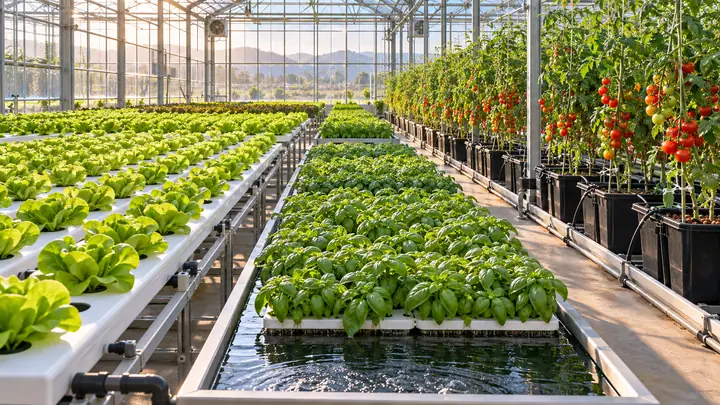
Plants float on foam or plastic rafts over a bed of nutrient solution typically 20–30 cm deep. Air pumps or circulation keep the water oxygenated. The large water volume holds temperature and nutrient concentration steady for hours, which makes DWC forgiving.
Dutch bucket (bato bucket)
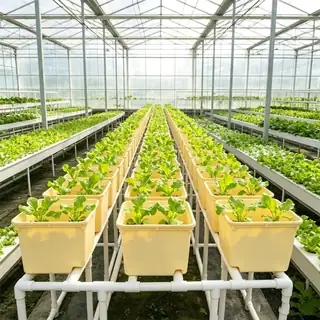
Each bucket holds roughly 10–12 liters of an inert substrate such as perlite or coco coir. Drip emitters feed each bucket on a timer, and excess solution exits through a siphon elbow into a shared drain line. The system can recirculate or run to waste. Buckets are spaced along a row under a trellis wire for vining crops.
How do NFT, DWC and Dutch buckets compare?
| Factor | NFT | DWC (raft) | Dutch bucket |
|---|---|---|---|
| Best crops | Lettuce, herbs, leafy greens, strawberries (with care) | Lettuce, basil, leafy greens | Tomato, cucumber, pepper, eggplant, melon |
| Water volume per plant | Very low | High | Moderate (in substrate plus tank) |
| Tolerance to pump or power failure | Low: roots can dry within an hour or two in warm conditions | High: roots stay submerged; oxygen is the limit | Moderate: substrate holds some moisture |
| Root-zone temperature stability | Low: thin film heats and cools quickly | High | Moderate |
| Plant density | High; channels can be stacked or set on A-frames | Moderate; single level | Low; wide spacing for large plants |
| Structural load | Light | Heavy (water-filled beds) | Moderate |
| Labor focus | Channel cleaning, transplanting | Raft handling, bed cleaning | Pruning, trellising, harvest |
| Disease spread risk | Shared solution spreads root pathogens fast | Shared solution; warm water favors Pythium | Lower if run to waste; similar if recirculating |
Which system should I choose for my crop?
Start from the crop, its cycle length and its size at harvest:
- Short leafy crops (4–7 weeks): NFT or DWC. Choose NFT for density and vertical stacking, DWC for stability in hot climates or where power is unreliable.
- Herbs harvested repeatedly: NFT works well; basil also does well in DWC.
- Strawberries: substrate troughs with drip irrigation are the most common commercial choice, although NFT is also used. See our A-frame guide for strawberries and leafy greens.
- Vining fruiting crops (months on the plant): Dutch buckets. The substrate anchors large root systems and the bucket spacing leaves room for trellising.
What design numbers matter for NFT?
- Slope: commonly 1–3% (1–3 cm drop per meter) so the film moves without pooling.
- Flow: typically around 1–2 liters per minute per channel; too little starves the far end, too much floods roots.
- Channel length: keep runs moderate, roughly 12 m or less, because oxygen drops and temperature rises along the channel.
- Channel material: food-grade, UV-stabilized PVC with a white or light outer surface to limit heating, and covers that block light to prevent algae.
Our food-grade PVC flat NFT system is built for these layouts.
What design numbers matter for DWC?
- Depth: roughly 20–30 cm of solution under the rafts.
- Dissolved oxygen: aim to stay above about 6 mg/L using air diffusers or water circulation.
- Water temperature: about 18–22 °C for most leafy greens. Above roughly 24 °C, oxygen falls and root rot risk rises; a chiller may be needed in hot regions.
- Bed liner and frame: the beds carry heavy water loads, so frame rigidity and liner quality matter. See our custom deep water culture growing beds.
What design numbers matter for Dutch buckets?
- Substrate: perlite, coco coir or a mix. Rinse before use to remove dust and salts.
- Plants per bucket: commonly one to two, depending on crop and training system.
- Irrigation: drippers of roughly 2–4 L/h, with several short irrigation events per day that increase with light and plant size.
- Drain fraction: many growers target around 15–30% runoff to avoid salt buildup in the substrate.
- Drain line: slope toward the return tank so no solution stands in the pipe.
Options include the commercial-grade large Dutch bucket system and a complete Dutch bucket set with pump.
How do build and running costs compare?
Exact prices depend on scale, materials and local labor, but the cost drivers differ in predictable ways:
- NFT has a moderate cost per plant site because channels are light and dense. Running costs are low on water and fertilizer, but you need reliable pumps, alarms and, ideally, backup power.
- DWC costs more per plant site in materials (beds, liners, rafts, aeration) and needs a strong floor or frame. In return, it is the least sensitive to short power cuts. Cooling large water volumes in summer can add energy cost.
- Dutch buckets have a low cost per bucket but each plant occupies far more floor area. Recurring costs include substrate replacement, more labor for pruning and trellising, and fertilizer lost to runoff if you run to waste.
Compare systems on cost per kilogram sold, not cost per meter of channel. A cheaper system that loses one crop a year to a pump failure is not cheaper.
What usually goes wrong?
- Warm solution. The most common cause of root disease in all three systems. Insulate tanks, shade pipes and size cooling for summer peaks.
- No backup for NFT. Add a flow alarm, a standby pump or a battery backup; a short outage in summer can wilt a full crop.
- Clogged drippers in Dutch buckets. Filter the feed line and flush laterals regularly.
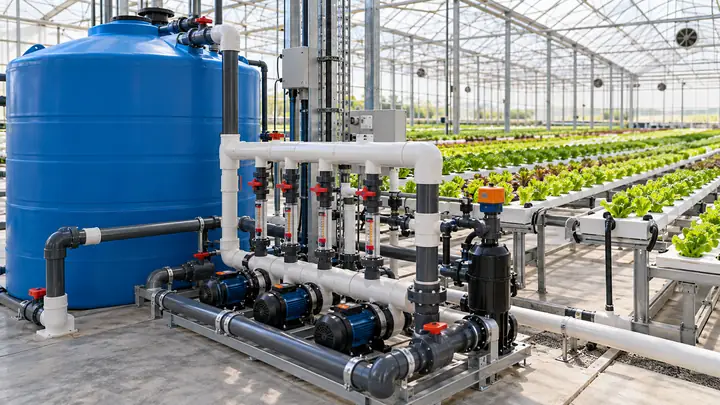
- Nutrient drift. Recirculating systems accumulate ions plants do not use, such as sodium. Monitor EC and pH daily and replace the solution when drift becomes hard to correct. Our guide on sizing a fertigation system covers dosing and control.
Can I combine systems on one site?
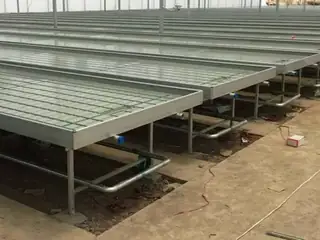
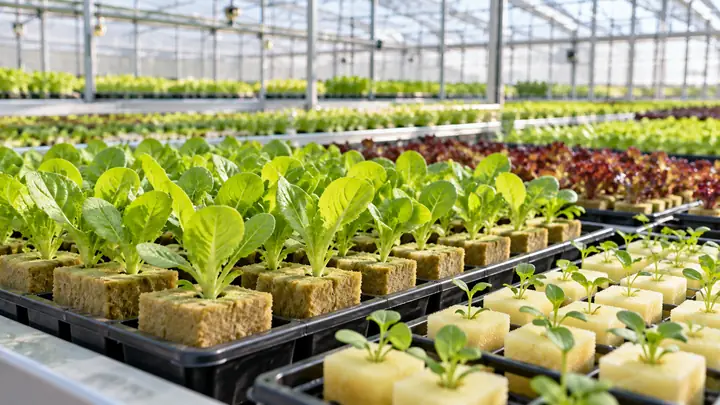
Yes, and most commercial sites do. A typical layout raises seedlings on tidal seedling benches, transplants leafy greens into NFT or DWC, and grows fruiting crops in Dutch buckets in a separate greenhouse zone with its own nutrient tank. Separate tanks let you run different EC targets for each crop.
Browse all hydroponic channels, benches and media, or share your crop plan and greenhouse dimensions for a layout and quote.