Short answer
To start a vertical farm, first confirm buyers for one or two crops such as leafy greens or herbs, then size growing positions from weekly demand. Choose a format (container, building fit-out or greenhouse), check the site's power and water, and write a business plan with a monthly cash flow. Electricity and labor usually dominate running costs, so confirm both before buying equipment.
What does it take to start a vertical farm?
To start a vertical farm, you need four things in this order: a confirmed buyer for a specific crop, a site with enough power and water, a growing system sized to that demand, and a business plan that shows the farm can cover electricity, labor and equipment payback. Most failed projects reverse that order and buy equipment first.
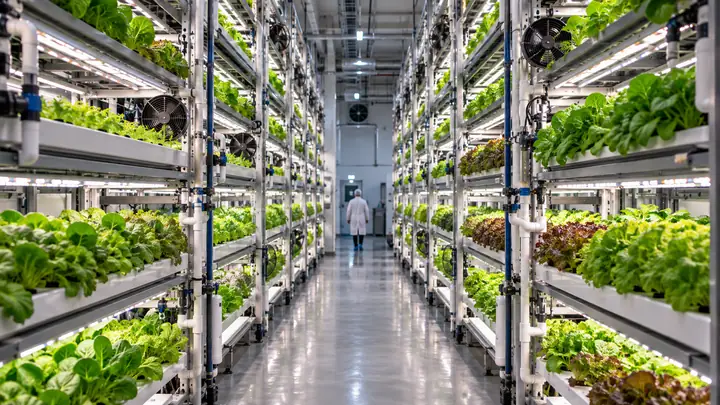
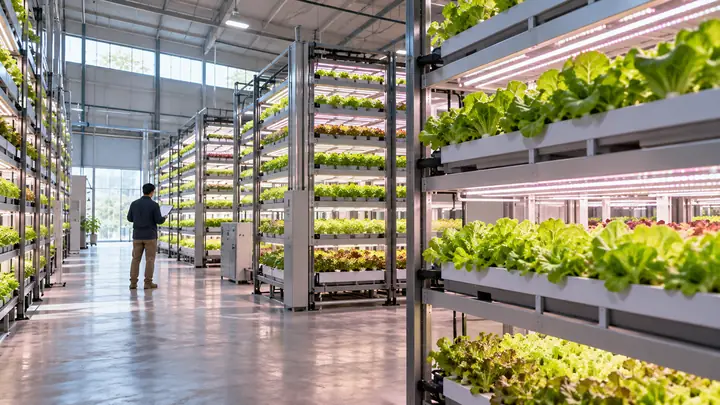
A vertical farm grows crops in stacked layers indoors under LED lighting, usually with hydroponic or aeroponic irrigation and full climate control. It is a manufacturing business as much as a farming one: output is predictable, but so are the bills. This guide walks through how to start a vertical farm as a commercial project, from market research and the vertical farm business plan to realistic cost drivers and the first crop cycle. If you are still deciding whether the model suits you at all, start with our overview of what vertical farming is and how it works.
Is vertical farming a good business to start?
It can be, but only in the right market. Vertical farming makes the most sense where at least one of these is true:
- Fresh leafy greens and herbs are imported or trucked long distances, so local product earns a premium for freshness and shelf life.
- The climate is too hot, cold or dry for reliable field or greenhouse production for much of the year.
- Buyers such as restaurants, hotels, caterers or retailers want consistent, pesticide-free supply every week.
- Electricity is reasonably priced, or you can use off-peak tariffs or on-site solar.
The story of many vertical farming startups is a useful warning. Several well-funded companies built very large facilities before they had proven unit economics, then struggled with energy costs and pricing pressure. The lesson is not that the model fails, but that a new farm should grow into its demand, starting with a size it can sell out and expanding in modules.
How to start a vertical farm: 10 steps
- Pick one or two target crops. Leafy greens, herbs, microgreens and strawberries are the usual choices. Price them against what buyers pay today.
- Secure demand. Talk to 10–20 potential buyers. Get letters of intent or trial orders with volumes, packaging and delivery frequency.
- Size production from demand. Convert weekly orders into plants per week, then into growing positions using crop cycle length and expected losses.
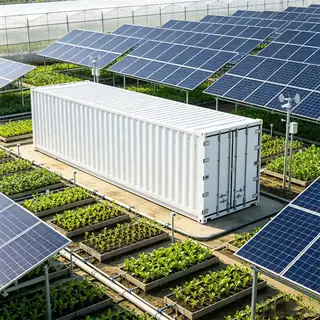
- Choose a format. Shipping container, fit-out of an existing building, or a hybrid with a greenhouse. Each has a different cost per square meter of growing area.
- Find and check a site. Confirm available electrical capacity, water quality, drainage, zoning, floor loading, ceiling height and access for deliveries.
- Write the business plan. Build a monthly cash flow with capital costs, operating costs, ramp-up and sales price.
- Arrange funding and permits. Typical sources include owner equity, equipment loans, local agriculture or food-security grants, and investors.
- Specify and order equipment. Racks or towers, lighting, HVAC and dehumidification, irrigation and fertigation, water treatment and controls.
- Install, commission and run trials. Run two or three crop cycles at partial capacity to tune light, EC, pH and climate before committing to full orders.
- Ramp up sales and document routines. Write standard operating procedures for seeding, transplanting, harvest, cleaning and food safety.
What should a vertical farm business plan include?
A lender or investor will read your vertical farm business plan to answer one question: can this farm sell enough at a good enough price to cover its costs and repay its equipment? The table below lists the sections that matter most.
| Section | What it must show | Typical evidence |
|---|---|---|
| Market and customers | Who buys, how much, at what price | Letters of intent, buyer interviews, current wholesale and retail prices |
| Product and crop plan | Crops, varieties, pack sizes, weekly volumes | Seeding and harvest schedule, yield assumptions per position |
| Facility and equipment | Format, layout, growing area, key systems | Floor plan, supplier quotations, utility capacity letter |
| Operations and staffing | Who does what, labor hours per week | Task list per crop cycle, shift plan, training plan |
| Capital budget | Total investment including shipping, installation and working capital | Itemized quotes, contingency of roughly 10–20% |
| Operating budget | Monthly electricity, labor, seeds, nutrients, packaging, rent, maintenance | Local tariffs, wage rates, consumable prices |
| Financial projections | Monthly cash flow, break-even, payback period | Three to five years, with a slow ramp-up in year one |
| Risks and mitigation | What happens if price drops, power fails or a crop is lost | Sensitivity table, backup power plan, insurance |
Build sensitivity into the numbers. Show what happens if the sales price is 15% lower, electricity is 20% higher, or yields reach only 70% of target in the first six months. A plan that survives those cases is far more credible.
How much does vertical farming cost?
There is no single answer to how much vertical farming costs, because it depends on format, scale, level of automation, local building costs and energy prices. A single container farm, a few hundred square meters fitted out in a warehouse, and a multi-thousand-square-meter plant factory differ by orders of magnitude. Instead of a headline number, plan around the cost drivers.
Capital costs
| Item | What drives the cost | Notes |
|---|---|---|
| Building or container | Purchase or lease, insulation, floor, fire and food-safety finishes | A container includes the shell; a warehouse fit-out often needs insulated panels |
| Growing system | Number of layers, rack or tower type, mobile vs static racks | See our vertical farming equipment guide |
| LED lighting | Growing area, light intensity needed by the crop, fixture efficiency | Usually one of the largest single items |
| HVAC and dehumidification | Lighting heat load, plant transpiration, outside climate | Under-sizing is a common and costly mistake |
| Irrigation, fertigation and water treatment | Recirculation, dosing channels, source water quality | RO may be needed where water is hard or saline |
| Controls and sensors | Level of automation, remote monitoring, data logging | Simple timers to full PLC control |
| Electrical upgrade | Grid connection capacity, transformers, backup generator | Check early; it can delay a project by months |
| Germination, harvest and packing area | Seeding equipment, cold room, washing and packing | Often forgotten in early budgets |
| Shipping, installation and commissioning | Distance, import duties, local labor | Ask for EXW, FOB and CIF prices to compare |
Operating costs
Electricity and labor typically dominate operating costs. Lighting alone has been estimated at around 30% of operating costs in indoor vertical farms, and climate control adds substantially to that. Published comparisons also suggest vertical farms use several times more electricity per kilogram of produce than greenhouses, which is why energy price is one of the first numbers to confirm. Other recurring costs include seeds, growing media, nutrients, packaging, water, rent, maintenance, LED replacement over time, delivery and insurance.
Ways to keep vertical farming cost under control include matching light intensity to what each crop actually needs, running lights on off-peak tariffs where possible, choosing efficient fixtures, recirculating nutrient solution, and designing workflows that cut handling time per plant.
Should I start with a container, a building fit-out or a greenhouse?
| Format | Best for | Strengths | Limits |
|---|---|---|---|
| Container farm | Pilots, remote sites, a single buyer | Fast to deploy, relocatable, self-contained | Small growing area; higher cost per square meter at scale |
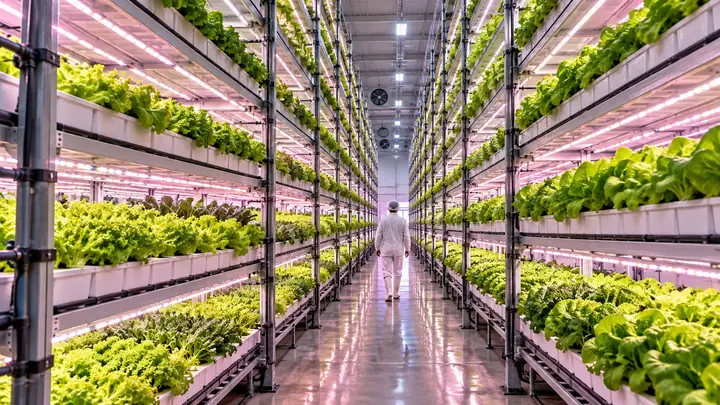
| Indoor plant factory in a building | Steady demand above a few containers' output | Shared climate and workflow lower unit cost | Needs a suitable building and longer build time |
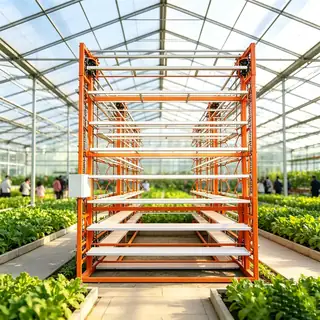
| Greenhouse with vertical systems | Mild or sunny climates, strawberries, greens | Uses free sunlight; much lower energy per kilogram | Less control; output varies with season |
For a detailed comparison, read container farm vs. indoor plant factory and our shipping container farm guide. Many first-time owners start with one container such as a turnkey climate-controlled container farm to prove demand, then move into a building with a customizable indoor vertical plant factory. In greenhouses, A-frame vertical systems are a low-energy way to stack production.
Which crops should a new vertical farm grow?
| Crop | Typical cycle after transplant | Why it fits | Watch out for |
|---|---|---|---|
| Lettuce and leafy greens | Roughly 3–6 weeks | Short cycle, compact, high plants per square meter | Tipburn; price competition with field lettuce |
| Basil and herbs | Roughly 3–5 weeks, or repeated cuts | High value per kilogram, strong restaurant demand | Short shelf life, chilling injury in basil |
| Microgreens | Roughly 1–3 weeks from sowing | Very fast turnover, low equipment need | Labor-intensive harvest, small market size |
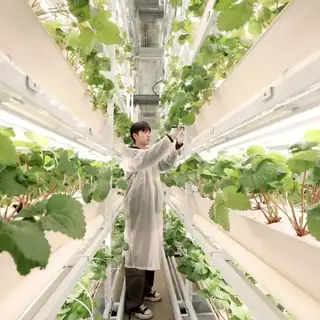
| Strawberries | Months per cycle | Premium off-season price | Pollination, higher light need, longer payback |
Most new farms start with leafy greens and herbs because they are forgiving and quick to learn. Lettuce and microgreens each have their own planning rules for spacing, light and harvest labor, so plan crop by crop.
How do I start a hydroponic farm on a smaller budget?
If the full capital budget is out of reach, learn the crop and the market first. Knowing how to start hydroponics at a small scale, even with a few racks or towers in a rented room, teaches you nutrient management, pest hygiene and harvest labor before the big money is spent. A trial room with a mobile vertical grow rack or a handful of towers can supply a few restaurants and generate real yield data for the business plan.
The steps for how to start a hydroponic farm at this scale are the same as above, just smaller: pick a crop, find buyers, size the system, then expand. Starting an indoor garden or a hydroponic garden for personal use is a different project with far simpler economics.
What mistakes sink new vertical farms?
- Building before selling. Capacity without contracts turns into waste.
- Underestimating electricity. Check the tariff, demand charges and grid capacity before signing a lease.
- Under-sized dehumidification. Plants transpire most of the water you give them; humidity drives disease.
- Ignoring water quality. Test source water for EC, alkalinity, sodium and chloride before you choose a nutrient program.
- Too many crops too soon. Each crop needs its own light, spacing and recipe.
- No labor plan. Seeding, transplanting, harvesting, packing and cleaning are daily work; budget the hours.
How can we help you plan the project?
Mars Vertical Farm has more than 20 years of production experience and builds container farms, indoor plant factories, racks and towers in a 2,000+ m² factory in Shanghai, with quotations in USD on EXW, FOB Shanghai or CIF terms. Browse our container and indoor plant factories and vertical hydroponic towers and racks, then send us your target crop, weekly volume and site dimensions and we will propose a layout and equipment list you can use in your business plan.