Short answer
Hydroponics grows plants in a mineral nutrient solution, with roots in water or an inert medium. Aeroponics suspends roots in air and sprays them with nutrient mist, giving more oxygen but less tolerance of pump failures. Aquaponics feeds plants with fish waste converted by bacteria, producing fish and crops but with less precise nutrient control and pH.
Aeroponics vs. hydroponics vs. aquaponics: what is the difference?
In the aeroponics vs. hydroponics question, the difference is how nutrient solution reaches the roots. Hydroponics grows plants with roots in or wetted by a flowing or standing nutrient solution, often with an inert medium; aeroponics suspends roots in air and sprays them with a fine nutrient mist. Aquaponics is a third route: it combines fish farming with hydroponics, so fish waste, converted by bacteria, feeds the plants instead of bagged fertilizer.
Strictly speaking, aeroponics is a specialized form of soilless culture, and many growers treat it as a branch of hydroponics. All three are closed or semi-closed systems that use far less water than open-field irrigation. They differ in complexity, risk, nutrient control and what they cost to run, and those differences decide which one fits a commercial project.
What is hydroponics?
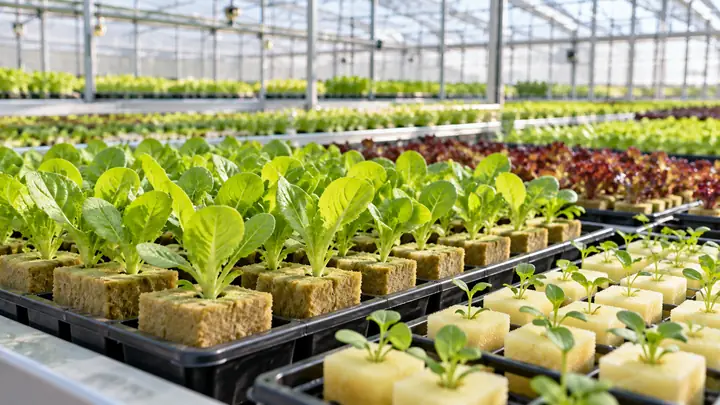
Hydroponics is growing plants without soil, supplying all mineral nutrients through a water-based solution mixed from fertilizer salts. The grower sets the recipe and controls it with EC and pH. Common hydroponic methods include:
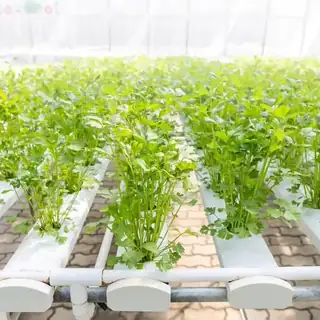
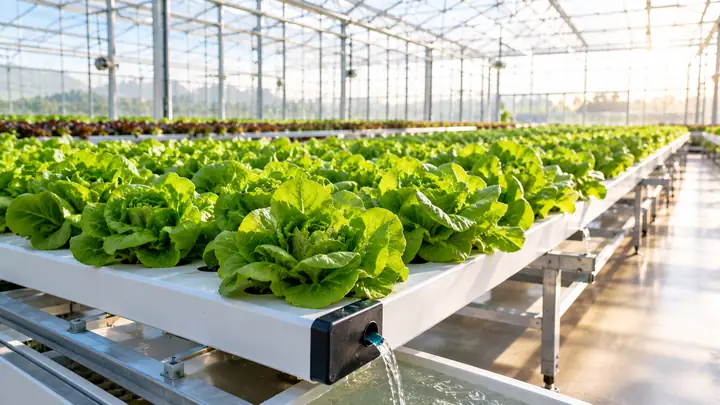
- Nutrient film technique (NFT): a thin film flows through sloped channels past bare roots. See our NFT hydroponic system guide.
- Deep water culture (DWC): roots hang in deep, aerated solution under floating rafts. See the deep water culture guide.
- Ebb and flow, drip and Dutch buckets: plants in substrate are irrigated on a schedule.
For the full background, read what is hydroponics.
What is aeroponics and how does it work?
The aeroponics definition is simple: plants are held in a closed chamber or column with their roots hanging in air, and nozzles spray the roots with nutrient solution at intervals. Excess solution drains to a tank and is recirculated. Because roots are surrounded by air rather than water, they get abundant oxygen, which can speed growth when the system is well run.
There are two quite different kinds of aeroponic systems, and much confusion comes from mixing them up:
- High-pressure aeroponics uses a pressure pump, an accumulator and fine misting nozzles to create very small droplets, typically in short bursts every few minutes. It is the "true" aeroponics used in research and some commercial plant factories and seed potato production. It is precise but demanding: nozzles clog, pressure must be held, and a timer or pump failure leaves roots exposed within minutes.
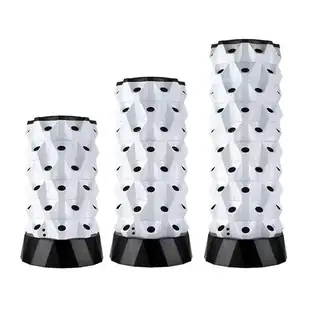
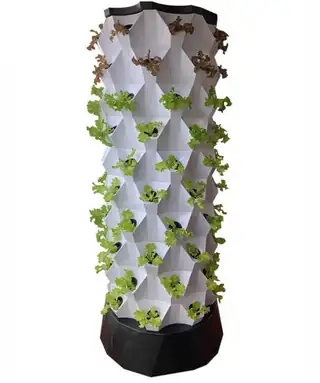
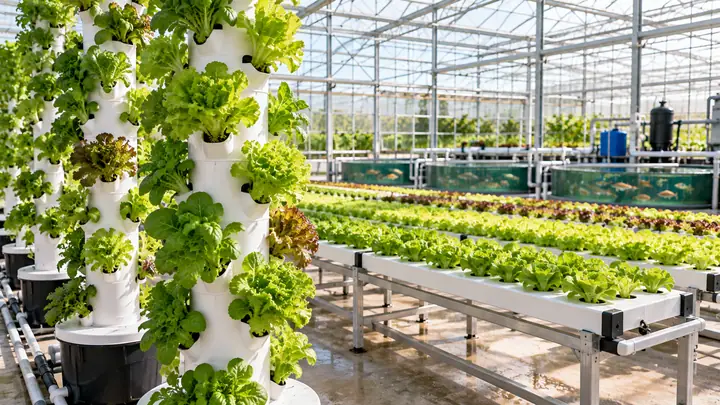
- Low-pressure aeroponics uses ordinary pumps to spray or trickle solution through larger nozzles or down the inside of a tower. Many vertical aeroponic growing system towers sold for greenhouses and homes work this way. Droplets are larger and the roots partly sit in a thin film, so it is closer to NFT in behavior, but it is more forgiving and much easier to maintain.
Aeroponic farming is most often seen in vertical towers for leafy greens, herbs and strawberries, in seed potato minituber production and in research. Our pineapple aeroponic greenhouse tower is an example of a low-pressure vertical design; the hydroponic towers guide explains how towers compare.
What is aquaponics?
Aquaponics links a recirculating fish tank to a plant growing system. Fish excrete ammonia; nitrifying bacteria in the biofilter and growing beds convert it first to nitrite and then to nitrate, which plants take up. The plants clean the water, which returns to the fish. Extension guidance notes that a new system needs at least several weeks to establish those bacteria before planting.
The plant side of an aquaponic system can be a media bed, deep water rafts, or NFT channels. NFT aquaponics, sometimes called nutrient film aquaponics, works well for leafy greens, but it needs good solids filtration because fish waste can clog narrow channels and coat roots. Vertical aquaponics systems use towers or stacked beds to raise plant density over the fish tanks.
The trade-off is control. In hydroponics vs. aquaponics, hydroponics lets you set every nutrient directly. In aquaponics, nutrient supply depends on fish stocking and feeding, pH must be a compromise between fish, bacteria and plants (often roughly 6–7, versus about 5.5–6.5 in hydroponics), and some elements, commonly iron, potassium and calcium, usually need supplementing.
How do aeroponics, hydroponics and aquaponics compare?
| Factor | Hydroponics | Aeroponics | Aquaponics |
|---|---|---|---|
| Root environment | Solution film, deep water or inert substrate | Air, with periodic nutrient mist or spray | Water from fish tanks, via media, rafts or channels |
| Nutrient source | Mineral fertilizer, mixed to a recipe | Mineral fertilizer, mixed to a recipe | Fish feed converted by bacteria, plus supplements |
| Typical pH | About 5.5–6.5 | About 5.5–6.5 | Compromise, often about 6–7 |
| Nutrient control | High | High | Moderate; tied to fish biomass and feeding |
| Root oxygen | Good to very good, depending on method | Very high | Good, needs aeration for fish too |
| Sensitivity to pump or power failure | Low (DWC) to high (NFT) | Very high for high-pressure systems | High, because fish also depend on aeration |
| Technical complexity | Moderate | Moderate (low-pressure) to high (high-pressure) | High: two living systems to manage |
| Typical commercial crops | Lettuce, herbs, tomatoes, cucumbers, strawberries, peppers | Leafy greens, herbs, strawberries, seed potatoes | Leafy greens and herbs, plus fish |
| Main revenue | Crops | Crops | Crops and fish |
What are the pros and cons of each system?
Hydroponics
- Pros: mature, widely understood technology; full control of nutrients; wide choice of methods for every crop; equipment and expertise are easy to find.
- Cons: requires buying fertilizer and disposing of spent solution responsibly; some methods (NFT) have little buffer against failures.
Aeroponics
- Pros: excellent root oxygenation; low solution volume; very light structures suited to vertical towers; roots are easy to inspect.
- Cons: nozzles clog, especially with hard water or poorly dissolved fertilizer; high-pressure systems need precise pumps and timers; any interruption dries roots fast.
Aquaponics
- Pros: fish waste replaces most fertilizer; two products from one water loop; appeals to buyers seeking organic-style production, depending on local certification rules.
- Cons: slower to establish; compromise pH limits peak plant performance; fish health, feed costs and animal welfare rules add risk; harder to scale and to correct problems quickly, since you cannot dose pesticides or many treatments without harming fish or bacteria.
How do water use, energy and maintenance compare?
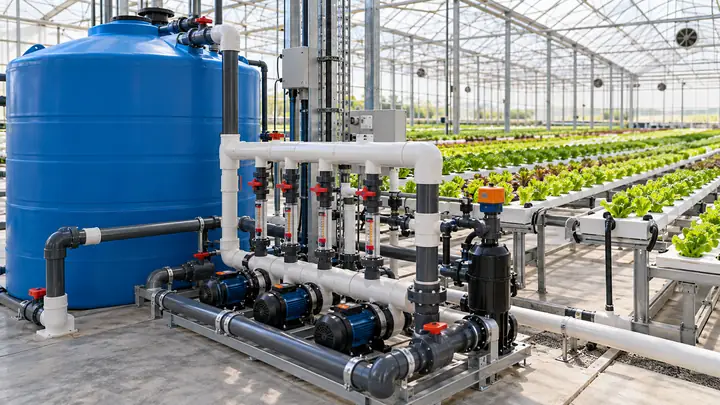
All three systems recirculate water, so water use per kilogram of crop is typically far lower than in open-field irrigation. The differences lie elsewhere:
- Water volume in the system: aeroponics holds the least solution, which makes it quick to adjust but gives little thermal buffer. Deep water hydroponics holds the most. Aquaponics holds large volumes in fish tanks and biofilters.
- Energy: high-pressure aeroponics adds the load of pressure pumps; aquaponics needs continuous aeration for fish and bacteria; hydroponics varies by method, with DWC aeration and NFT circulation pumps as the main loads. In indoor farms, lighting and climate control usually dwarf all of these.
- Routine maintenance: hydroponics centers on EC, pH and cleaning between crops. Aeroponics adds nozzle inspection and cleaning. Aquaponics adds daily fish feeding, ammonia and nitrite testing, and solids removal.
- Waste: hydroponic and aeroponic systems periodically discharge spent nutrient solution, which should be reused on other crops or handled per local rules. Aquaponics produces fish solids that must be removed and can be composted.
Which system should a commercial grower choose?
Use this checklist to narrow the choice:
- Define your crop and market. Leafy greens and herbs fit all three. Tomatoes, cucumbers and peppers fit substrate hydroponics far better than aeroponics or aquaponics.
- Decide whether you want to sell fish. If not, aquaponics adds complexity without matching benefit.
- Check your water. Hard or saline water causes nozzle clogging in aeroponics and pH drift in all systems. Plan water treatment early.
- Assess power reliability. Where outages are common, favor systems with water buffer, such as deep water culture, or budget for backup power.
- Be honest about skills and labor. High-pressure aeroponics and aquaponics need more technical attention than NFT, DWC or drip systems.
- Compare cost drivers. Hydroponics usually has the most predictable build and running costs. Aeroponics adds high-pressure components or tower hardware; aquaponics adds tanks, biofilters, fish stock and feed.
- Pilot before you scale. Run a small trial of your chosen system with your water, climate and crops before committing to a full facility.
For most commercial projects focused purely on vegetables, conventional hydroponics such as NFT, DWC or substrate systems remains the lowest-risk choice. Low-pressure aeroponic towers are a good fit for high-density leafy greens in greenhouses or indoor farms. Aquaponics makes most sense when fish are part of the business plan or where its educational and marketing value is important. Our overview of commercial hydroponic systems goes further into scale and layout.
Are aeroponic and aquaponic kits worth it?
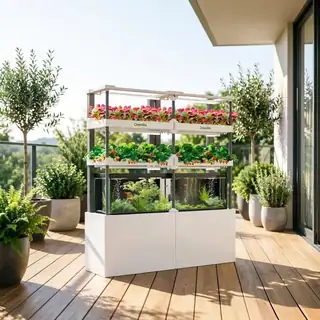
An aeroponics kit or small aero hydroponic garden is a useful way to learn the method, and indoor aquaponics units are popular in classrooms and homes. Our indoor recirculating aquaponics system with LED is one example. For commercial buyers looking at aeroponics systems for sale, the questions are different: nozzle or spray design and how easily it is cleaned, pump redundancy, food-grade and UV-stable materials, frame strength and how the system integrates with fertigation and climate control.
Mars Vertical Farm has manufactured hydroponic and aeroponic towers, channels and plant factories for more than 20 years, with exports to markets including the USA, Canada, Germany, Saudi Arabia and Australia. Browse our vertical hydroponic towers and racks, or tell us your crop, site and target output and we will suggest a suitable system and quotation.