Short answer
Size a hydroponic water pump by working out the flow your channels or emitters need, then the total head: lift from the reservoir surface to the highest outlet plus pipe friction and any emitter pressure. Pick a pump that delivers that flow at that head on its curve, with roughly 20 to 30% margin. Deep water culture also needs an air pump and air stones.
What does a hydroponic water pump do?
A hydroponic water pump moves nutrient solution from the reservoir to the plants and, in recirculating systems, keeps it flowing back again. You size it from two numbers: the flow your channels, drippers or towers need, and the total head (height plus friction loss) the pump has to push against.
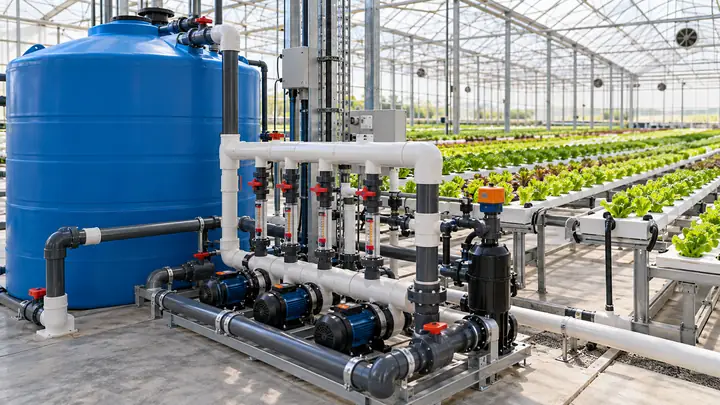
In most systems the pump runs alongside two other components: an air pump with air stones to raise dissolved oxygen in the reservoir, and a set of pipes, fittings and drains that carry water around the loop. Together they form the hydroponic pump system. When any part of it is undersized or badly laid out, the symptoms show up in the crop as dry channel ends, warm stagnant water, algae or root rot.
This guide covers how to choose a hydroponics pump, when you need an air pump, how to size the reservoir, and how to lay out PVC plumbing so that the system drains, cleans and survives a power cut.
Which types of hydroponics pump are used?
| Pump type | How it works | Typical use | Points to watch |
|---|---|---|---|
| Submersible pump | Sits inside the reservoir; water cools the motor | Home and small commercial NFT, towers, DWC circulation | Adds heat to the solution; harder to service; choose a sealed, food-safe model |
| Inline (external) centrifugal pump | Mounted outside the tank, fed by a flooded suction line | Commercial NFT, A-frames, Dutch buckets, multi-zone farms | Needs priming or a flooded inlet; easier to service and to fit with valves and filters |
| Multistage or booster pump | Several impellers in series for higher pressure | Drip-fed substrate systems, long runs, fertigation units | Size carefully to the emitter pressure; usually paired with filters |
| Dosing pump | Injects small, metered volumes | Adding nutrient stock and acid for EC and pH control | Not a circulation pump; calibrate regularly |
| Air pump (diaphragm or linear) | Pushes air through tubing to air stones | DWC rafts, reservoirs, buckets | Moves air, not water; place it above the water line or fit check valves |
A submersible hydroponic water pump is the simplest choice for a single small system. Once a farm grows to several racks or a greenhouse range, an external water pump for hydroponics on a manifold is usually easier to maintain, because you can isolate it with valves and swap it without draining the tank.
How do you size a water pump for a hydroponic system?
Follow these steps to size a water pump for a hydroponic system:
- Find the required flow. For NFT, multiply the number of channels by the flow per channel. Many leafy-green systems run in the region of 1 to 2 L/min per channel, depending on channel width and length. For drip systems, multiply the number of emitters by the emitter flow. For DWC, the pump only circulates and mixes, so a modest turnover of the tank volume each hour is usually enough.
- Measure the static head. This is the vertical distance from the water surface in the reservoir to the highest outlet, such as the top channel of an A-frame or the top of a tower.
- Estimate friction losses. Pipes, elbows, valves and filters all resist flow. On short, generously sized runs this can be a small fraction of the static head. On long or narrow runs it can exceed it.
- Add the outlet pressure. Open outlets into channels need almost none. Drip emitters and sprayers need their rated pressure, often expressed in bar or meters of head.
- Read the pump curve. Choose a pump that delivers your required flow at the total head, not its maximum "open flow" figure. Allow roughly 20 to 30% margin for clogging, wear and future expansion.
- Add control. Fit a ball valve or bypass after the pump so that you can trim flow, and a non-return valve where backflow could drain a header.
Example: a rack has 20 NFT channels at about 1.5 L/min each, which gives 30 L/min, or 1.8 m³/h. The top channel is 1.8 m above the reservoir surface, and friction is estimated at about 1 m, so the total head is roughly 3 m. You need a pump that delivers at least 1.8 m³/h at 3 m of head, which with margin means looking for around 2.2 to 2.4 m³/h at that head on the curve.
For drip-fed systems that also inject fertilizer, the pump and the dosing unit are sized together; see how to size a fertigation system.
Do you need a hydroponic air pump and air stones?
Roots need oxygen. In NFT, the thin film of moving solution and the air above it provide most of it. In deep water culture, roots sit in still water, so a hydroponic air pump feeding air stones is standard; extension guidance for lettuce rafts suggests keeping dissolved oxygen around 6 to 8 ppm. Air stones in a hydroponics reservoir also help mix nutrients and limit stagnant zones.
Practical points:
- Spread the air. Several medium hydroponic airstones or diffuser bars along a raft bed oxygenate more evenly than one large stone.
- Keep the water cool. Warm water holds less oxygen. Many growers aim for roughly 18 to 22 °C in the solution, and root disease pressure tends to climb as water gets warmer.
- Size by depth and volume. The best air pump for hydroponics is one rated for the depth of your tank with enough output for all its stones. Deeper water needs more pressure. Check the manufacturer's rating at your depth rather than its open-air figure.
- Protect the pump. Mount the air pump above the water level or fit check valves so that water cannot siphon back into it during a power cut.
- Measure, don't guess. A handheld DO meter quickly shows whether aeration is enough.
For raft design and stocking density, see our deep water culture guide, and for channel systems the NFT system guide.
How big should a hydroponic reservoir be?
A hydroponic reservoir (or hydroponic tank) must be large enough to buffer changes in EC, pH and temperature, and to hold all the water that drains back from the system when the pump stops. A larger volume is more stable, but costs more to fill, heat or chill.
- Drain-back volume first. Add up the water standing in channels, pipes and towers. When the pump stops, that water returns to the tank. If the tank cannot hold it, it overflows.
- Add a working volume. A crop drinks a lot on a hot day. A working volume equal to at least one to two days of plant uptake reduces how often EC swings or the pump runs dry.
- Use opaque, food-safe material. Hydroponic reservoir tanks should block light to prevent algae and should be made of food-grade plastic or lined steel.
- Cover it. A lid reduces evaporation, light, debris and pests.
- Plan for cleaning. Fit a drain valve at the lowest point and leave access for scrubbing between crops.
Top up the hydroponic system reservoir every few days and plan a partial or full solution change every few weeks to stop unwanted ions from building up. Commercial farms often split large hydroponic reservoirs into one per zone, so a disease or dosing mistake does not spread across the whole farm.
How do you plumb a PVC hydroponic system?
Most hydroponics with PVC pipe uses PVC for the supply manifold and either PVC pipe or purpose-made PVC channels for the growing troughs. PVC hydroponic systems are popular because the material is cheap, easy to glue and widely available. Good practice:
- Use food-safe, UV-stabilized material for anything that touches the nutrient solution, and opaque or white-outer pipe to keep light out.
- Size supply headers generously so that pressure is even from the first outlet to the last. A header that is too narrow starves the far end.
- Size drains larger than supplies. Returns flow by gravity, so they need a larger diameter and a steady fall back to the tank.
- Set channel slope. NFT channels are commonly laid at a fall of roughly 1 to 3%, so water flows without pooling.
- Add unions and valves at the pump, filter and each zone so that parts can be isolated and removed without cutting pipe.
- Filter before small outlets. Fit a screen or disc filter ahead of drippers and small feed tubes; see our irrigation filters guide.
- Pressure-test and flush the system with clean water before planting, then check every outlet for even flow.
Hydroponics using PVC pipes made from drainage-grade or round pipe works for small builds, but round pipes hold less root space and dry out faster at the edges than flat-bottomed channels. Commercial growers usually move to dedicated hydroponic pipe or square channels, such as our flat food-grade PVC NFT system with pump.
Can you run a solar hydroponic pump?
Yes, but design for continuity. A solar powered hydroponic pump is a DC pump fed by panels, a charge controller and usually a battery bank. NFT roots can dry out within tens of minutes to a couple of hours if flow stops, depending on temperature and plant size, so a solar hydroponic pump without battery backup is risky for NFT. DWC and drip systems on timers are more forgiving. Size the battery to cover nights and cloudy spells, and keep a mains or generator backup for critical crops. Our solar-powered irrigation guide explains panel and battery sizing in more detail.
How do you prevent root rot in hydroponics?
Root rot in hydroponics is usually caused by water molds such as Pythium, which thrive in warm, low-oxygen, dirty systems. Infected roots turn brown, soft and slimy, and plants wilt even though they stand in water. Plumbing and aeration are your first line of defense:
- Keep solution temperature in a moderate range and dissolved oxygen high.
- Avoid dead legs, sumps and low points in pipework where water stagnates.
- Block light from tanks and channels so that algae cannot feed microbial growth.
- Start with clean plugs, remove diseased plants promptly, and clean and sanitize the whole system between crops.
- Treat source water if it carries pathogens or sediment.
Hydroponic root rot treatment is mostly about correcting those conditions: cool and aerate the solution, remove badly affected plants, and flush and sanitize. Once disease is established in lines and tanks it is hard to remove, so prevention is far cheaper than cure.
Pump and plumbing maintenance checklist
- Clean pump intakes and pre-filters weekly, and more often if you see algae or root debris.
- Check flow at the last channel or emitter in each zone every week.
- Replace air stones when their output drops or they clog with scale.
- Keep a spare pump on site for each critical zone.
- Fit a low-level float switch to protect pumps from running dry, and a flow or power alarm for night-time failures.
Need a complete system?
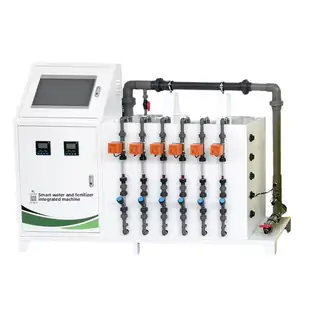
Mars Vertical Farm supplies complete recirculating systems with pumps, reservoirs and pipework, including deep water culture floating grow beds, NFT racks and the smart fertigation machine with dosing pump for EC and pH control. Explore our hydroponic systems, or send us your layout and we will size the pump, reservoir and plumbing as part of a quotation.