Short answer
Drip irrigation for vegetables uses low-pressure tubing with emitters or drip tape to water each row or container at the root zone. A basic system needs a backflow preventer, a 150-200 mesh filter, a pressure regulator, a supply line and driplines spaced about 20-30 cm apart. Size each zone so total emitter flow stays below your available water supply.
What is drip irrigation for vegetables?
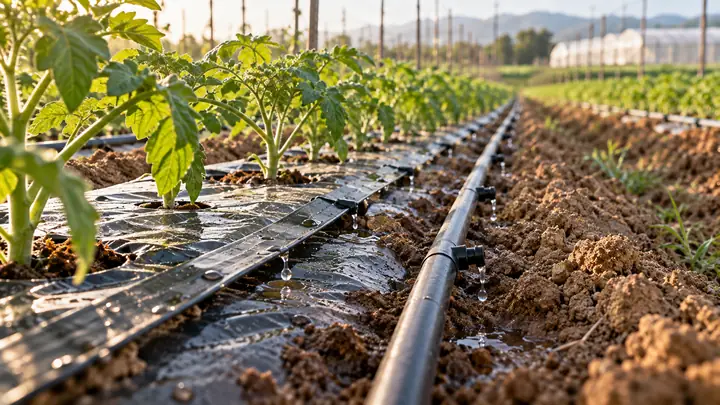
Drip irrigation for vegetables delivers water slowly through emitters or drip tape directly to the root zone of each row, bed or container. Instead of wetting the whole surface like a sprinkler, a vegetable drip irrigation system applies water at low pressure and low flow, so more of it reaches the roots and less is lost to evaporation, runoff and weeds.
The same principles apply to a home vegetable garden, a market garden of a few thousand square meters, a tunnel of tomatoes or a terrace of pots. What changes is the water source, the size of each zone and how much automation makes sense. This guide covers practical layouts for beds, containers and small farms, the parts you need, simple sizing arithmetic and the mistakes we see most often. For a deeper look at each component, see our drip irrigation system guide.
Why use drip instead of sprinklers or hand watering?
Drip is the default for most vegetable growers who irrigate regularly, for practical reasons:
- Less water. Extension guidance from Kansas State University notes that drip may use less than half the water of sprinkler irrigation, because water goes only where roots are.
- Drier leaves. Tomatoes, cucurbits, peppers and strawberries suffer less foliar disease when leaves stay dry.
- Fewer weeds. Paths and inter-rows stay dry, so weeds germinate mainly in the wetted strip.
- Low pressure. Most drip tubing runs at roughly 0.5–1 bar, so a small pump, a garden tap or even a raised tank can supply it.
- Fertigation. Soluble fertilizer can be injected into the same lines and placed in the root zone.
- Less labor. A garden irrigation system with a timer replaces daily hand watering and gives more consistent moisture.
There are limits. Emitters clog without filtration, lines are easily cut by hoes and rodents, and very small seeds such as carrots or lettuce often need overhead or hand watering until they germinate, because the wetted strip from a dripper may not keep the whole seedbed moist.
Which drip setup fits a garden, containers or a small farm?
Most layouts fall into one of the patterns below. Sizes are typical starting points; always check the manufacturer data for the tube or emitter you buy.
| Setting | Typical layout | Emitters | Head and control |
|---|---|---|---|
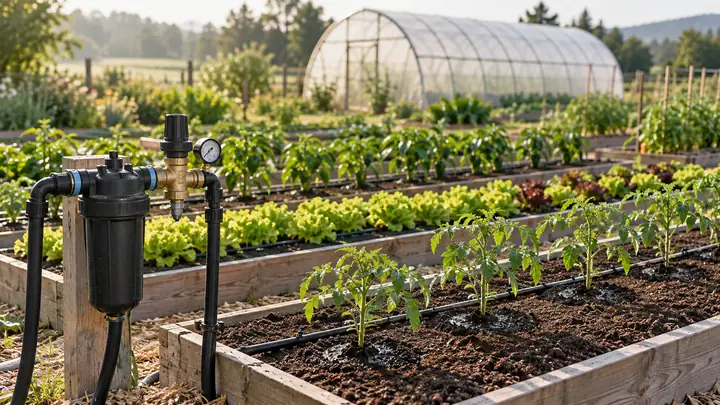
| Raised beds and vegetable garden irrigation | 16 mm (1/2 in) supply along the bed ends, two to four inline driplines per 1.2 m bed | Inline dripline, 20–30 cm spacing, roughly 1–2 L/h per emitter | Tap, backflow preventer, filter, pressure regulator, battery timer |
| Flower bed irrigation and mixed borders | Dripline looped through the bed, or point emitters at larger shrubs | Inline dripline or 2–4 L/h point drippers | Same as above; separate zone from vegetables |
| Container drip irrigation | 16 mm supply with 4–6 mm microtube to each pot | Pressure-compensating drippers or stakes, 1–4 per pot | Timer with several short cycles per day |
| Market garden or small farm (roughly 0.1–2 ha) | Drip tape on every bed, PE or layflat mains, one sub-main per block | Drip tape, 20–30 cm spacing | Pump or mains, disc or screen filter, valve per zone, fertilizer injector |
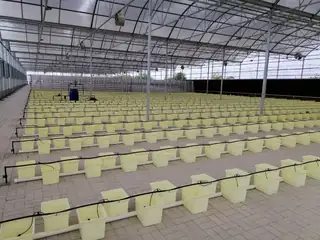
| Tunnels and greenhouses | Dripline per row, or drip stakes into pots, bags or buckets | Pressure-compensating dripline or 2 L/h stakes | Automatic filter, solenoid valves, fertigation unit |
| Portable irrigation for rented or temporary plots | Above ground irrigation on the surface with quick couplers | Thicker-walled dripline that can be rolled up | Portable pump or tank, screen filter, manual timer |
For row crops the main choice is between thin-walled tape and heavier dripline. Our comparison of drip tape vs. drip line vs. tubing explains service life, cost and when each makes sense.
What parts does a garden drip system need?
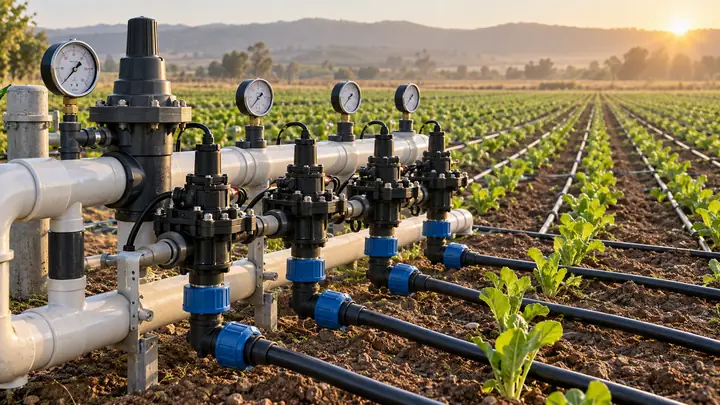
Every garden drip system, from a single bed to a large garden irrigation system, has the same core. The head assembly is installed at the water source, usually in this order (check local plumbing rules for backflow requirements):
- Shut-off valve so you can isolate the system.
- Timer or controller, if you are automating at a tap.
- Backflow preventer to stop garden water, and any fertilizer, from siphoning back into drinking water.
- Filter. A 150–200 mesh screen or disc filter suits most mains and well water; surface water from ponds or ditches usually needs a sand media filter first.
- Pressure regulator to bring pressure down to what the tube is rated for, often about 0.7–1.0 bar for drip tape and garden dripline.
Downstream of the head you need a supply line (often 16 mm or 20 mm PE), driplines or tape, barbed or compression fittings, end caps or flush valves, and stakes to hold lines in place. A home irrigation system diagram is simply this: source, head assembly, supply line, laterals along each row, and closed ends that can be opened for flushing.
How do I plan a vegetable garden drip irrigation layout?
Work through these steps before buying parts:
- Map the site. Sketch beds, row lengths, slopes and the water source. Note which beds hold which crops through the season.
- Measure flow and pressure. Time how long the tap takes to fill a 10 L bucket. A tap that fills it in 40 seconds delivers about 15 L/min (900 L/h). A cheap gauge on the tap gives static pressure.
- Choose emitter spacing. On sandy soil water moves down more than sideways, so use closer spacing (around 20 cm). On loam or clay, 30 cm or more usually gives a continuous wetted strip.
- Group crops into zones. Put crops with similar water demand and root depth on the same valve: fruiting crops together, leafy greens together, perennials separately.
- Calculate zone flow. Multiply the number of emitters by the emitter flow. Keep each zone at roughly 70–80% of the flow you measured, or split it.
- Check run lengths. Each tube has a maximum lateral length at a given slope and pressure. Keep within it, or feed long rows from the middle.
- Install and flush. Lay the supply line, connect laterals, open the ends and flush before capping.
- Test the wetting pattern. After a normal cycle, dig a small hole beside an emitter and confirm moisture reaches the root depth of the crop.
Worked example: four beds of 1.2 × 6 m, each with two driplines at 30 cm spacing, give eight lines of 20 emitters, or 160 emitters. At 1.6 L/h each, the zone needs about 256 L/h, or roughly 4.3 L/min, well within a typical garden tap. One zone is enough. A plot ten times larger would need several zones or a pump. Our guide on how to design a drip irrigation system covers friction loss and pipe sizing in more detail.
How does container drip irrigation work?
Pots, grow bags and planters dry out far faster than beds, so a container drip system is often the single most useful piece of automation for terraces, rooftops and greenhouse substrate crops. Practical rules:
- Use pressure-compensating drippers so pots at the end of the line get the same water as pots near the tap.
- Match emitters to pot size. One 2 L/h dripper suits a small pot; large pots or containers over roughly 20 L usually need two or more, placed on opposite sides.
- Water in short pulses. Several short cycles per day suit soilless media such as coir or perlite better than one long cycle. In substrate culture, many growers aim for roughly 10–30% drainage to prevent salt build-up.
- Keep microtube short and secure each end with a stake so drippers do not pop out of the pot.
The same approach, scaled up, is how commercial greenhouses irrigate tomatoes and cucumbers in buckets. A Dutch bucket planting system is essentially container drip irrigation with a drain return, fed from a nutrient tank.
What spacing and depth do common vegetables need?
| Crop | Effective root depth (typical) | Lines per 1.2 m bed | Notes |
|---|---|---|---|
| Tomato, pepper, eggplant | 40–60 cm | 1–2 | Steady moisture reduces blossom-end rot and fruit cracking |
| Cucumber, squash, melon | 30–60 cm | 1–2 | High demand at fruit set; keep foliage dry |
| Lettuce and leafy greens | 15–30 cm | 3–4 | Shallow roots; short, frequent cycles |
| Onion, garlic, carrot | 20–40 cm | 2–3 | Close emitter spacing; reduce water before harvest of bulbs |
| Strawberry | 15–30 cm | 1–2 under mulch | Drip under plastic mulch keeps fruit clean |
| Beans and peas | 30–50 cm | 1–2 | Avoid water stress at flowering |
How do I scale drip irrigation to a small farm?
Above a few hundred square meters, a tap and battery timer are no longer enough. A small farm drip system usually adds:
- Zoning with valves. The farm is split into blocks that irrigate one at a time, each sized to the pump or supply flow. Solenoid valves let a controller run them in sequence.
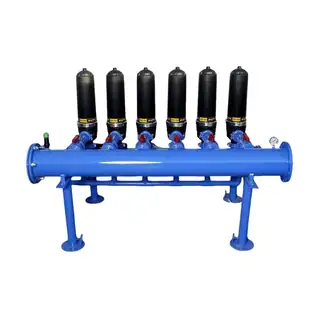
- Better filtration. Well water with sand, or any surface water, needs a disc or media filter that can be cleaned without stopping the farm. An automatic backwash disc filter system cleans itself on pressure difference. Our filter comparison explains which type to pick.
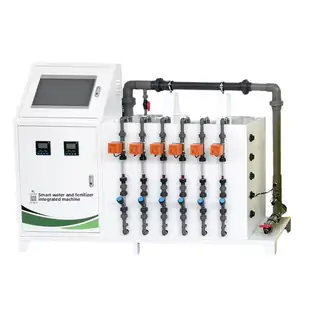
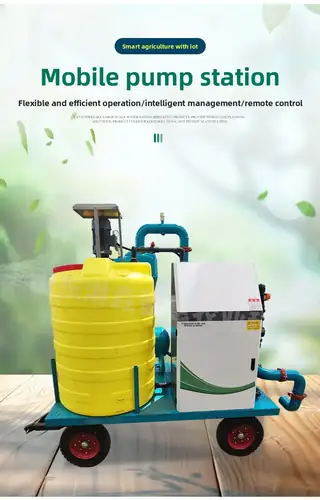
- Fertilizer injection. A venturi or dosing pump adds soluble fertilizer to the water. On larger tunnels a smart fertigation machine with dosing pump controls EC and pH automatically, while scattered plots can share one towed mobile water-fertilizer unit.
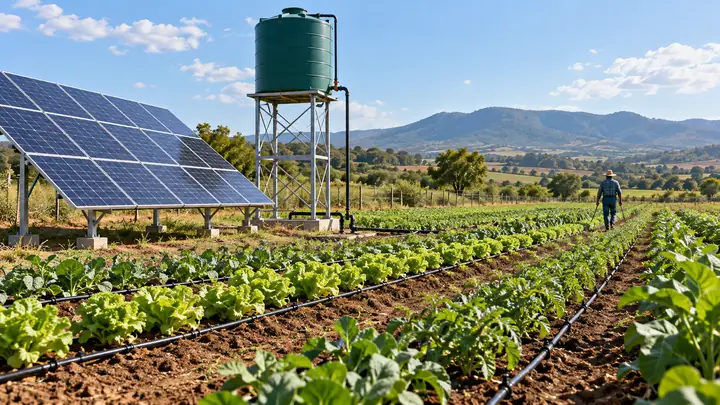
- A suitable power source. Where grid power is unreliable, solar pumping or gravity from a header tank can run low-pressure drip; see solar-powered and gravity drip irrigation.
Do I need a timer or an irrigation controller?
Automation is what turns drip from a convenience into consistent crop quality. The options, from simplest to most capable:
- Manual irrigation timer. A mechanical countdown valve on the tap. It prevents forgotten hoses but still needs someone to start it.
- Battery tap timer. Runs one or two zones on a schedule. Good for an automatic garden irrigation system of a few beds.
- Residential irrigation controller. A wall-mounted multi-zone controller that drives solenoid valves, the usual heart of a residential irrigation system or home irrigation controller setup.
- Smart controller with sensors. Adjusts run times from weather data or soil moisture sensors, and logs water use. See our guide to smart irrigation controllers and timers.
Whatever you use, schedule by checking the soil. In summer, beds often need a cycle every one to two days; containers may need several per day. Dig down 10–15 cm a few hours after irrigating: if the soil is dry at root depth, run longer; if it is soggy, shorten or space out the cycles.
What maintenance does a drip system need?
Most drip failures come from a handful of avoidable mistakes: no filter or regulator, laterals longer than the tube allows, mixing different emitter types on one zone, and injecting fertilizer without a backflow preventer. A simple routine keeps lines working for years:
- Clean the filter at least monthly, and weekly on dirty water.
- Open line ends and flush every few weeks, and always after fertigation with phosphates or iron.
- Walk the lines during a cycle to spot leaks, dry plants and blocked emitters.
- Cover lines with mulch to shade them from sunlight and deter damage.
- In frost-prone climates, drain the head assembly and lines before winter.
Choosing equipment for a small farm
Garden kits are fine for a few beds. Once you are planning zones, filtration and fertigation for a tunnel or small farm, it pays to size the equipment properly. Mars Vertical Farm builds filtration, fertigation and irrigation control equipment in its Shanghai factory and exports to growers in countries including Canada, the USA, Brazil, Germany and Australia. Browse the irrigation, fertigation and water treatment range, or send us your plot layout, water source and crop list for a quotation.