Short answer
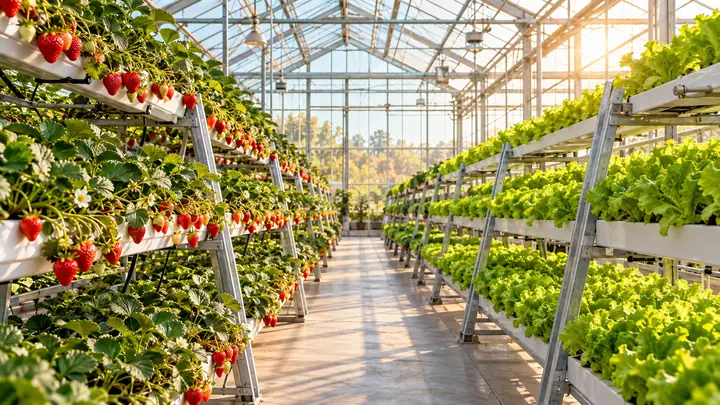
An A-frame system mounts growing channels on the two sloped faces of a triangular steel frame, so the same greenhouse floor holds roughly two to four times as many plants as a single flat bench. For strawberries, use substrate troughs with coco coir slabs and drip irrigation; for leafy greens, use NFT pipe channels. Run the frames north-south and leave wide enough aisles so lower tiers still get light.
What is an A-frame hydroponic system?
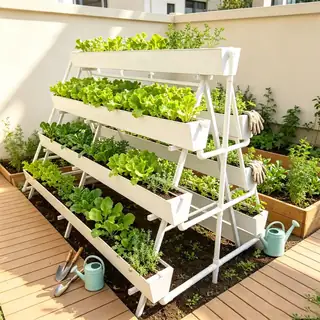
An A-frame is a triangular rack, usually galvanized steel, with growing channels fixed horizontally across both sloped faces. Each face typically carries 3–4 tiers, so a frame holds 5–8 channels in total. Channels can be:
- NFT pipes or flat channels with planting holes, for leafy greens and herbs.
- Open troughs holding coco coir slabs or other substrate, for strawberries and some fruiting or ornamental crops.
Because the frame narrows at the top, upper channels shade lower ones less than they would on a vertical wall, and both faces collect light. A-frames are used mainly in greenhouses, where natural light reaches both faces, but they can also work indoors with side lighting.
How does an A-frame compare with other layouts?
| Layout | Plants per m² of floor | Light per plant | Labor access | Best fit |
|---|---|---|---|---|
| Flat bench or single-level channels | Baseline | Highest and most even | Easy, waist height | High-light crops, simple operations |
| A-frame | Roughly 2–4 times baseline | Good on top tiers, lower near the floor | Good; most tiers reachable standing | Strawberries, lettuce, herbs in greenhouses |
| Vertical tower | High | Uneven around the tower | Good for small sites | Herbs, greens, retail and education |
| Multi-layer rack with LEDs | Highest | Even, all artificial | Needs lifts or rolling racks | Indoor plant factories |
How should an A-frame be set up for strawberries?
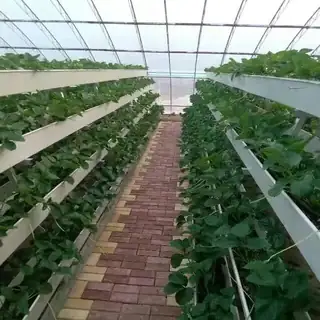
- Channel type: open PVC troughs with built-in drainage, holding coco coir slabs or grow bags. See our A-frame strawberry system with coconut coir slabs.
- Plant spacing: commonly about 15–20 cm between plants along the trough, often in a single or staggered double row.
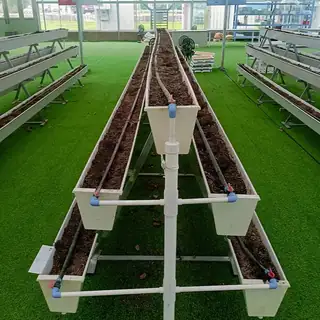
- Irrigation: pressure-compensating drip emitters, often one per plant or a few per slab, so upper and lower tiers receive equal volumes despite the height difference.
- Drainage: aim for a drain fraction of roughly 15–30% to prevent salt build-up, collected in a gutter at the end of each trough.
- Nutrition: EC is typically around 1.2–2.0 mS/cm and pH around 5.5–6.2, adjusted by growth stage and variety.
- Varieties: day-neutral (everbearing) types give a long harvest window; short-day types give concentrated crops.
- Pollination: in closed greenhouses, bumblebees or other managed pollinators are common; poor pollination causes misshapen fruit.
Raised troughs keep fruit clean and off the ground, which reduces rot and makes picking faster. The fruit hangs over the trough edge where it dries quickly after irrigation.
How should an A-frame be set up for leafy greens?
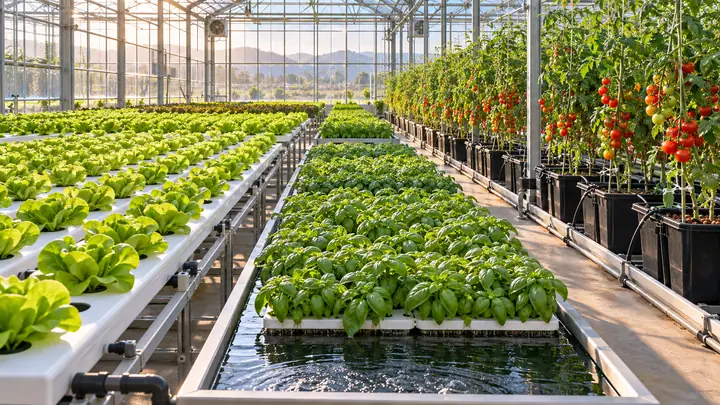
- Channel type: NFT pipe or flat channels with holes for net cups or sponge plugs. Options include our greenhouse A-frame NFT lettuce system and the galvanized A-frame with PVC NFT channels.
- Hole spacing: commonly about 18–25 cm for head lettuce; tighter for baby leaf and herbs.
- Slope and flow: channels need a slight fall, commonly 1–3%, and a flow of roughly 1–2 L/min per channel.
- Channel length: keep runs moderate so the solution does not warm up or lose oxygen by the far end.
- Nutrition: EC around 1.2–1.8 mS/cm and pH around 5.5–6.2.
For the trade-offs between NFT and other water-based systems, see NFT vs. DWC vs. Dutch bucket.
How should frames be oriented and spaced?
- Orientation: in greenhouses, run frame ridges north-south. The east face gets morning sun and the west face afternoon sun, so both produce evenly. East-west rows leave one face shaded for much of the day at higher latitudes.
- Height: keep the top channel within comfortable reach, usually about 1.8–2.2 m, so workers can plant and harvest without ladders.
- Aisle width: roughly 0.8–1.2 m between frames, wider if you use harvest carts. Narrow aisles cut light to the lower tiers.
- Lowest tier: keep it at least about 30–40 cm off the floor for cleaning and airflow, and to keep splash and pests away from fruit.
- Tier count: more tiers mean more plants but less light per plant. In low-light winters, fewer tiers or supplemental lighting on the lower channels may give better total yield.
What materials should I look for?
- Frame: hot-dip galvanized steel resists corrosion in humid greenhouses better than painted steel.
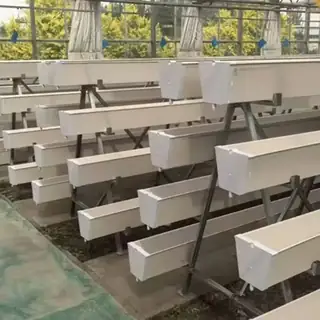
- Channels: food-grade, UV-stabilized PVC with a light-colored exterior to reduce heat gain and an opaque body to block algae.
- Connections: end caps and drain fittings that can be removed for cleaning between crops.
- Customization: tier count, frame width and channel length should match your greenhouse bay. Our 5–8 layer hydroponic A-frame is configured to the site.
How should irrigation and nutrient tanks be planned?
Plan the water system around crop groups, not around individual frames:
- Separate tanks for separate crops. Strawberries and lettuce use different EC targets, so give each crop group its own nutrient tank or dosing line.
- Zone by frame block. Group frames into irrigation zones that share a valve, so a leak or blockage affects one block, not the whole greenhouse.
- Return lines. Slope collection gutters and return pipes back to the tank so no solution stands in the system. Return water should pass through a filter before it recirculates.
- Backup and alarms. NFT channels on A-frames dry out quickly if a pump fails. A flow or level alarm and a standby pump are inexpensive insurance.
- Seedlings. Raise transplants in a separate nursery area so the frames stay in production; plants go onto the frames already rooted.
Measure drainage EC and volume from a few troughs on different tiers each week. If lower tiers drain more or less than upper tiers, adjust emitters or irrigation timing.
What mistakes should I avoid?
- Packing frames too tightly. More frames per bay can mean lower total yield if the bottom tiers stay shaded.
- Non-compensating emitters on strawberry troughs. Pressure differences between tiers cause uneven watering.
- Ignoring root-zone temperature. Sun on dark channels heats the solution; choose light-colored channels and insulate supply pipes.
- No plan for cleaning. Channels and troughs need sanitizing between crops; design for easy removal or flushing.
- Under-sizing the nutrient system. Many frames on one tank require reliable dosing and EC/pH control; see our smart fertigation unit.
Browse all vertical hydroponic towers and racks, or send us your greenhouse dimensions, crop and target output for an A-frame layout and quote.