Short answer
To start a mushroom farm, choose one or two forgiving species such as oyster mushrooms, secure clean substrate and reliable spawn, and set up separate areas for substrate preparation, pasteurization or sterilization, inoculation, incubation and fruiting. Fruiting rooms need controlled temperature, high humidity and steady fresh air. Pilot small batches, find buyers, then scale in steps.
What is a mushroom farm?
A mushroom farm is a facility that grows edible fungi on a prepared organic substrate, such as straw, supplemented sawdust or compost, under controlled temperature, humidity and fresh air. Unlike plant crops, mushrooms do not photosynthesize; they digest the substrate, so the farm is really a sequence of rooms that move each batch from preparation to colonization to fruiting.
That makes mushroom agriculture closer to a food-processing operation than to field farming. Success depends on hygiene, process discipline and climate control more than on land. This guide explains how to start a mushroom farm: how mushrooms grow, which species and cultivation methods suit a new business, what rooms and equipment you need, when a shipping container mushroom farm makes sense, and what drives profit.
How do mushrooms grow?
The growth of mushrooms in cultivation follows the same stages for almost every species:
- Spawn. Grain or sawdust fully colonized by the chosen strain. Most new farms buy spawn from a specialist lab rather than producing it.
- Substrate preparation. Straw, sawdust or compost is hydrated, supplemented if needed, and pasteurized or sterilized to reduce competing molds and bacteria.
- Inoculation. Spawn is mixed into the cooled substrate, which is packed into bags, blocks, buckets or shelves. This step needs the cleanest conditions on the farm.
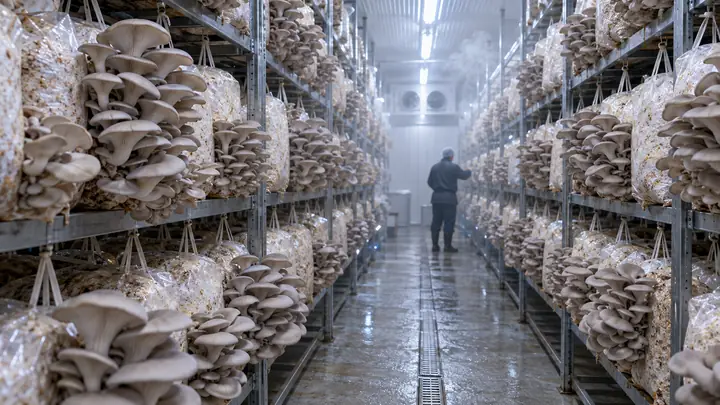
- Spawn run (incubation). The mycelium colonizes the substrate in a warm, dark room with little fresh air, typically for two weeks to several months depending on species.
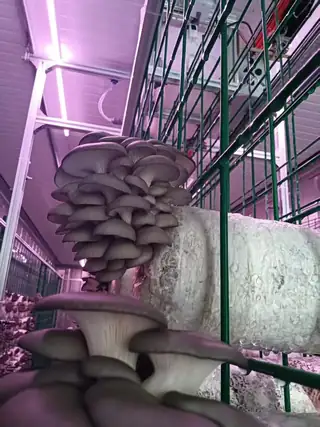
- Pinning and fruiting. A change in conditions, usually lower temperature, more fresh air, high humidity and some light, triggers primordia that grow into mushrooms over several days.
- Harvest and further flushes. Most substrates produce several flushes before they are spent. Spent substrate is removed and often composted or used as a soil amendment.
University of Florida extension guidance for oyster mushrooms on straw, for example, describes a spawn run at about 24–25 °C and 80–90% relative humidity until the bag turns white in roughly two to three weeks, then fruiting at around 20 °C with about 90% humidity, good air exchange and light.
Which mushrooms should a new farm grow?
Most new commercial mushroom growing businesses start with oysters, then add other specialty mushrooms once the process is stable. Conditions below are typical ranges; strains vary, so follow your spawn supplier's data.
| Species | Common substrate | Spawn run (typical) | Fruiting conditions (typical) | Notes for a new farm |
|---|---|---|---|---|
| Oyster (grey, pearl, blue, pink, yellow) | Pasteurized straw or supplemented sawdust | About 2–3 weeks | Roughly 15–24 °C depending on strain; 85–95% RH; high fresh air | Fast, forgiving and the usual first crop; very sensitive to CO2 build-up |
| Shiitake | Sterilized supplemented sawdust blocks, or hardwood logs | Often 6–12 weeks or more on blocks | Roughly 12–20 °C; 80–90% RH; soak or cold shock to trigger flushes | Longer cycle, strong demand, good shelf life |
| Lion's mane | Sterilized supplemented sawdust | About 2–4 weeks | Roughly 16–22 °C; high RH; gentle air movement | Popular gourmet mushroom; delicate to handle |
| King oyster | Sterilized supplemented sawdust in bottles or bags | About 3–5 weeks | Cooler, around 12–18 °C; controlled CO2 to shape thick stems | Needs tighter climate control than other oysters |
| Wood ear (including golden ear types) | Supplemented sawdust | Several weeks | Warm and very humid | Strong demand in Asian markets; tolerant of warm climates |
| White button and brown (Agaricus) | Pasteurized compost with a casing layer | About 2 weeks after compost is ready | Roughly 16–18 °C during cropping | Composting is an industrial process; most small farms buy spawned compost or avoid this crop |
Morels are of growing interest, but cultivation is more specialized and is mainly done in outdoor beds or tunnels with seasonal temperature cues. Treat indoor morel production as a trial rather than a first crop.
What are the main mushroom growing methods?
Cornell Small Farms describes four methods of commercial mushroom cultivation used by smaller farms, and they map well to most mushroom farming techniques worldwide:
- Logs outdoors. Shiitake inoculated into hardwood logs and forced by soaking. Low equipment cost, but slow, seasonal and labor-intensive.
- Oysters on straw. Straw is pasteurized with hot water, lime or steam, inoculated, packed into bags or buckets, and fruited indoors. Low-cost and quick, with a cycle of about five weeks.
- Indoor supplemented sawdust blocks. Sawdust and bran are sterilized in bags, inoculated in a clean room, incubated and fruited in climate-controlled rooms. This is the standard method for gourmet mushroom cultivation year-round.
- Outdoor sawdust blocks. Spent or ready-to-fruit blocks fruited in shade during mild seasons, adding extra flushes at low cost.
Large operations add bottle cultivation (highly automated, common for king oyster and enoki) and compost-based shelf systems for button mushrooms. For year-round edible mushroom cultivation, almost every commercial farm relies on indoor rooms with controlled climate.
What rooms and equipment does a mushroom farm need?
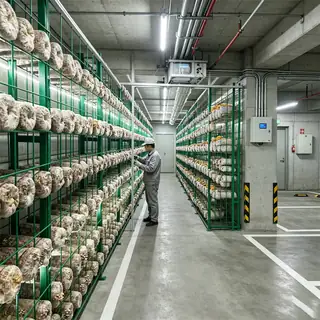
Lay the farm out so work flows in one direction, from dirty to clean to fruiting, and so spent substrate never passes back through clean areas:
- Substrate preparation area: storage for straw or sawdust, a mixer, and water supply and drainage.
- Pasteurization or sterilization: hot-water or steam pasteurization tanks for straw; an autoclave or atmospheric steam chamber for sawdust bags.
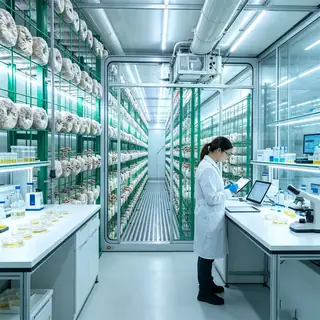
- Inoculation room or lab: smooth, washable surfaces, filtered air (often a laminar flow hood for small farms), and strict hygiene.
- Incubation room: racks, temperature control and low air exchange. Light is not needed.
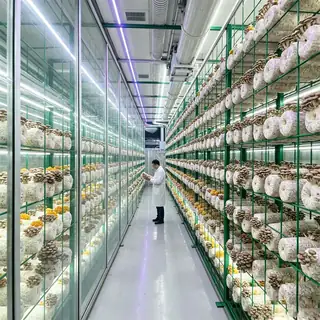
- Fruiting rooms: the most demanding space, with humidifiers or foggers, fresh-air fans with filtration, heating and cooling, low-level lighting, and sensors for temperature, humidity and CO2.
- Harvest and packing area: clean tables, scales, packaging and a cold room for finished product.
Fruiting rooms are where most yield is won or lost. Oysters in particular need plenty of fresh air; when CO2 builds up they form long stems and small caps. At the same time, high humidity has to be held without water droplets settling on the mushrooms, which encourages bacterial blotch. That balance is why many growers now use purpose-built, insulated chambers with automatic control rather than converted rooms.
Is a shipping container mushroom farm a good option?
A mushroom container is an insulated container or prefabricated cabin fitted out as a fruiting or incubation room, with racks, humidification, ventilation, heating and cooling, lighting and a controller. It suits farms that need a stable climate quickly, without building or insulating a structure.
| Option | Strengths | Limits | Best for |
|---|---|---|---|
| Shipping container or modular cabin | Insulated, pre-wired, repeatable rooms; each unit can run a different climate; relocatable | Fixed volume; still needs substrate preparation and packing space elsewhere | New farms, hot or cold climates, staged expansion |
| Converted building | Large volume, lower cost per square meter if insulation is good | Retrofit of insulation, drainage and HVAC can be slow and costly | Farms with a suitable existing building |
| Prefab mushroom house | Purpose-built panels and climate control at larger scale | Needs a prepared site and foundation | Established growers scaling up |
| Grow tents and mushroom growing boxes | Very low cost; good for learning and strain trials | Small capacity; hard to hold stable conditions | Pilots and training, not commercial volume |
Because fruiting and incubation need different conditions, a common pattern is one or more units for incubation and several for fruiting, so batches move through on a schedule. Our 40-foot container smart mushroom cabin and vertical modular mushroom growing chamber are built for this kind of staged layout, while the oyster mushroom grow box with drip irrigation suits smaller oyster production. For larger sites, a prefab energy-saving smart mushroom house gives more volume per unit. For a broader view of container formats, see our shipping container farm guide.
What drives shipping container mushroom farm cost?
Prices vary widely with specification, so compare like for like. The main cost drivers are container size and insulation thickness, cooling and heating capacity for your climate, the humidification system, fresh-air handling and filtration, rack layout and material, the controller and remote monitoring, and shipping and import duties. Operating costs are dominated by electricity, substrate and spawn, and labor. Our guide to importing agricultural equipment from China covers freight and customs.
How do you start a mushroom farm, step by step?
- Research the market. Talk to chefs, grocers, wholesalers and market managers. Find out which species they buy, in what volume, at what price and how often.
- Pick one or two species. Start with what the market wants and what is forgiving to grow, usually oysters, then add shiitake or lion's mane.
- Secure substrate and spawn. Find a reliable supply of clean straw or hardwood sawdust and bran, and a spawn supplier with consistent strains.
- Check rules and permits. Food business registration, zoning, wastewater and any agricultural or food-safety certification required by your buyers.
- Design the workflow. Size each room from weekly target output: blocks per week, spawn-run length and fruiting time set how much incubation and fruiting space you need.
- Run a pilot. Grow small batches for a few months, record contamination rates and yields, and refine your process before scaling.
- Build or buy production space. Choose between converted buildings, containers or prefab rooms based on climate, capital and how fast you need to start.
- Set up sales and logistics. Fresh mushrooms are perishable, so plan harvest days around deliveries and keep a cold chain from packing to customer.
- Scale in steps. Add rooms or units once demand and process are proven, rather than building full capacity on day one.
Many of the same planning questions apply to other controlled-environment crops; see how to start a vertical farm for site, power and business-plan checklists.
Can you grow mushrooms for profit?
Yes, many small and mid-size farms do, but margins come from consistency rather than from a single good harvest. When raising mushrooms for profit, track these drivers:
- Yield per block or bag. Growers often express this as biological efficiency: fresh mushroom weight as a percentage of dry substrate weight. It varies widely by species, strain and process.
- Contamination rate. Every lost block wastes substrate, spawn, energy and labor. Hygiene is a profit lever.
- Selling price and channel. Direct sales to restaurants and markets usually pay more than wholesale but take more time.
- Energy. Heating, cooling and humidification can be a large share of operating cost in extreme climates; insulation pays back.
- Labor. Bagging, inoculating, harvesting and packing are hand tasks; layout and equipment decide how many hours they take.
- Spent substrate. Selling or composting it can turn a disposal cost into a small revenue stream.
Cornell Small Farms notes that sawdust-block producers need cold storage and working capital as volume grows, and recommends starting small, for example with purchased blocks or oysters on straw, before committing to a larger facility.
Planning your mushroom farm equipment
Mars Vertical Farm manufactures smart mushroom cabins, containers and prefab mushroom houses alongside its wider container and indoor plant factory range, with 20+ years of production experience and CE-marked products. If you are deciding between a container and a building, our comparison of container farms and indoor plant factories may help. When you are ready, send us your target species, weekly output and site climate and we will suggest a room layout and quotation.