Short answer
Choose a container farm when you need a self-contained, relocatable unit that can start producing quickly at a modest, steady volume, such as a pilot, a remote site, or a single restaurant or retail customer. Choose an indoor plant factory built inside an existing building when your demand would require more than a handful of containers, because shared climate control, racking and workflow make each square meter of growing area cheaper to build and run.
What is the difference between a container farm and an indoor plant factory?
Both are closed, soilless growing systems that replace sunlight with LED lighting and control temperature, humidity, CO2 and nutrients. The difference is the shell and how it scales.
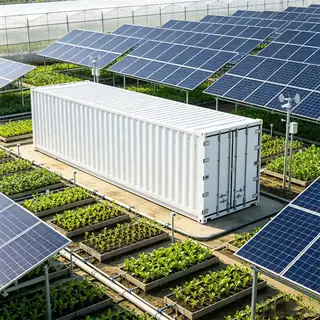
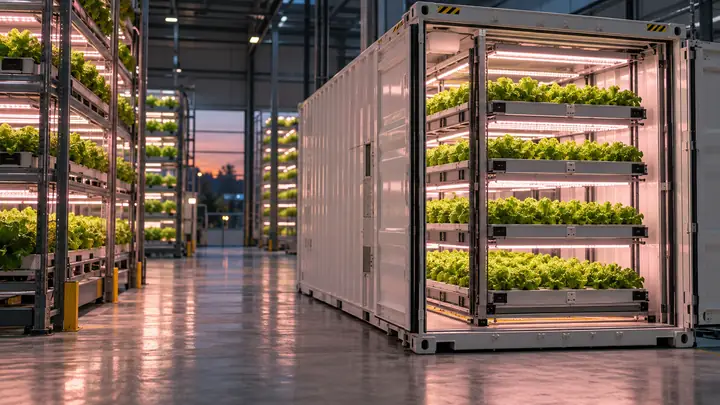
- Container farm: a 20-ft or 40-ft shipping container fitted at the factory with insulation, racking, LED lighting, air conditioning, irrigation and a control system. It ships as one unit and is typically producing within weeks of delivery once power and water are connected.
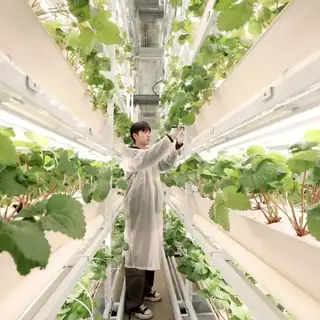
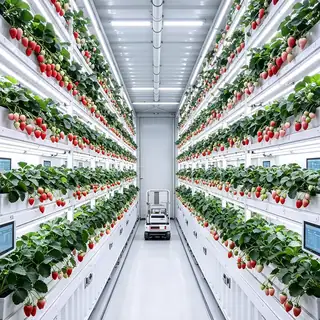
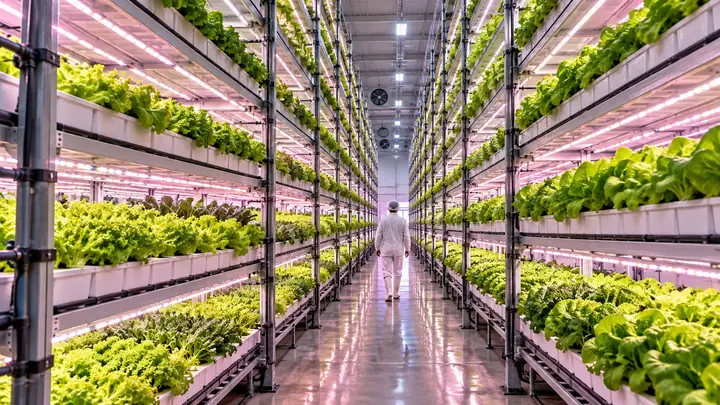
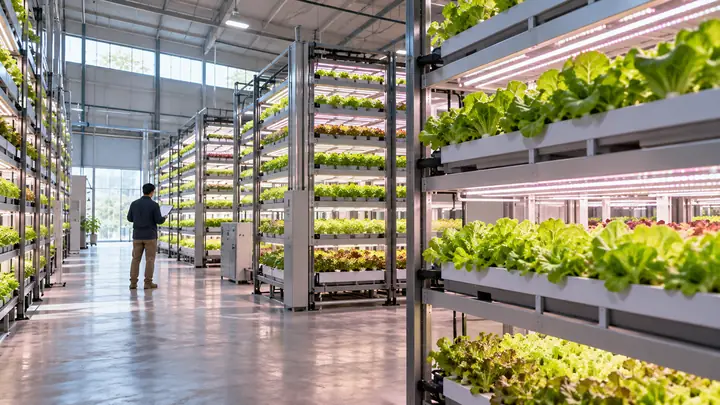
- Indoor plant factory: the same building blocks (multi-layer racks, lighting, HVAC, fertigation, environmental controls) installed inside a warehouse, a factory hall or a purpose-built insulated room. The layout is designed around your floor plan and can grow room by room.
Neither format grows plants better by itself. Yield depends on light intensity, climate stability, crop variety and the grower's routine. The real choice is about volume, capital, timeline and site.
How do they compare side by side?
| Factor | Container farm | Indoor plant factory |
|---|---|---|
| Typical starting size | One 20-ft or 40-ft unit | Roughly 100 m² of floor and up |
| Time to first harvest | Short: delivery, hookup, one crop cycle | Longer: building works, installation, commissioning |
| Cost per m² of growing area | Higher; every unit carries its own HVAC and controls | Lower at scale; shared HVAC, controls and work areas |
| Scaling | Add units; each one is a separate climate zone | Add rooms or racks within one designed layout |
| Mobility | Can be relocated by truck or ship | Fixed to the building |
| Working space | Narrow aisle; harvesting and packing usually happen outside | Room for germination, packing, cold storage and staff |
| Permits | Often simpler, but zoning still applies in many places | Building, electrical and food-handling approvals as for any facility |
| Best fit | Pilots, remote sites, campuses, single buyers | Commercial supply to retailers, distributors or several customers |
When does a container farm make sense?
A container is the right tool when speed, mobility or simplicity matters more than the lowest cost per kilogram. Typical cases we see in project inquiries:
- Pilot projects. You want to prove a crop, a buyer relationship or a team before committing to a building.
- Remote or harsh locations. Mining camps, islands, desert or northern communities where fresh greens are flown or trucked in at high cost.
- Leased or temporary land. If you may have to move within a few years, a unit you can lift and ship protects the investment.
- A single, close customer. A restaurant group, school, hospital or retailer that wants on-site production.
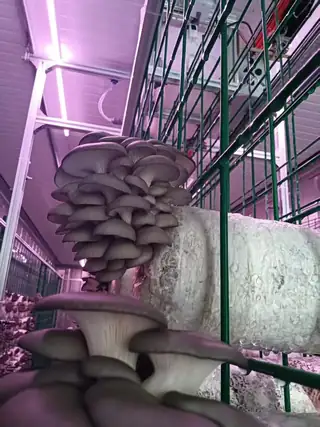
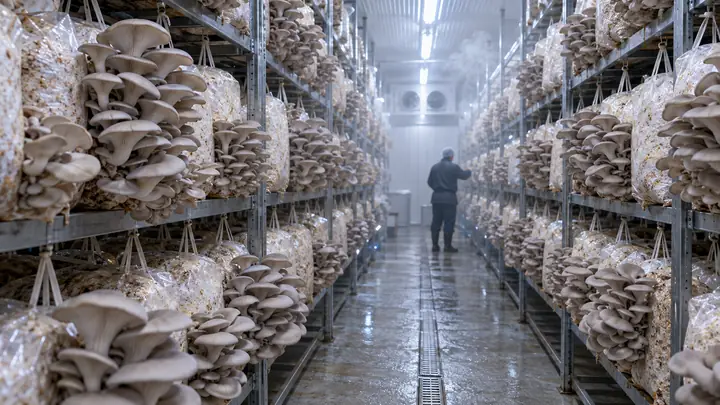
- Specialty modules. Hydroponic fodder for livestock and mushroom cultivation also work well in containers, because each crop needs its own climate.
Options in our range include the turnkey climate-controlled container farm for leafy greens and the 40-ft smart mushroom cabin.
When is an indoor plant factory the better investment?
Once production has to supply several customers every week, the economics usually shift toward a building. Reasons:
- Shared infrastructure. One well-sized HVAC system and one control room serve the whole growing area instead of duplicating equipment in every box.
- Better workflow. Seeding, transplanting, harvesting, packing and cold storage can be laid out in a line, which reduces labor per kilogram.
- Taller racks. A building with 4–6 m clear height can hold more growing layers than a container's interior, often with mobile lifts or rolling racks.
- Food-safety zoning. Separate clean and dirty areas, changing rooms and hand-wash stations are easier to design in a building.
A customizable indoor vertical plant factory is designed around your floor plan, crop list and power supply rather than a fixed box.
How do I size the system from my demand?
Work backward from what you can sell. A simple method for leafy greens:
- Weekly demand. Say a buyer wants 300 kg of lettuce per week.
- Unit weight. At roughly 150 g per head, that is about 2,000 heads a week.
- Time on the racks. If plants spend about five weeks in the main growing area after the nursery, you need around 10,000 occupied plant sites at any time, plus a margin of 10–15% for losses and uneven growth.
- Plant density. At a typical 20–30 plants per m² of rack layer, that means roughly 380–550 m² of layer area.
- Compare formats. A 40-ft container typically offers somewhere around 60–100 m² of layer area depending on the racking design. This example would need five or more containers, which is the point where a building-based plant factory normally deserves a quote.
Run the same arithmetic for herbs, microgreens or strawberries using their own unit weights and cycle times. Strawberries, for example, stay on the racks for months, so they need more area per kilogram but sell at a higher price; see our strawberry plant factory for that crop.
What drives operating cost in both formats?
Operating costs follow the same pattern in a container and in a building. The largest items are usually:
- Electricity. LED lighting is commonly the largest single load, often around half of total electricity or more, followed by air conditioning and dehumidification. Every watt of light ends up as heat that the HVAC must remove.
- Labor. Seeding, transplanting, harvesting, cleaning and packing. Good workflow design matters more than automation level for small sites.
- Consumables. Seeds, growing media, nutrients, packaging and filter cartridges.
- Water. Recirculating systems use far less water than field growing, but source water quality still matters. High-salt or hard water may need treatment such as an industrial RO system.
Ask any supplier for the rated electrical load (kW) and estimated daily energy use (kWh) of the specific design, and multiply by your local tariff before comparing prices.
What should I check on site before choosing?
- Power: available capacity, voltage, phase and frequency. Many systems need three-phase supply; confirm early.
- Water: a recent lab analysis of EC, pH, hardness, bicarbonates, sodium and iron.
- Drainage: where cleaning water and occasional nutrient dumps can go, and local discharge rules.
- Ambient climate: extreme heat or cold changes insulation and HVAC sizing.
- Access: for containers, crane or truck access and a level concrete pad; for buildings, clear height and floor loading.
- Connectivity: internet or cellular coverage if you want remote monitoring and alarms.
How does a project usually run with us?
With 20+ years of production experience and a 2,000+ m² factory in Shanghai, we handle each project one-to-one: inquiry, proposal and quotation, R&D confirmation of the design, contract, production with quality control, third-party lab testing, shipping and logistics, and after-sales support. Our quality system is ISO 9001 certified and products carry CE marking. If you are shipping internationally, our China import checklist covers Incoterms and customs paperwork, and livestock farms should read the hydroponic fodder planning guide.
Browse all container and indoor plant factories, or send us your crop, weekly volume and site details for a quote.