Short answer
Vertical farming equipment includes a growing structure (multi-tier grow racks, mobile racks, towers or A-frames), a hydroponic irrigation system such as NFT or ebb and flow, LED lighting on each layer, air conditioning and dehumidification, water treatment and EC/pH fertigation, and a control system with sensors and alarms. Fully indoor farms usually use racks with lights; greenhouses favor towers and A-frames.
What is vertical farming equipment?
Vertical farming equipment is everything needed to grow crops in stacked layers under controlled conditions: the growing structure (racks, towers or A-frames), the irrigation system that feeds the roots, LED lighting, climate control, water treatment and the controls that tie them together. Choosing it well means matching each system to your crop, building and budget, not buying the tallest rack available.
This guide is an equipment list for commercial growers. It explains the main vertical farming systems, how vertical grow racks and towers differ, what lighting, HVAC and fertigation each needs, and which questions to ask before you buy. For the business side, such as demand, budgeting and site selection, see how to start a vertical farm.
What are the main types of vertical farming systems?
Most commercial vertical growing uses one of five structures. Each suits different crops and buildings.
| System | How it stacks plants | Best crops | Lighting | Typical setting |
|---|---|---|---|---|
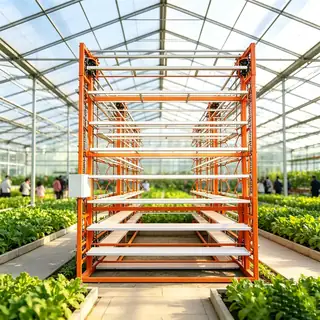
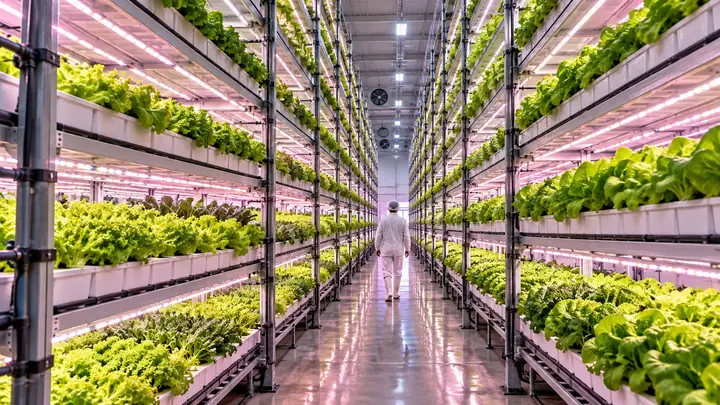
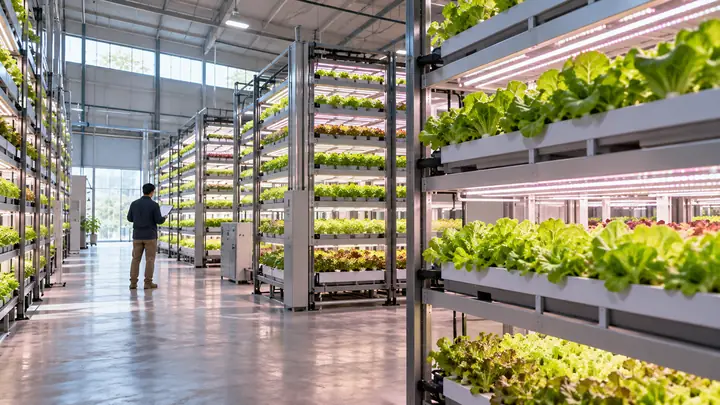
| Multi-tier grow racks | Horizontal shelves of trays or channels, 3–10+ layers | Lettuce, herbs, microgreens, seedlings | LED on every layer | Plant factories, containers, grow rooms |
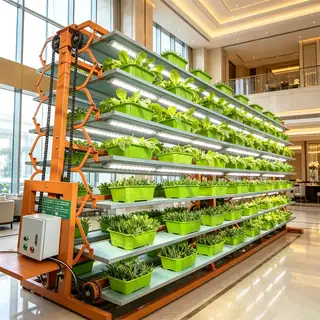
| Mobile (rolling) grow racks | Racks on rails that slide together to remove fixed aisles | Same as static racks | LED on every layer | Buildings where floor space is expensive |
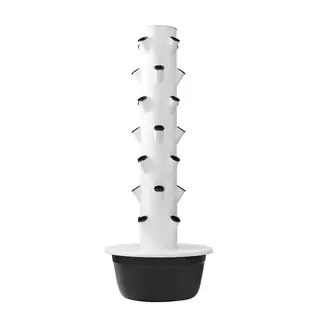
| Vertical grow towers | Plants set into the sides of an upright column | Leafy greens, herbs, strawberries | Sunlight or vertical LED bars | Greenhouses, rooftops, indoor rooms |
| A-frame systems | Channels on two sloped faces of a triangular frame | Strawberries, leafy greens | Mostly sunlight | Greenhouses and tunnels |
| Rotating racks | Trays rotate so each plant passes through light and access height | Leafy greens, seedlings | Sunlight or LED | Greenhouses, demonstration sites |
In practice, racks with lights dominate fully indoor farms, while towers and A-frames are more common where sunlight is available. Our A-frame vertical systems guide covers that format in detail.
How do vertical grow racks work?
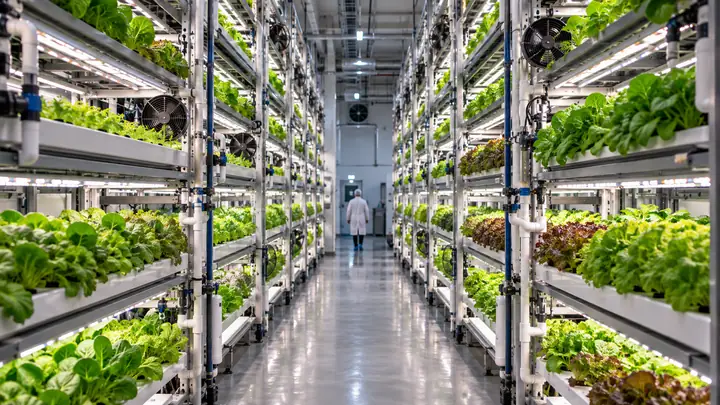
A vertical grow rack system is a steel or aluminum frame holding several growing layers, each with its own LED fixtures, an irrigation feed and a drain. Plants grow in trays, rafts or channels on each shelf, and nutrient solution circulates from a tank below or from a central fertigation room.
How many layers and how much spacing?
The number of layers depends on ceiling height, crop height and how staff reach the top tier. Leafy greens usually need roughly 30–50 cm per layer including the light fixture and tray, while taller herbs or strawberries need more. Racks above about 2.5 m generally need scissor lifts, platforms or automated tray handling, which affects labor and safety.
Static or mobile vertical grow racks?
Static racks are simpler, cheaper and easier to plumb. Mobile vertical grow racks sit on rails so one aisle can be opened at a time, which can raise usable growing area noticeably in the same room. The trade-off is flexible hoses and cables, more careful installation and slower access. Commercial grow racks such as our mobile vertical grow racks with grow trays suit operators who want maximum density, while movable multi-layer indoor grow shelves fit smaller grow rooms and trial lines.
What should a grow rack be made of?
- Frame: hot-dip galvanized or powder-coated steel, or aluminum, rated for wet trays and full plant weight.
- Trays and channels: food-grade, UV-stable plastic such as PVC or ABS, smooth inside for cleaning.
- Fixings: stainless or coated hardware, because nutrient solution and high humidity corrode plain steel.
- Drainage: a slight slope and accessible drains on every layer to prevent standing water.
When are vertical farming towers the better choice?
Vertical farming towers feed nutrient solution to the top of a column and let it trickle down past the roots, returning to a tank. They need little floor space, have no shelves to light, and work well with sunlight, which makes them popular in greenhouses, rooftops and retail displays. Indoors, a vertical grow tower needs side lighting, and plants at the top and bottom can receive uneven light. Our hydroponic and aeroponic towers guide compares tower designs, and the Space Tree multilayer hydroponic tower is one example of a commercial vertical growing tower.
Which irrigation method should vertical grow systems use?
Hydroponic vertical farming systems usually use one of these root-zone methods:
- NFT (nutrient film technique): a thin film of solution flows down slightly sloped channels. Light, low water volume, widely used for lettuce and herbs. See our NFT hydroponic system guide.
- Ebb and flow: trays flood and drain on a timer. Good for seedlings, microgreens and potted herbs.
- Shallow deep water culture: plants float on rafts over a few centimeters of aerated solution. Stable, but heavy on upper racks.
- Aeroponics: roots hang in air and are misted. High oxygen, but nozzles clog and failures hurt crops fast.
- Drip to substrate: used for strawberries and fruiting crops in troughs or bags.
Weight matters on tall racks. A water-filled tray can weigh many times more than an NFT channel, so check the rack's rated load per layer before choosing deep water methods.
What lighting does vertical growing need?
Fully indoor vertical farming technology relies on LED fixtures mounted close above each layer. LEDs run cooler than older lamp types, can be placed within roughly 20–40 cm of the canopy and allow spectrum tuning. Key specifications to compare:
- Photon efficacy (µmol/J): how much usable light each watt produces. Higher means lower running cost.
- Light intensity (PPFD) and uniformity across the shelf, not just at the center.
- Daily light integral (DLI): leafy greens are commonly grown at roughly 12–17 mol/m²/day; herbs and fruiting crops need more.
- Waterproof rating and heat management for a humid environment.
- Dimming and scheduling so light can be matched to crop stage and electricity tariffs.
Grow racks with lights should be specified as a system: fixture spacing, layer height and rack width together determine uniformity.
What climate control equipment is required?
In a closed room, almost all the electricity used by lights ends up as heat, and almost all the irrigation water taken up by plants ends up as humidity. Climate control equipment must remove both:
- Air conditioning sized for lighting load, equipment and building heat gain.
- Dehumidification sized for plant transpiration, which is often the most under-sized item in a vertical grow room.
- Horizontal airflow fans inside each rack layer, so air moves through the canopy and prevents tipburn and disease.
- CO₂ enrichment (optional) to raise growth rates in a sealed room, with safety monitoring.
- Air filtration and positive pressure to keep pests out.
What water, fertigation and automation equipment is needed?
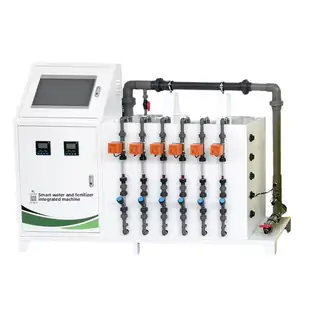
Every recirculating system needs a nutrient tank, pumps, filtration and an EC/pH dosing unit. Where source water is hard or saline, reverse osmosis treatment is often added. A smart fertigation machine with dosing pump automates mixing for multiple racks; smaller rooms can start with a batch tank and manual top-ups. Our hydroponic nutrients, EC and pH guide explains the targets.
Vertical farming automation ranges from timers and float switches to a full PLC or IoT control system that logs temperature, humidity, CO₂, EC, pH and water level, sends alarms and adjusts equipment. Higher automation reduces labor and mistakes but costs more and needs trained staff. Most new farms automate climate, lighting and dosing first, and keep seeding and harvest manual until volumes justify machines.
Vertical farming equipment checklist
- Growing structure: racks, mobile racks, towers or A-frames, with rated load per layer.
- Trays, channels, rafts or towers in food-grade material, plus growing media such as sponge plugs.
- LED lighting with drivers, mounting, dimming and timers.
- Irrigation: pumps, supply and return pipes, valves, drains and a nutrient tank.
- Fertigation: EC and pH sensors, dosing pumps, stock tanks and filtration.
- Water treatment: filtration and, if needed, reverse osmosis.
- Climate: AC, dehumidifiers, circulation fans, CO₂ system and insulation.
- Controls: controller or PLC, sensors, alarms and remote monitoring.
- Germination and seedling area: seeding trays, a nursery rack or seedling cabinet.
- Harvest and post-harvest: cutting tables, cold room, packing and sanitation equipment.
- Electrical: distribution boards, backup power and surge protection.
- Safety: platforms or lifts for high racks, leak detection and emergency lighting.
What drives the cost of vertical grow racks and systems?
Vertical grow racks cost varies widely, so compare offers on the same basis. The main cost drivers are the number of layers and total growing area, frame material and finish, whether racks are static or mobile, whether LEDs and irrigation are included, the level of automation, and packaging, shipping and installation. Ask suppliers to quote grow area per rack in square meters and the number of plant positions, so you can compare cost per growing position rather than cost per rack.
What should I ask before buying vertical farming systems?
When comparing vertical farming systems for sale, ask for a layout drawing based on your room, the rated load per layer, material specifications for frames and trays, light intensity and uniformity data, the irrigation schematic, and the spare parts list. Confirm voltage and plug standards for your country and whether the system carries the certifications your market requires.
Mars Vertical Farm manufactures racks, towers, channels and complete plant factories on three production lines in Shanghai, under ISO 9001 with CE-marked products, and offers OEM/ODM options. Browse vertical hydroponic towers and racks or complete indoor plant factories, then send us your room dimensions and target crop for a rack layout and quotation.