Short answer
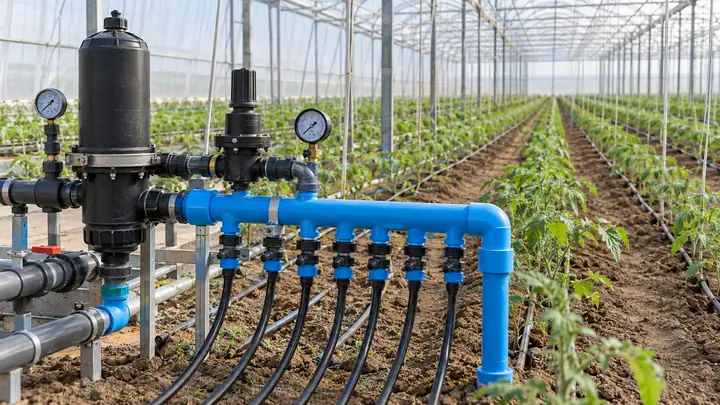
A drip irrigation system delivers water slowly through low-pressure tubing and emitters directly to plant roots. Water passes from the source through a backflow preventer, a filter, an optional fertilizer injector and a pressure regulator, then through mains and laterals to emitters that release roughly 0.5-8 L/h each. It typically uses much less water than sprinklers.
What is a drip irrigation system?
A drip irrigation system is a network of low-pressure pipes and emitters that delivers water, and often fertilizer, slowly and directly to the root zone of each plant. Unlike sprinklers, which wet the whole field surface, drip irrigation applies water as a line or point source near the roots, so far less is lost to evaporation, runoff and wind drift.
In the broader sense, an irrigation system is any engineered way of supplying water to crops beyond rainfall: surface (flood and furrow), sprinkler, center pivot and localised irrigation. Drip belongs to the localised family, together with micro-sprinklers. This guide explains how drip irrigation works, what each component does, how drip is used for vegetables, trees and hydroponics, and its pros and cons. For practical bed and container layouts, see drip irrigation for vegetables and small farms.
How does drip irrigation work?
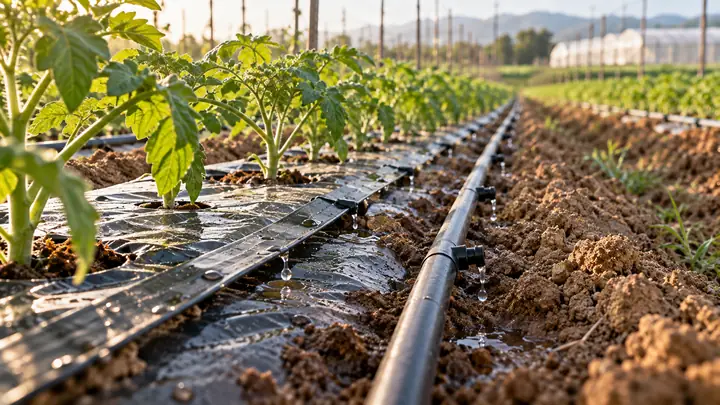
Water flows from the source through a pump or pressurized supply, is cleaned by a filter, has its pressure reduced to the design value, and is distributed through mains and sub-mains to laterals: the drip tubes laid along each row. Emitters in or on the laterals dissipate pressure through a narrow labyrinth or diaphragm and release water at a controlled rate, typically around 0.5–8 L/h per emitter.
Because flow is slow, water soaks in and spreads through the soil by capillarity, forming a wetted bulb under each emitter. On sandy soil the bulb is deep and narrow; on clay it is wide and shallow. Emitter spacing and run time are chosen so neighboring bulbs overlap into a continuous wetted strip along the row, or so each tree gets enough wetted volume.
Irrigation is scheduled in short, frequent cycles that keep the root zone close to its ideal moisture, rather than in large, infrequent applications. That is why drip pairs so well with automation and with fertigation: nutrients are applied little and often where the roots can take them up.
What are the components of a drip irrigation system?
Every drip system, from a garden kit to a 100-hectare orchard, uses the same building blocks. The table summarizes the parts of an irrigation system and what to check when buying them.
| Component | What it does | Common types | What to check |
|---|---|---|---|
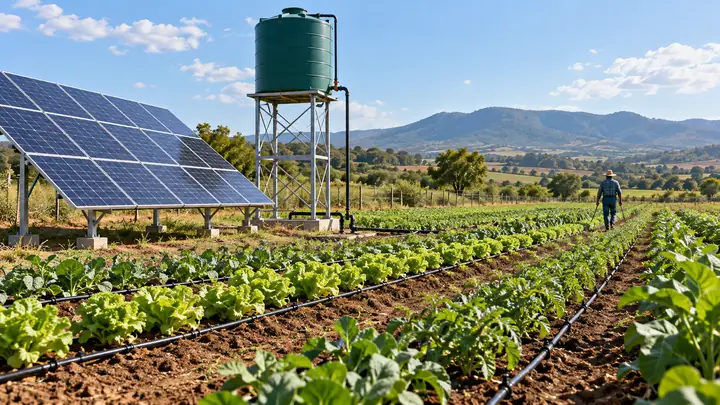
| Water source and pump | Supplies flow and pressure | Mains, well, pond, tank; surface or submersible pump; solar or engine drive | Flow at the required pressure, not just maximum flow |
| Backflow preventer / check valve | Stops irrigation water and fertilizer flowing back into the source | Check valve, double-check assembly, anti-siphon valve | Local code requirements, especially with chemical injection |
| Filter | Removes particles that block emitters | Screen, disc, sand media, hydrocyclone | Mesh or micron rating required by the emitter maker; cleaning method |
| Fertilizer injector | Adds nutrients to irrigation water | Venturi, proportional injector, dosing pump with EC/pH control | Injection rate relative to zone flow |
| Pressure regulator | Reduces and stabilizes pressure | Spring regulator, pressure-reducing valve | Outlet pressure and flow range match the zone |
| Valves | Open and close zones | Manual ball valve, solenoid valve, hydraulic valve | Size, pressure loss, voltage |
| Controller / timer | Runs zones on schedule | Tap timer, multi-zone controller, wireless or Wi-Fi smart controller | Number of zones, sensor inputs, remote access |
| Mains and sub-mains | Carry water to each block | PVC, PE (polyethylene), layflat hose | Diameter for acceptable friction loss |
| Laterals (drip tubing) | Deliver water along the row | Drip tape, inline dripline, blank tube with button emitters | Wall thickness, emitter spacing, flow, maximum run length |
| Emitters | Release water at a set rate | Non-compensating, pressure-compensating, adjustable, micro-sprayer | Flow rate, pressure range, clog resistance |
| Fittings and flush valves | Connect and terminate lines | Barbed, compression, lock-type; end caps; automatic flush valves | Pipe size compatibility and pressure rating |
Filtration: the part that decides service life
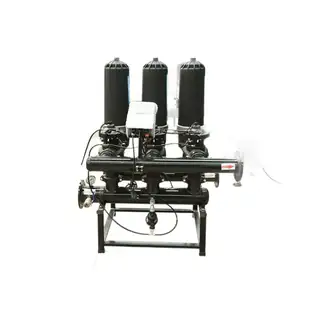
Emitter passages are small, so irrigation water filtration is the most important protection in the system. Kansas State University extension suggests 150–200 mesh screen filters for well or municipal water and treats sand media filters as essential for surface water. Disc filters cost more than screens but handle more dirt and are easy to clean. See our comparison of disc, sand and screen filters; for larger farms, an automatic gear disc filter backflushes itself without stopping irrigation.
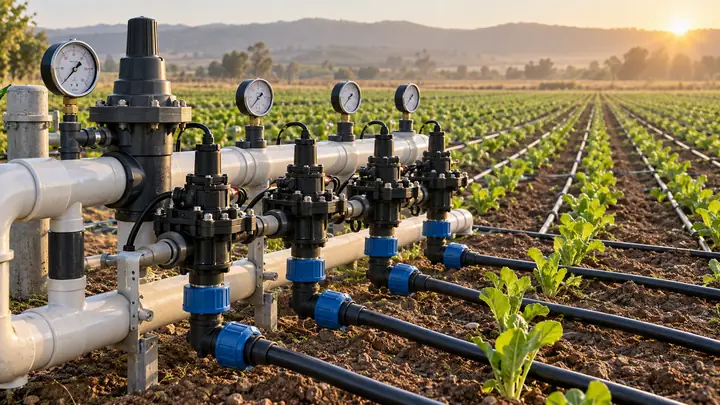
Drip irrigation pressure regulator
Drip tubing is designed for low pressure: Kansas State cites 8–15 psi (roughly 0.5–1 bar) for most drip tubing, while heavier dripline often tolerates 1–3 bar or more. Mains and pump pressure is usually higher, so a drip system pressure regulator (also called a pressure reducer) is installed after the filter. It protects tape and fittings, and keeps flow uniform. Pressure-compensating emitters even out flow along a slope or long lateral, but they still have a maximum pressure. Larger systems use pressure-reducing valves on each zone and pressure-relief valves to protect the mains.
Drip irrigation tubing and fittings
Irrigation tubing comes in three main forms. Thin-walled drip tape is cheap and usually replaced each season on vegetables. Inline dripline has emitters welded inside a thicker tube and lasts many seasons. Blank PE tube, commonly 16 mm or 1/2-inch drip irrigation tubing, takes punched-in button emitters wherever you need them, which suits trees, shrubs and pots. Fittings must match the tube's outer or inner diameter exactly; mixing sizing standards is a common source of leaks. Read more in drip tape vs. drip line.
Irrigation controllers, timers and rain sensors
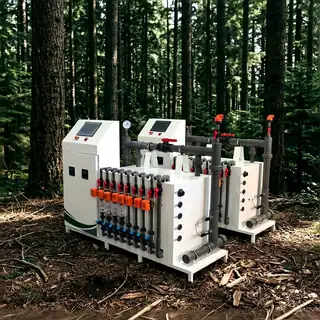
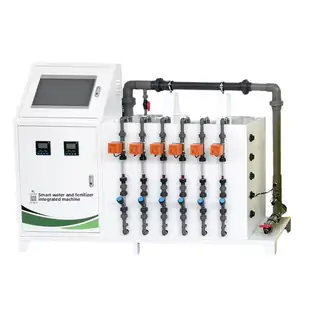
An irrigation timer can be a simple battery unit on a tap or a multi-zone irrigation controller that drives solenoid valves. Modern controllers add a rain sensor that skips cycles after rain, soil moisture sensors, flow meters and Wi-Fi or wireless remote control. On commercial farms the controller is often combined with fertigation; an IoT farmland irrigation and fertilization system schedules zones, doses fertilizer and logs data in one unit. Our guide to smart irrigation controllers compares the options.
What types of drip systems are there?
- Surface drip: tape or dripline laid on the soil or under plastic mulch. The standard for vegetables and strawberries.
- Subsurface drip (SDI): dripline buried 15–45 cm deep and left for many years. Used in field crops, turf and some orchards; needs careful filtration and root-intrusion control.
- Point-source drip for trees: two or more emitters per tree, or a ring of dripline around the trunk that moves outward as the canopy grows. A drip system for fruit trees often uses pressure-compensating emitters because orchards are rarely flat. See drip irrigation for orchards and fields.
- Micro drip for pots and hanging baskets: microtubes and stake emitters from a 16 mm supply line, used in nurseries and greenhouses.
- Hydroponic drip systems: drippers feed nutrient solution to plants in an inert substrate such as coir, rockwool or perlite. In recirculating designs, drainage returns to a tank to be filtered and reused.
How is drip used in hydroponics?
Drip hydroponics is the most widely used soilless method for fruiting crops such as tomatoes, cucumbers, peppers and strawberries. Each plant sits in a slab, bag or bucket of substrate, and a drip stake delivers nutrient solution several times per hour of daylight. The grower monitors the EC and pH of both the supply and the drainage and adjusts frequency to aim for a target drainage percentage, often roughly 10–30%.
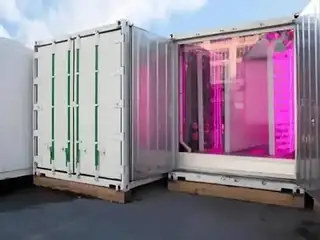
The components are the same as a soil system, with a nutrient tank and dosing unit in place of a simple injector. Indoor farms also use drip for leafy greens in multi-tier racks, as in our drip-irrigated indoor leafy greens plant factory. For how drip compares with NFT, DWC and ebb and flow, see types of hydroponic systems explained.
How do I design a drip irrigation system?
Drip irrigation system design follows the same sequence at any scale:
- Analyze the water. Test for suspended solids, iron, manganese, hardness, pH and salinity. They decide the filter type and whether acid or other treatment is needed.
- Estimate crop water demand. Use local evapotranspiration data and crop coefficients to find peak daily water use per plant or per square meter.
- Select laterals and emitters. Choose spacing and flow to match soil type, crop spacing and root depth.
- Divide the area into zones. Each zone's total flow (emitters × emitter flow) must fit within the source capacity.
- Size pipes. Choose mains, sub-mains and manifolds so friction loss and elevation change keep pressure variation within the emitter's tolerance, commonly a target of about 10–20% variation across a zone.
- Size the pump. Pump duty is peak zone flow at the pressure needed for emitters plus losses in pipes, filters, valves and injectors.
- Choose the head unit. Filter, fertigation, pressure regulation and control, sized for peak flow.
- Plan maintenance. Include flush valves at lateral ends, pressure gauges before and after filters, and access for cleaning.
What are the pros and cons of drip irrigation?
| Advantages | Disadvantages |
|---|---|
| High water use efficiency; can use substantially less water than sprinklers | Higher material cost per hectare than furrow irrigation |
| Dry foliage reduces leaf disease | Emitters clog without good filtration and water treatment |
| Works at low pressure, cutting pumping energy | Lines can be damaged by rodents, machinery and tools |
| Precise fertigation and automation | Salts can accumulate at the edge of the wetted zone in arid climates |
| Fewer weeds and drier paths for field work | Thin drip tape creates plastic waste unless recycled |
| Suits slopes and irregular fields with pressure-compensating emitters | Requires routine checks; failures are less visible than with sprinklers |
Buying a drip irrigation system or components
For a garden, a drip irrigation kit with tubing, emitters, a filter and regulator is usually enough. For a farm or greenhouse, buy from an irrigation equipment supplier who sizes the system from your field map, water analysis and crop plan, rather than from a parts list. Mars Vertical Farm manufactures filtration, fertigation and irrigation control equipment, holds ISO 9001 certification, and supplies OEM/ODM projects. Browse the irrigation, fertigation and water treatment range, or send us your field layout and water test for a sized proposal and quotation.