Short answer
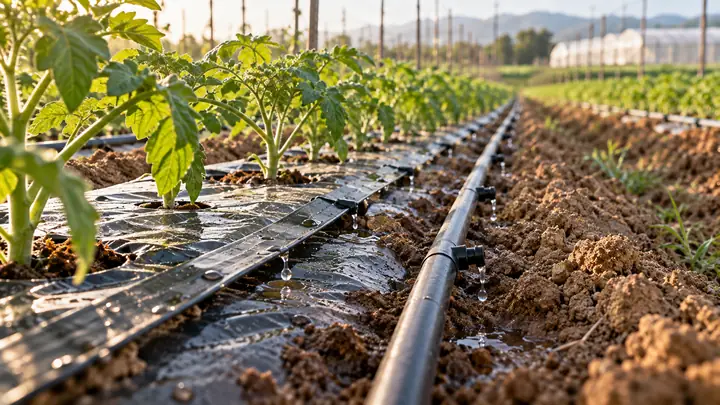
Drip irrigation for orchards and fields delivers water and fertilizer through emitters on polyethylene lines directly to the root zone. Orchards typically use one or two laterals per tree row with inline emitters, wetting roughly a third to a half of the canopy area. Field crops often use drip tape, and subsurface drip suits multi-year row crops where lines stay buried.
What is drip irrigation for orchards and fields?
Drip irrigation for orchards and fields delivers water and fertilizer slowly, through emitters placed along polyethylene lines, directly into the root zone of each tree or crop row. Compared with flood, furrow or sprinkler irrigation, it wets only part of the soil, so less water is lost to evaporation, runoff and weeds.
Drip belongs to a family called localized irrigation, or micro irrigation, which also includes micro-sprinklers and bubblers. For orchards, vineyards and row crops, it has become one of the most common agricultural irrigation systems wherever water is limited or expensive, because it pairs naturally with fertigation and automation.
This guide covers how drip compares with other irrigation methods, how to lay out drip for fruit trees and field crops, when subsurface drip irrigation makes sense, and what farm irrigation equipment you need at the head of the system.
What are the main types of irrigation systems for agriculture?
Farm irrigation systems fall into three broad groups: surface (flood and furrow), sprinkler (including center pivots and guns) and localized irrigation (drip and micro-sprinklers). Each fits different crops, soils and water supplies.
| Irrigation method | Typical application efficiency | Energy / pressure | Labor | Typical use |
|---|---|---|---|---|
| Flood / basin | Low to moderate | Very low | High | Rice, pasture, traditional orchards |
| Furrow | Low to moderate | Very low | Moderate to high | Row crops on level fields |
| Sprinkler / pivot | Moderate to high | Medium to high | Low (pivot) to moderate | Grains, forage, large open fields |
| Micro-sprinkler | High | Low to medium | Low | Orchards on sandy soils, frost protection, citrus |
| Surface drip | High, often around 90% when well designed | Low | Low once installed | Orchards, vineyards, vegetables, berries |
| Subsurface drip (SDI) | High | Low | Low; maintenance is harder to see | Row crops, alfalfa, high-value vegetables |
Efficiency figures are typical ranges for well-managed systems; a poorly maintained drip system can perform worse than good surface irrigation.
Pros and cons of drip compared with other irrigation methods
- Pros: high water use efficiency, precise fertigation, dry foliage and alleys (less disease and easier spraying and harvest), works on irregular and sloping fields, low operating pressure, and easy automation.
- Cons: higher upfront cost than surface systems, emitters can clog without good filtration, damage from rodents and machinery, salts can accumulate at the edge of the wetted zone in arid regions, and drip offers little frost protection compared with micro-sprinklers.
How do you design drip irrigation for an orchard?
Watering fruit trees with a drip system is about wetting enough of the root zone, not just putting emitters near the trunk. Mature trees need a wide wetted strip, while young trees need water close to a small root ball.
Young trees
For newly planted trees, one lateral per row with one or two emitters near each tree is usually enough. Some growers use a short loop of drip line, often called a tree irrigation ring, around each young tree, which spreads water evenly around the root ball. As trees grow, add emitters further out or install a second lateral.
Mature trees
For mature orchards, common layouts include:
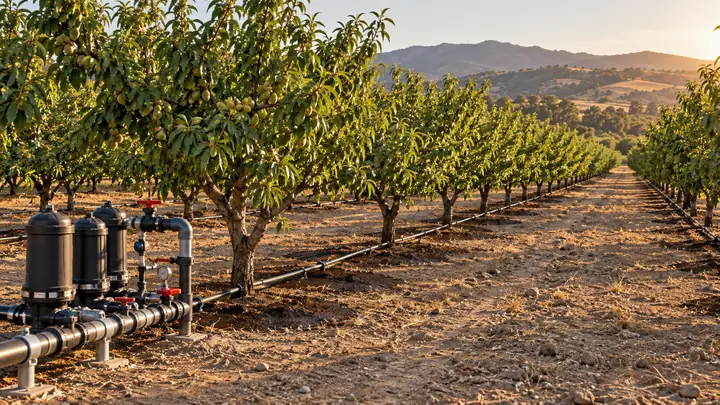
- Single lateral with closely spaced inline emitters, for example every 50–100 cm, which forms a continuous wetted strip. Common in high-density apple, pear and stone fruit orchards and vineyards.
- Double lateral, one line on each side of the tree row, often 0.5–1.5 m from the trunk depending on canopy size. Used for large trees such as citrus, avocado, mango, walnut and almond.
- Several point-source emitters per tree, spaced around the trunk near the canopy drip line. Extension guidance commonly suggests splitting a tree's flow between three or four emitters rather than one.
A practical target many designers use is wetting roughly a third to a half of the area under the canopy, more on sandy soils and in hot, dry climates. Tree irrigation tubes and short micro irrigation tube leaders (spaghetti tubing) can reach individual trees from a lateral, but on commercial scale inline drip line with built-in emitters is usually faster to install and easier to maintain.
Vineyards and trellised crops
In vineyards and trellised orchards, the lateral is often clipped to the bottom trellis wire 30–60 cm above the ground. This keeps it clear of mowers and weed control, makes leaks easy to spot, and lets water drip onto the vine row. Inline emitters are typically spaced to match vine spacing or set closer for a continuous strip on light soils. Many vineyards use deficit irrigation strategies at certain growth stages, which makes accurate, uniform delivery and a flow-monitoring controller even more important.
How much water does a fruit tree need?
Daily water use depends on canopy size, crop, climate and season. Designers estimate it from reference evapotranspiration (ET), a crop coefficient and the shaded area. A mature tree with a large canopy may use from a few tens of liters to well over 100 liters per day at peak summer demand in hot, dry climates; small trees use much less. Size the system for peak demand, then let the controller reduce run times in cooler weeks. Our drip irrigation design guide walks through the calculation.
How is drip irrigation used for field crops?
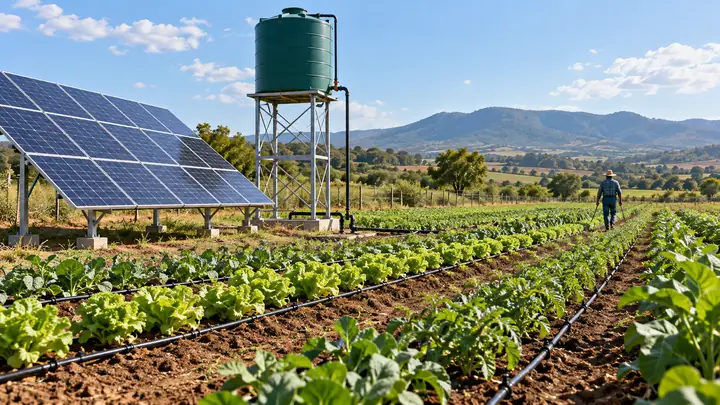
Field irrigation with drip is common for vegetables, melons, berries, cotton, sugarcane, maize seed and other high-value or water-limited crops. A typical field irrigation system uses:
- Drip tape laid on or just under the bed for one or a few seasons, often under plastic mulch.
- Thicker drip line for multi-year crops or where lines are retrieved and reused.
- Lay-flat hose or PVC/PE sub-mains along the headland, with a valve for each block.
The choice between tape and line is mainly about crop life, wall thickness and budget; see drip tape vs. drip line for details. For smaller vegetable operations, our guide to drip irrigation for vegetables and small farms is a better starting point.
When does subsurface drip irrigation make sense?
Subsurface drip irrigation (SDI) places drip tape or drip line below the soil surface, usually somewhere between about 15 and 60 cm deep depending on crop, soil and tillage. Colorado State University Extension describes SDI as a low-pressure, high-efficiency system and reports a normal life of roughly 12–15 years for well-maintained systems.
A subsurface drip system suits:
- Perennial or rotated row crops where lines can stay in place for many years, such as alfalfa, maize, cotton and some vegetable rotations.
- Orchards and vineyards where growers want to keep the surface dry for weed control and machinery traffic.
- Arid, windy regions where surface evaporation is high.
Main risks are root intrusion into emitters, rodent damage, and clogging that is hard to see until plants show stress. Good filtration, regular flushing, chemical treatment where water quality requires it, and air/vacuum relief valves are essential. Subsurface irrigation is not a good idea where burrowing rodents are common and cannot be controlled.
What drives subsurface drip irrigation cost?
Subsurface drip irrigation cost per hectare is higher than surface drip because of installation equipment, heavier-wall tubing, flush manifolds and more careful filtration. The main cost drivers are field size and shape, lateral spacing and wall thickness, water quality (which sets filtration and treatment), pumping requirements and the level of automation. Larger, regular fields generally cost less per hectare.
What farm irrigation equipment is needed at the head of the system?
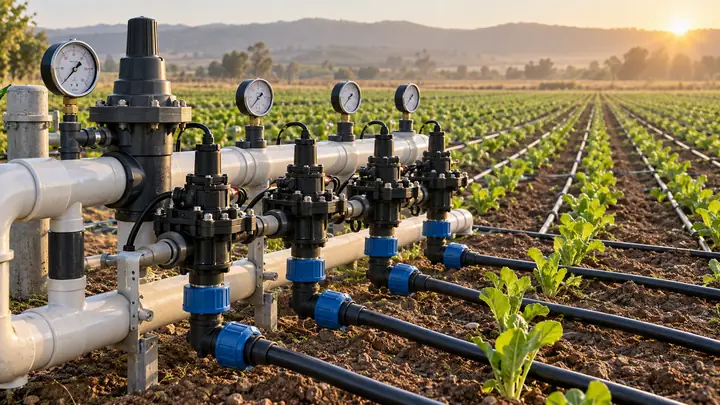
The head unit, sometimes called the control head, prepares water before it enters the network. For orchards and fields, a typical sequence is:
- Water source and pump: well, canal, reservoir or pond, with an electric, solar or engine-driven pump. An engine pump irrigation system with IoT fertilization suits fields without grid power; see also solar-powered irrigation systems.
- Backflow prevention, required wherever fertilizer or chemicals are injected.
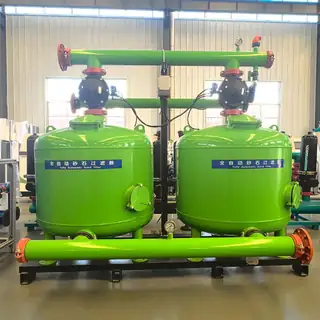
- Primary filtration: sand media filters for surface water with algae and organic load, or hydrocyclones for sandy well water. A backwash sand filtration system is a common choice for pond and canal water.
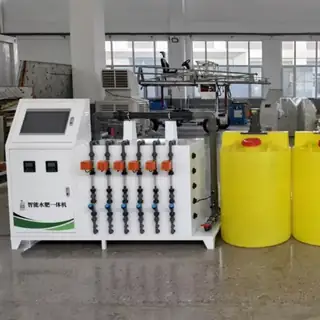
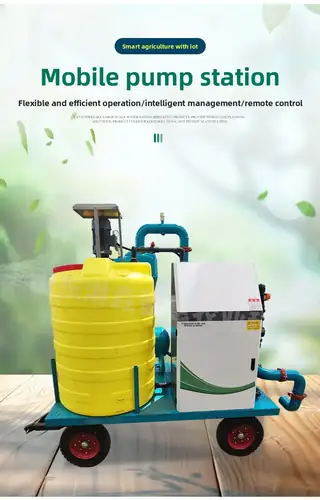
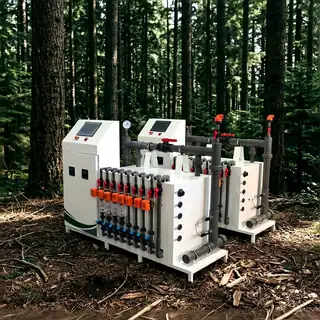
- Fertilizer injection: venturi, proportional injector or a dosing unit. A towed mobile water-fertilizer unit can serve several scattered plots.
- Secondary filtration: disc or screen filters, typically around 120–150 mesh for drip line and often finer for thin-wall tape, depending on the emitter manufacturer's recommendation.
- Control valves, pressure regulation, flow meter and controller.
Filtration is the single biggest factor in drip system life. Our irrigation filters guide explains how to match filter type to water source. For scheduling, see smart irrigation controllers; a simple micro irrigation timer or micro irrigation controller is fine for a trial block, but large blocks benefit from flow monitoring and remote alarms.
Orchard and field drip installation checklist
- Test water quality (EC, pH, iron, manganese, hardness, suspended solids) before choosing filters and emitters.
- Map the field with elevations; split it into blocks that each irrigate evenly at the available flow.
- Choose lateral type, emitter flow and spacing to match soil texture and root zone.
- Use pressure-compensating drip line on slopes or long runs.
- Install air/vacuum relief valves at high points and flush valves or manifolds at lateral ends.
- Flush mains, sub-mains and laterals before connecting emitters, and again after installation.
- Measure flow and pressure at the start and end of several laterals to confirm uniformity.
- Set a maintenance routine: filter cleaning, line flushing and, where needed, acid or chlorine treatment.
Sourcing farm irrigation supplies
Drip lines and emitters are consumables, while the head unit (pumps, filters, fertigation and control) is a long-term investment. Mars Vertical Farm manufactures filtration, fertigation and pumping units in Shanghai, with ISO 9001 quality management, and quotes in USD on EXW, FOB Shanghai or CIF. Browse the irrigation and fertigation range, or send us your field map, water analysis and crop plan for a head-unit proposal.