Short answer
Use sand media filters for surface water with heavy organic load or algae, such as ponds, canals and open reservoirs. Use disc filters for wells and moderately dirty water when you want compact, automatic backflushing. Use screen filters for clean groundwater or municipal water, or as a final safety filter after a media or disc filter.
Why does filter choice matter so much in drip irrigation?
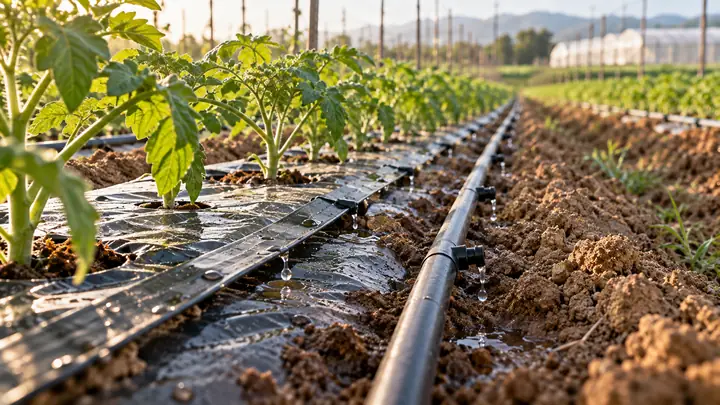
Drip emitters have small passages, often well under 1 mm. Particles, algae, bacterial slime and chemical precipitates block them gradually, which reduces uniformity long before an emitter stops completely. Plants near clogged emitters get less water and fertilizer, and the problem is hard to see until yield or quality drops. A filter sized for your water prevents most of that, and it is far cheaper than replacing dripline.
How does each filter type work?
Sand media filter
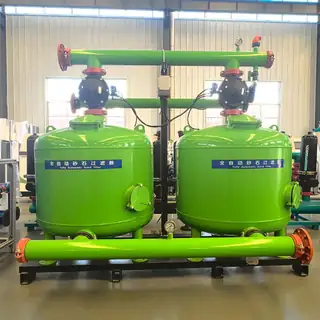
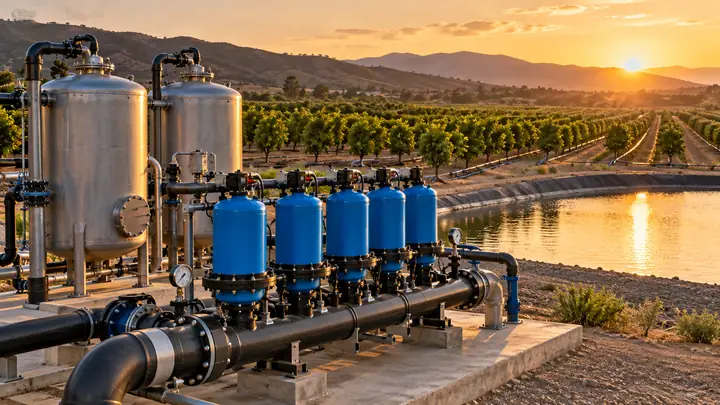
A pressure tank holds a bed of graded quartz sand or crushed silica. Water flows down through the bed, which traps particles throughout its depth, not just on the surface. That depth gives media filters a large holding capacity for organic matter, algae and fine silt. Cleaning is by backwashing: flow is reversed through one tank using filtered water from the others, lifting the bed and flushing out trapped dirt. That is why media filters are installed in batteries of two or more tanks.
Disc filter
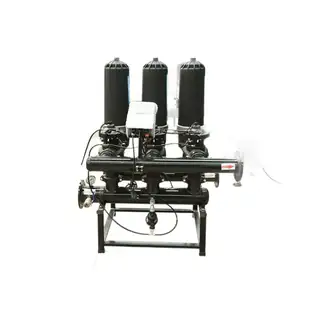
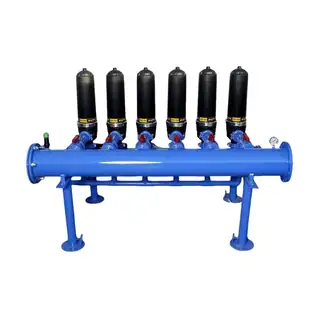
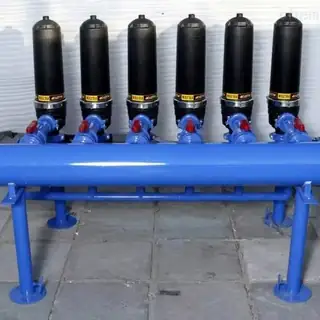
Stacks of thin plastic discs with grooved faces are pressed together. Water passes through the grooves from outside to inside, and particles are caught at the edges and within the groove crossings, giving some depth filtration in a compact housing. Automatic units release the stack and spin the discs with jets of water during backflush, often in under a minute per unit. Our fully automatic gear disc filter and greenhouse backwash disc filter system are examples.
Screen filter
A perforated or woven stainless steel or plastic screen traps particles on its surface. Screens are simple and inexpensive, and they give a precise cut-off size, but they clog quickly with soft organic material such as algae, which smears across the mesh. Manual screens need regular cleaning; automatic screen filters use suction scanners or brushes.
How do disc, sand media and screen filters compare?
| Factor | Sand media | Disc | Screen |
|---|---|---|---|
| Best water source | Ponds, canals, reservoirs, treated wastewater | Wells, rivers with moderate load, mixed sources | Clean wells, municipal water |
| Main strength | Holds large amounts of organic matter and algae | Compact, good dirt-holding, fast automatic flushing | Simple, precise particle cut-off, low cost |
| Weakness | Large footprint, heavy, uses more backwash water | Heavy algae loads cause frequent flushing | Clogs quickly with organics |
| Filtration type | Depth | Surface and partial depth | Surface |
| Typical backflush pressure need | Moderate; needs adequate backwash flow | Often around 2.5–3 bar at the inlet for automatic units | Varies by design |
| Maintenance | Media top-up or replacement every few years | Inspect and clean discs, check seals | Inspect and clean screen, replace if damaged |
| Common role | Primary filter on surface water | Primary filter on most farms | Secondary or safety filter |
What mesh or micron rating do I need?
A common rule of thumb is to remove particles larger than roughly one-seventh to one-tenth of the emitter's smallest water passage, because small particles can group together and block a passage several times their size. Always follow the emitter manufacturer's recommendation first.
| Mesh | Approximate opening | Typical use |
|---|---|---|
| 80 | about 180 µm | Micro-sprinklers, sprayers |
| 120 | about 125–130 µm | Most drip lines and drippers |
| 150 | about 100 µm | Low-flow drippers |
| 200 | about 75 µm | Very low-flow drippers, misting nozzles |
Sand media filters are rated by media grade rather than mesh; the effective particle removal depends on sand size and flow rate, so ask for the equivalent mesh rating of the media used.
What should a water test tell me before choosing?
- Suspended solids and turbidity: how much physical dirt the filter must hold.
- Algae and organic matter: high levels point to sand media.
- Sand and heavy grit: install a hydrocyclone (sand separator) ahead of the main filter so grit does not wear discs or overload media.
- Iron and manganese: dissolved forms pass through any filter and then oxidize inside the dripline. They need oxidation (aeration or chemical) followed by filtration.
- Calcium carbonate scale: treated with acid injection, not filtration.
- Bacterial slime: controlled with periodic line treatment such as chlorination, following local rules.
How do I size a filter station?
- Start from peak system flow in m³/h. See how to size a fertigation system for the flow calculation.
- Use dirty-water ratings. Manufacturers often rate filters for clean water. For surface water, derate capacity substantially, commonly by around a quarter to a half, or use the supplier's water-quality tables.
- For media filters, size the bed area so the filtration rate stays within the supplier's recommended range for your water; heavier loads need more bed area per m³/h.
- Plan backflushing. Automatic stations flush on a pressure differential setpoint, commonly about 0.3–0.5 bar above the clean reading, plus a time backup. Check that inlet pressure stays high enough during flushing.
- Allow for growth. A modular battery lets you add units when you expand.
What are the most common filtration mistakes?
- Sizing on clean-water flow. The filter works on day one, then flushes constantly in summer when algae peaks.
- Skipping the sand separator on a sandy well. Grit wears disc faces and seals and fills media tanks.
- Injecting fertilizer before the filter. Precipitates and undissolved fertilizer load the filter, and acid can attack some media and housings. Inject after the main filter and add a safety screen downstream.
- Ignoring low pressure during backflush. If inlet pressure drops below what the filter needs, flushing is incomplete and dirt builds up.
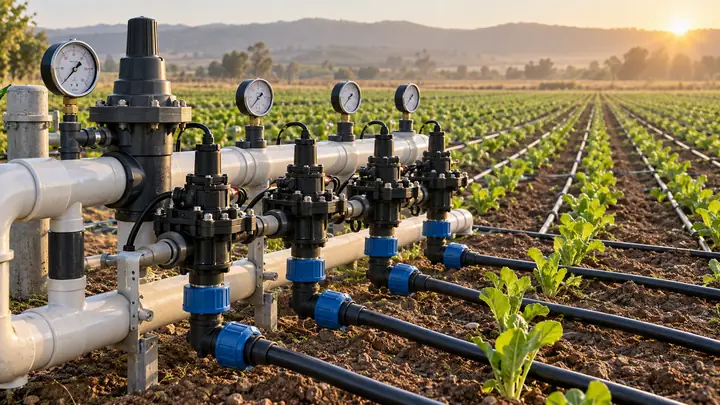
- No pressure gauges. Install gauges or transmitters before and after every filter so operators can see differential pressure at a glance.
- Never flushing laterals. Even good filters pass very fine silt. Open line ends periodically to flush settled material.
How are filters combined in practice?
Typical layouts by water source:
- Pond or canal: intake screen, sand media battery, then a disc or screen safety filter after fertilizer injection.
- Sandy well: hydrocyclone, then disc filter battery.
- Clean well or municipal: disc or screen filter, then a small safety screen after injection.
- Greenhouse or hydroponic supply with poor water: sand and carbon pre-treatment followed by reverse osmosis, such as our backwash sand and quartz filtration system.
Browse all irrigation, fertigation and filtration equipment, or send us a water analysis and your peak flow for a filter recommendation.