











Short answer
A metering pump is a positive displacement pump that injects an exact, adjustable volume of fertilizer or chemical into an irrigation line, typically within about 1–3% accuracy regardless of line pressure. A venturi injector has no moving parts and draws solution by suction created by a pressure difference, so it is cheaper but its rate varies with pressure unless an EC and pH controller regulates it.
What is a metering pump, and how is it different from a venturi injector?
A metering pump is a positive displacement pump that delivers a precise, adjustable volume of liquid per stroke or per revolution, so it can inject fertilizer, acid or chlorine at a controlled rate into a pressurized irrigation line. A venturi injector does a similar job with no motor and no moving parts: water flowing through a narrow throat creates suction that draws concentrated solution into the line.
Both are used to feed nutrients and treatment chemicals in greenhouses, vertical farms, orchards and open fields. The metering pump wins on accuracy and independence from line pressure; the venturi wins on simplicity and purchase price. This guide explains how each works, the main types of dosing pumps, how to size a chemical injection pump, and when a venturi fertilizer injector is the better choice. For a broader overview of all injector families, see our guide to fertilizer injectors and fertigation systems.
How does a metering pump work?
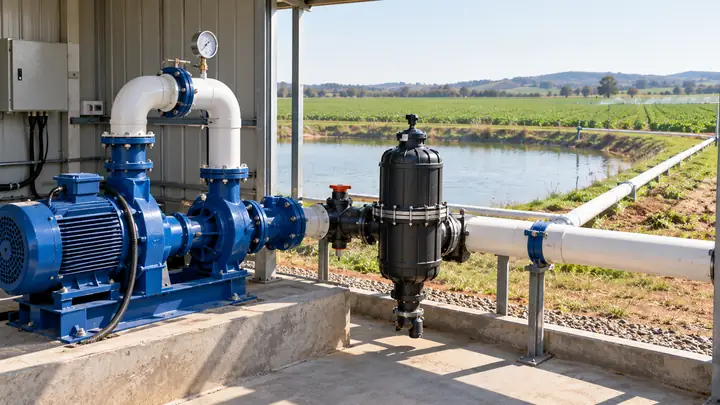
A metering pump moves a fixed volume on every stroke and changes its output by changing stroke length, stroke frequency or motor speed. Because the volume per stroke stays nearly constant across the pump's rated pressure range, output is predictable even when line pressure moves. Good diaphragm metering pumps typically repeat within a few percent, and many quality units are specified at around plus or minus 1–2% at steady conditions.
The terms dosing pump, chemical metering pump, chemical feed pump and chemical injection pump are used almost interchangeably in irrigation and water treatment. "Dosing" usually describes the job, adding a small, measured quantity, while "metering" describes the accuracy. In practice, metering and dosing pumps are the same family of equipment.
What are the main types of dosing pumps?
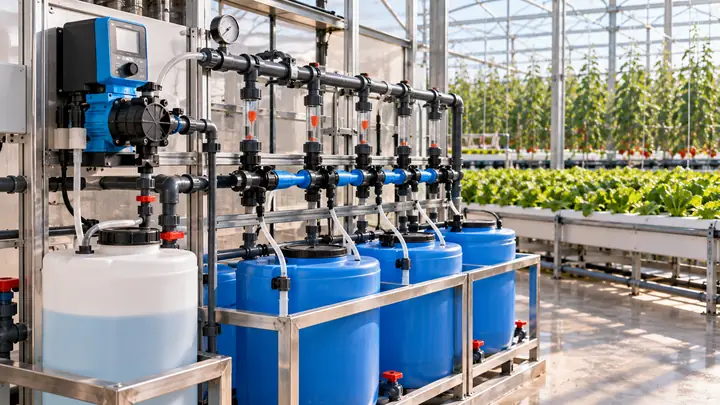
- Electronic solenoid diaphragm pumps. A solenoid pulses a PTFE-faced diaphragm. These electronic metering pumps cover small flows, commonly from well under 1 L/h to around 50 L/h, at pressures up to roughly 10–20 bar (145–290 psi). They accept 4–20 mA, pulse or digital signals, which makes them easy to link to an EC (electrical conductivity) or pH controller. This is the typical electric fertilizer pump or chemical dosing pump on a greenhouse fertigation head.
- Motor-driven mechanical diaphragm pumps. An electric motor and gearbox drive the diaphragm, giving larger flows (tens to hundreds of liters per hour) and smoother output. They are a common industrial dosing pump for large fertigation heads and water treatment plants.
- Hydraulic diaphragm and piston (plunger) pumps. These are used where line pressure is high or where a low flow must be delivered at high pressure, for example injecting into a pressurized main or industrial process.
- Peristaltic pumps. Rollers squeeze a flexible tube, so the liquid touches only the tube. They self-prime and handle gassing liquids such as sodium hypochlorite well, but tubes wear and need regular replacement. They are popular in hydroponic nutrient dosers.
- Water-powered proportional injectors. The water flow drives a piston that draws concentrate at a fixed ratio, often adjustable from about 1:500 to 1:50 (0.2–2%). They need no electricity and stay proportional as flow changes, which suits nurseries and smaller greenhouses.
How does a venturi injector work?
A venturi injector works by accelerating water through a narrow throat, which drops the pressure at a side suction port below atmospheric pressure so that liquid from an open tank is drawn in and mixed. It needs a pressure difference between the inlet and outlet to create that vacuum; with no difference, there is no suction.
Manufacturers publish performance tables that relate inlet pressure, outlet pressure, motive flow and suction rate. As a rule of thumb, suction begins only once the outlet pressure is meaningfully lower than the inlet, often around 20% lower, and rated suction usually needs a larger differential. Always size from the datasheet for the exact model rather than from a general rule.
How are venturi fertilizer injectors installed?
- Bypass with a throttling valve. The injector sits on a parallel loop around a valve in the main line. Partly closing the valve creates the pressure difference that drives the venturi. This is the simplest installation and is common on small and medium systems.
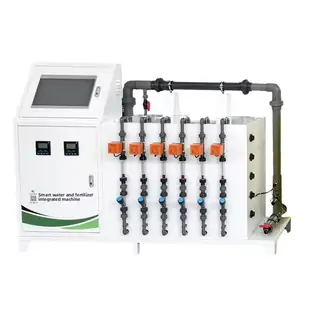
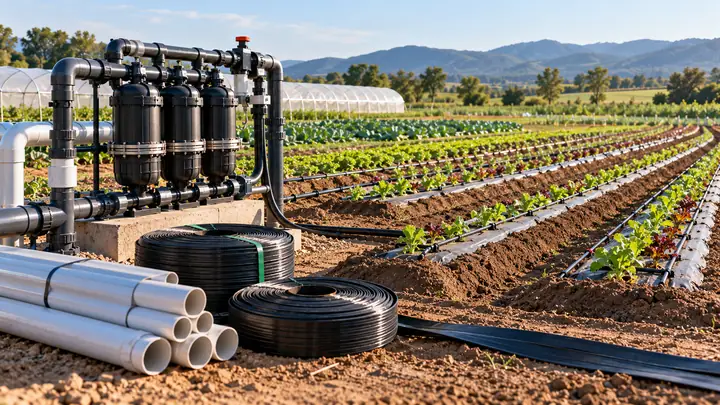
- Bypass with a booster pump. A small pump on the bypass loop creates the differential without throttling the main line, so injection does not cost system pressure. Most automatic fertigation machines use this layout, with several venturi channels each fitted with a flow meter and a solenoid or pulse valve.
- Full in-line. The whole flow passes through a larger venturi. It is simple but costs significant system pressure, so it is used mainly where pressure is plentiful.
A plain venturi injection rate changes with line pressure and flow, so on its own it is not a precise metering device. When a controller reads EC and pH downstream and pulses each channel's valve, a venturi system becomes an accurate closed-loop liquid fertilizer dispenser. This is how our smart fertigation machine mixes several stock tanks into the irrigation water.
Metering pump vs venturi injector vs proportional injector
The right injector depends on the accuracy you need, the power available, how much pressure loss you can accept and the chemicals you dose. The table compares the common options.
| Feature | Electric diaphragm metering pump | Peristaltic dosing pump | Water-powered proportional injector | Venturi injector |
|---|---|---|---|---|
| Power source | Electricity | Electricity | Water flow | Pressure differential (or booster pump) |
| Accuracy | High, typically about ±1–3% | Good, drifts as tube wears | Good, stays proportional to flow | Varies with pressure unless controlled by EC/pH loop |
| Typical flow range | <1 L/h to hundreds of L/h | Small, mL/min to tens of L/h | Set as a ratio, about 0.2–2% | Tens of L/h to over 1,000 L/h of suction |
| Pressure loss in main line | None | None | Moderate | Significant unless booster pump is used |
| Moving parts | Diaphragm, valves | Rollers, tube | Piston, seals | None |
| Signal control | Yes: pulse, 4–20 mA, Modbus on many models | Yes | No (manual ratio) | Via solenoid valves and controller |
| Purchase cost | Medium to high | Low to medium | Medium | Lowest |
| Best for | Acid and chlorine dosing, precise single-channel feed, high pressure lines | Hydroponic nutrient and pH dosing, hypochlorite | Nurseries, small greenhouses, no power on site | Multi-channel fertigation machines, field fertigation, low budget |
What do chemical injection pumps dose on a farm?
On farms, a chemical pump of this kind most often doses liquid fertilizers, acids and oxidizers, and each liquid sets different requirements for wetted materials. Matching the pump head, seals and tubing to the chemical is as important as matching the flow.
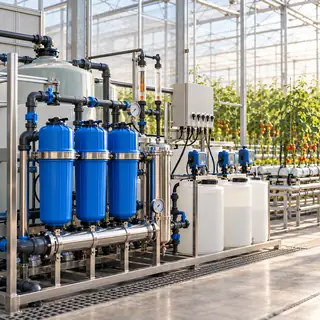
- Liquid fertilizer stock solutions, usually two stock tanks (A and B) to keep calcium apart from sulfates and phosphates. A liquid fertilizer pump for nutrients needs moderate accuracy and good corrosion resistance; PVC, PP or PVDF heads are typical. See our hydroponic nutrients, EC and pH guide for target values.
- Acids such as nitric, phosphoric or sulfuric acid, used to lower pH and bicarbonates and to dissolve emitter scale. Use PVDF or PTFE wetted parts and follow the supplier's safety data sheet.
- Chlorine (sodium hypochlorite) and hydrogen peroxide for biofilm control in drip lines and hydroponic channels. Hypochlorite releases gas, so pumps with degassing heads or peristaltic pumps are preferred. Never mix acid and chlorine in the same tank or injection point.
- Crop protection products through chemigation, where allowed by the product label. Chemigation is regulated in many US states and requires specific backflow and interlock devices, so confirm local rules before injecting any pesticide.
Tractor-mounted liquid fertilizer applicators use the same pump principles on a sprayer or side-dress toolbar. For fixed irrigation systems, the injector usually lives in the head unit next to the filters and controller.
How do I size a chemical metering pump or fertilizer injection pump?
You size a chemical metering pump from the irrigation flow, the dilution ratio of your stock solution and the pressure at the injection point. The core formula is simple: injection rate = system flow × target concentration ÷ stock concentration.
- Find the peak system flow. Use the largest irrigation zone, for example 10 m³/h (about 44 US gpm).
- Set the dilution ratio. If your nutrient recipe uses stock tanks mixed at 1:100, you need 10,000 L/h ÷ 100 = 100 L/h of each stock solution.
- Add headroom. Choose a pump or venturi channel rated around 1.25–1.5 times the calculated rate so it runs in the middle of its range, where accuracy is best. Here, about 125–150 L/h.
- Check discharge pressure. The pump must exceed line pressure at the injection point with margin. For a line at 3 bar (44 psi), a pump rated 5 bar or more is sensible.
- Check the chemical and materials. Confirm head, diaphragm, seals, suction and discharge tubing are compatible with every chemical the pump will handle.
- Plan the control signal. Decide whether the pump runs on a fixed rate, a flow meter pulse (proportional dosing) or an EC/pH controller (closed loop).
- Calibrate after installation. Run a drawdown test with a calibration column or a measuring cylinder and adjust the setting until measured output matches the target.
For multi-channel nutrient recipes with EC and pH targets, the sizing logic is covered in more depth in how to size a fertigation system.
Installation, accessories and safety
A reliable chemical metering system is more than the pump: it needs the right accessories, a correct injection point and interlocks that stop dosing when water stops. Most dosing problems in the field come from installation details rather than the pump itself.
- Foot valve with strainer on the suction line, kept a few centimeters above the tank bottom to avoid sediment.
- Injection valve (check valve) at the injection point so irrigation water cannot flow back into the chemical line.
- Backpressure valve where the pump discharges into low or variable pressure, to prevent siphoning and over-dosing.
- Pressure relief valve to protect the pump and tubing if a valve downstream is closed.
- Pulsation dampener for large diaphragm pumps feeding long lines.
- Backflow prevention on the water supply, as required by local plumbing and chemigation rules.
- Electrical interlock so the injector runs only while the irrigation pump runs and flow is confirmed.
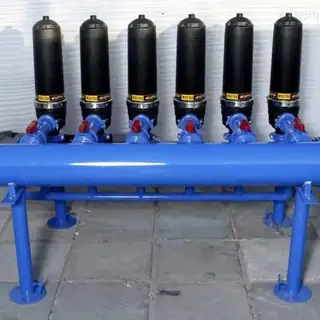
Inject upstream of the main filter where possible so that undissolved particles are caught, but downstream of any filter that could be damaged by the chemical. A self-cleaning irrigation filter sized for the full flow protects drippers from precipitates. Flush lines with clean water after fertigation, as described in our drip irrigation maintenance and repair guide.
Buying checklist for metering pumps and venturi injectors
When you compare chemical injection pump manufacturers or a dosing pump supplier, ask for the same information from each so that quotes are comparable. These are the specifications we ask buyers to confirm before we propose a fertigation head.
- Maximum and minimum flow (L/h or gph) and turndown at the required pressure.
- Maximum discharge pressure (bar or psi) and suction lift.
- Wetted materials of head, diaphragm, valves, seals and tubing, checked against each chemical.
- Supply voltage (for example 220–240 V single-phase or 380–415 V three-phase), IP rating and control inputs: pulse, 4–20 mA, RS485 or Modbus.
- For venturi injectors: suction rate at your actual inlet and outlet pressures, motive flow and whether a booster pump is included.
- Number of channels, flow meters per channel, EC and pH sensors and the controller's alarm functions.
- Spare parts kits (diaphragms, valve balls, peristaltic tubes) and recommended service intervals.
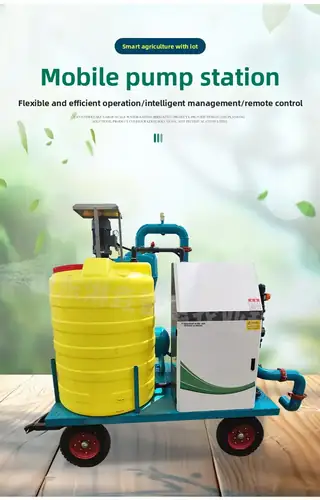
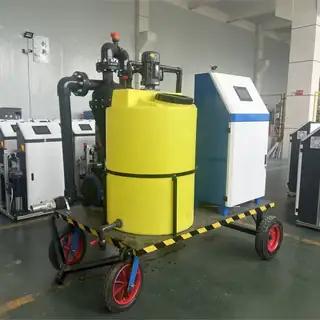
For mobile or small-site fertigation, an all-in-one cart such as our mobile integrated water-fertilizer unit combines the pump, injectors and controller on one frame. Pressure and flow on the main line also depend on the irrigation pump; our irrigation pumps guide covers that side.
Next steps
A metering pump is the right choice when you need precise, pressure-independent dosing of acid, chlorine or a single nutrient stream, while venturi injectors with a booster pump and EC/pH control are often the most economical way to run multi-channel fertigation. If you share your zone flows, stock tank recipe, water analysis and power supply, our engineers can recommend a metering pump, venturi or complete fertigation head and quote it factory-direct, including custom channel counts. Send us your project details to get started.