

Short answer
A soil moisture sensor is a probe in the root zone that measures soil water content (%) or soil water tension (kPa) so irrigation runs only when crops need water. Tensiometers and granular matrix sensors read tension; capacitance and TDR probes read volumetric water content. Common tension trigger points are about 10–30 kPa in sandy soils and 30–50 kPa in loams, refined by crop and growth stage.
What is a soil moisture sensor and how does it help irrigation?
A soil moisture sensor is a probe buried in the root zone that measures either how much water the soil holds (volumetric water content, in %) or how tightly the soil holds it (soil water tension, in kilopascals or centibars), so growers irrigate when plants actually need water instead of on a fixed timer. Combined with rain sensors and flow meters, it turns an irrigation system from guesswork into measured, verifiable watering.
This guide compares the main sensor types, gives typical irrigation trigger points, shows how to install probes, and explains where rain sensors and irrigation flow meters fit on farms, greenhouses and nurseries. For controller selection itself, see our guide to smart irrigation controllers.
Types of soil moisture sensors compared
Soil moisture sensors fall into two families: tension sensors, which tell you how hard roots must work to extract water, and volumetric sensors, which tell you how much water is in the soil. Both work for irrigation scheduling; the right one depends on soil, crop, budget and how you want to read the data.
| Sensor type | Measures | Typical range | Strengths | Limitations |
|---|---|---|---|---|
| Tensiometer | Soil water tension | 0 to about 80 kPa | Direct reading of plant-available water, no calibration | Needs refilling, can break suction in dry soil, freezing risk |
| Granular matrix / gypsum block | Tension via electrical resistance | About 0–200 kPa | Low cost, low maintenance, wider dry range | Slow response, less accurate in very wet soil, affected by salinity |
| Capacitance / FDR probe | Volumetric water content | 0 to saturation | Fast, continuous logging, multi-depth profile probes | Needs good soil contact and ideally soil-specific calibration |
| TDR (time domain reflectometry) | Volumetric water content | 0 to saturation | High accuracy, less soil-dependent | Higher cost |
| Resistive moisture sensor module | Relative wetness | Uncalibrated | Very cheap, easy for hobby projects | Probes corrode, drift with salts; not suitable for farm scheduling |
A two-prong resistive sensor module sold for hobby electronics is fine for a potted plant or a classroom project, and simple garden moisture sensor stakes help homeowners decide when to water. For sensor networks that drive farm irrigation decisions, capacitance probes and tension sensors are the professional standard.
How do you use a soil moisture sensor to schedule irrigation?
You schedule irrigation with a soil moisture sensor by setting a refill point, where irrigation starts, and a full point, where it stops, then watching readings move between them. The goal is to keep the root zone between field capacity and the point where crop stress begins.
Typical irrigation trigger points
Trigger points depend on soil texture, crop and growth stage. University extension services publish crop-specific values; the ranges below are common starting points for tension sensors that you then refine with field observation:
- Sandy soils: irrigate at roughly 10–30 kPa, because sand releases most of its available water at low tension.
- Loams: irrigate at roughly 30–50 kPa.
- Clays and clay loams: irrigate at roughly 50–80 kPa for many field crops.
- Shallow-rooted vegetables on drip: often kept wetter, toward the low end of these ranges.
With volumetric sensors, growers usually watch the shape of the curve rather than an absolute number: the reading jumps after irrigation, falls quickly as water drains, then flattens at field capacity. The refill point is set where the daily drawdown slows, which shows roots are starting to struggle.
Greenhouses and substrate crops
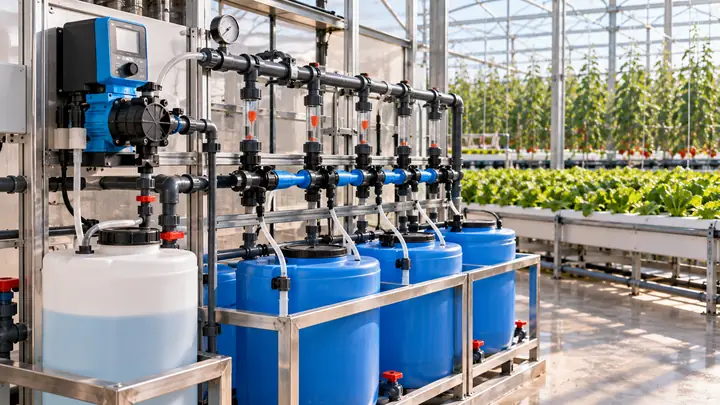
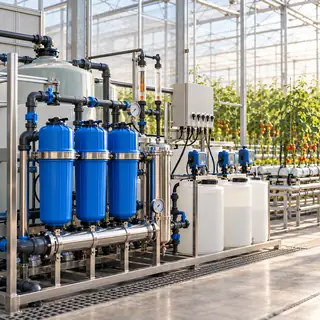
In greenhouses growing in coir, rockwool or peat, substrate moisture sensors measure water content and EC (electrical conductivity) in the slab, and are often combined with drain percentage and weighing scales. Many systems trigger irrigation by accumulated solar radiation and use moisture readings to fine-tune shot size and timing. Our greenhouse irrigation system guide covers these strategies.
How to install soil moisture sensors
Sensor placement matters more than sensor brand: a well-installed, representative probe beats an expensive probe in the wrong spot. Follow these steps:
- Choose representative sites. Place stations in typical soil for each irrigation zone, avoiding low spots, field edges and wheel tracks. Use at least one station per zone, more where soil varies.
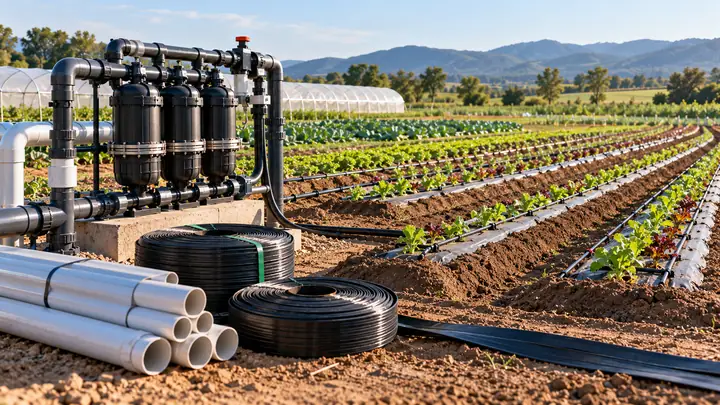
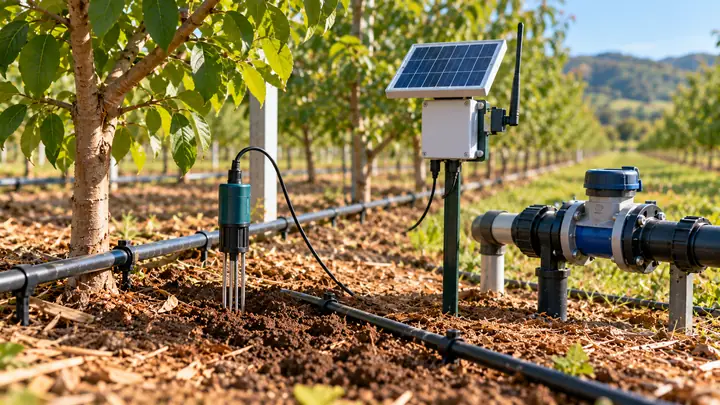
- Place within the wetted zone. With drip, install the probe near the emitter line, typically 10–30 cm (4–12 in) from an emitter and close to the plant row.
- Install at two or more depths. For vegetables, about one-third and two-thirds of the root depth, for example 15 cm and 30 cm (6 and 12 in). For orchards and vines, often 30 cm and 60 cm (1 and 2 ft) or deeper.
- Ensure good soil contact. Use an auger of the right diameter, add a soil slurry for tension sensors, and avoid air gaps around capacitance probes.
- Protect cables and loggers from machinery, rodents and sunlight, and mark the site.
- Let sensors settle for a few irrigation cycles before trusting readings, then compare with a hand probe or soil feel test.
The deeper sensor tells you whether irrigation is reaching the bottom of the root zone or overshooting it; if the deep sensor spikes after every irrigation, cycles are too long.
What does a rain sensor do in an irrigation system?
A rain sensor is a small switch that interrupts an automatic irrigation controller after a set amount of rain, so sprinklers do not run during or right after a storm. Most use hygroscopic disks that swell when wet and open a switch; they reset as the disks dry. Typical units let you set the shutoff at roughly 3–20 mm (1/8–3/4 in) of rain, and many include a freeze sensor that blocks irrigation near freezing.
- Sprinkler rain sensor and garden rain sensor: wired or wireless units mounted on a roof edge or post in open sky, connected to the controller's sensor terminals.
- Rules: some US states, Florida among them, require a rain shutoff device on automatic lawn irrigation systems; check current local requirements.
- On farms: a rain sensor is a useful safety interlock for outdoor nurseries and field zones, but it only knows that it rained, not how wet the root zone is. Soil moisture sensors and on-farm weather stations that calculate evapotranspiration (ET) give far better scheduling.
Flow meters and flow sensors for irrigation
A flow meter for irrigation measures how much water each zone actually receives, which makes it the best single tool for detecting leaks, clogging and pump problems. It also supports water-use reporting and proportional fertilizer dosing.
Types of irrigation flow meters
- Mechanical turbine and multi-jet meters: robust, affordable irrigation water flow meters with a totalizer dial and optional pulse output.
- Woltmann meters: large-bore turbine meters for mains of about 50 mm (2 in) and up.
- Electromagnetic (mag) meters: no moving parts, very low pressure loss and high accuracy; tolerate dirty water but need conductive water and power.
- Ultrasonic meters: inline or clamp-on, useful for retrofits without cutting pipe.
- Paddlewheel and Hall-effect flow sensors: small inline flow sensors with pulse output, common on controllers and fertigation units.
How to use flow data
Record each zone's normal flow when the system is new and clean. Afterwards, a reading well above baseline signals a leak or burst lateral; a reading below baseline signals clogging, a dirty filter or a valve not opening fully. Many controllers can shut a zone automatically on high flow. Install meters with straight pipe upstream and downstream as the manufacturer specifies, often several pipe diameters each side, and fit them after the filter to protect moving parts. Our drip irrigation maintenance and repair guide shows how to act on flow changes.
Wireless moisture monitoring systems and smart sensors
Wireless monitoring links sensors in the field to a dashboard or controller, so readings are available on a phone without walking every block. A smart moisture sensor or wireless flow meter typically reports through one of these networks:
- Wi-Fi: fine near buildings and greenhouses; a Wi-Fi flow sensor suits head units close to the office.
- LoRa / LoRaWAN: long range (often several kilometers in open country) at low power, popular for field stations.
- NB-IoT, LTE-M or 4G cellular: no gateway needed where coverage is good.
- Wired outputs: SDI-12, RS-485/Modbus, 4–20 mA or 0–5 V for direct connection to controllers and PLCs.
Irrigation monitors that combine soil moisture, flow, pressure and weather data let one manager oversee many zones and prove water use. See IoT smart agriculture for how these systems are built, and the IoT agricultural irrigation system for an example of a connected head unit.
Choosing sensors: a buyer's checklist
Choose sensors by the decision you want them to support, then match output, power and connectivity to your controller. Specify these items when requesting quotes:
- Measurement: volumetric water content, tension, or both; add soil temperature and EC if you fertigate.
- Depths and number of stations per zone, and whether you need multi-depth profile probes.
- Output and protocol: SDI-12, Modbus, 4–20 mA, 0–5 V or pulse for flow.
- Power: battery life, solar panel option, or controller-powered.
- Connectivity: Wi-Fi, LoRaWAN, cellular, or wired to the head unit.
- Flow meter size, pressure rating and accuracy for each zone or the main.
- Durability: outdoor moisture sensor housings rated for burial, UV and rodents.
Paired with a controller that acts on the data, a soil moisture sensor network usually pays back through water and energy savings, steadier yields and earlier warning of system faults.
Next steps
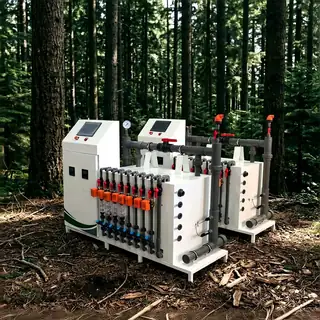
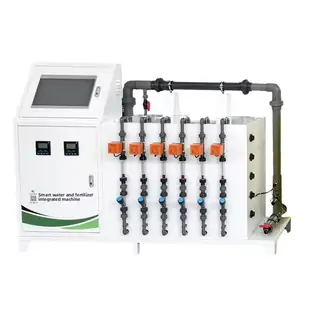
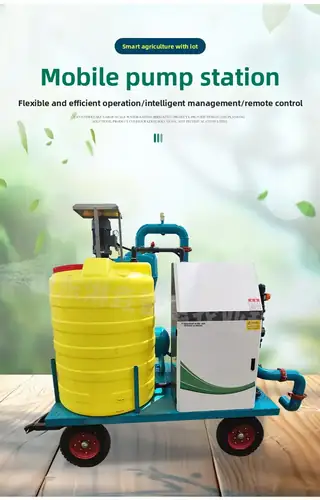
Mars Vertical Farm builds IoT-ready irrigation head units and fertigation machines that accept moisture, flow and EC/pH inputs. Browse the irrigation and fertigation range, or tell us your crop, zones and preferred network and we will propose a sensor and control package, with factory-direct supply and custom configuration.