Short answer
An insect light trap uses ultraviolet or visible light to attract night-flying insects and kills or captures them with an electric grid, suction fan, water pan or sticky board. On farms it controls and monitors moths, beetles and planthoppers. It is weak against daytime pests such as aphids, whiteflies and thrips, which need sticky cards, netting or biological control.
What is an insect light trap?
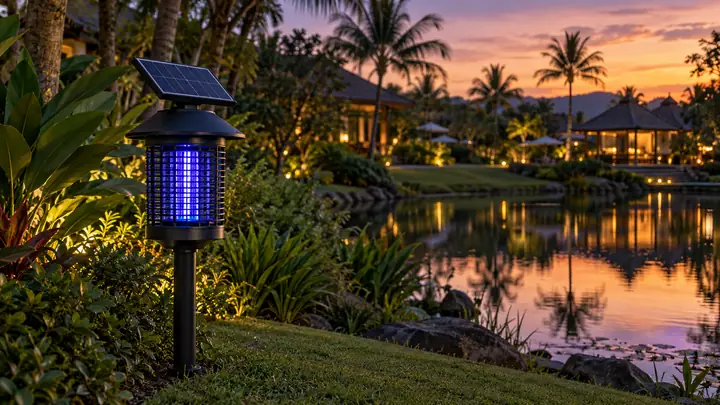
An insect light trap is a device that uses ultraviolet or visible light to lure flying insects, then kills or captures them with an electric grid, a suction fan, a water pan or a sticky board. On farms and in greenhouses, insect light traps are used for two jobs: reducing populations of night-flying pests, and monitoring when and how heavily those pests are flying.
Light traps are an old tool, but modern units have changed the practical picture. LED light sources use less power, solar panels remove the need for mains cables in the field, and IoT models can count and report the catch. This guide helps growers, farm managers and distributors choose the right type of insect light trap for each setting, from open fields and orchards to greenhouses, livestock buildings and fish ponds. For lamp spacing per hectare and solar sizing in open fields, see our companion solar insect-killing lamp guide.
Which farm pests do insect light traps control?
A light trap only works against insects that fly at night and are drawn to light. Fortunately for growers, that includes many of the most damaging crop pests:
- Moths whose caterpillars feed on crops: armyworms, cutworms, stem borers, bollworms, leaf rollers and fruit moths.
- Beetles, including chafers and scarab beetles whose larvae (white grubs) damage roots and turf.
- Planthoppers and leafhoppers in rice and other field crops.
- Some flies and midges, especially in enclosed or shaded buildings.
Light traps are weak against daytime pests such as aphids, whiteflies, thrips and most flies in sunlit areas. Those respond better to coloured sticky cards, biological control and exclusion netting. Biting mosquitoes are also poorly controlled by light; we explain why in do bug zappers work?
What types of insect light traps are used on farms?
Farm light traps differ mainly in how they kill or hold the insects. Each design suits different goals.
| Trap type | How it captures | Best for | Trade-offs |
|---|---|---|---|
| Electric grid (electrocution) | High-voltage grid kills insects on contact; they drop into a tray | Moth and beetle control in fields and orchards | Insects may be fragmented; grid must be guarded and kept clean |
| Frequency-vibration lamp | Lamp combining several wavelengths with a grid tuned to attract and stun insects | Rice, vegetables and broad-acre crops with mixed pest species | Similar maintenance to grid traps; bycatch depends on spectrum |
| Suction (fan) trap | Fan pulls insects near the lamp into a bag or container | Monitoring, damp sites, small insects that miss a grid | Uses more energy; bag must be emptied |
| Water-pan or funnel trap | Insects strike baffles and fall into water or a collection funnel | Research and pest monitoring | Needs frequent servicing; water evaporates or overflows |
| Glue-board UV trap | Insects land on a sticky board under UV lamps | Indoor areas such as packhouses and barns | Boards fill and need regular replacement |
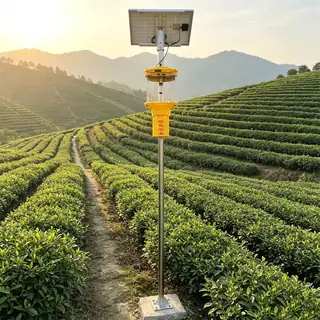
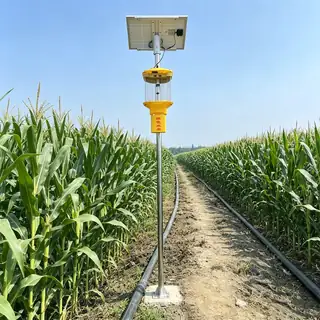
Most farm installations use electric grid, frequency-vibration or suction designs, increasingly in solar-powered versions. Examples include the solar vibration insect lamp for rice fields and the waterproof solar insect suction lamp.
Which light source works best: UV, black light or LED?
"Black light" simply means a lamp emitting mostly UV-A, so a black light insect trap and an ultraviolet insect trap are usually the same thing. The real choice is between fluorescent tubes and LEDs, and between pure UV and mixed spectra.
- Fluorescent UV tubes give broad UV-A output and remain common in grid traps. They lose intensity over time and are typically replaced every season or two of regular use.
- LED insect lights draw less power for a given attraction, which matters on solar units, and last much longer. Quality varies, so ask for the peak wavelength and lamp wattage.
- Mixed-spectrum lamps add violet, blue or green bands. Some target particular pests better; some are designed to reduce attraction of beneficial insects.
For most field pests, a UV-rich source peaking roughly between 360 and 400 nm is the reliable starting point. Where a regional extension service recommends a specific spectrum for a key pest, follow that advice over generic claims.
Should a light trap be used for control or monitoring?
Both, and it helps to be clear which you are doing.
Monitoring
Entomologists have used blacklight traps for decades to detect the start, peak and end of moth flights. University extension services note that these traps show when nocturnal moths are flying and how abundant they are, which helps time scouting and treatments, and that monitoring traps are not designed to reduce pest populations on their own. Catches drop with cold, wind, rain and a bright moon, so trends matter more than single nights. Suction and water-pan traps preserve specimens best for identification; IoT models such as the IoT insect monitoring and reporting lamp photograph and count the catch automatically.
Mass trapping (control)
When enough lamps are spaced across a field, mass trapping can remove a significant share of egg-laying adults and lower larval pressure in the next generation. This works best against pests with strong light attraction, as part of a programme that also includes scouting, resistant varieties, crop rotation and targeted sprays where needed. Treat lamps as one layer of integrated pest management, not a replacement for it.
How are light traps used in open fields and orchards?
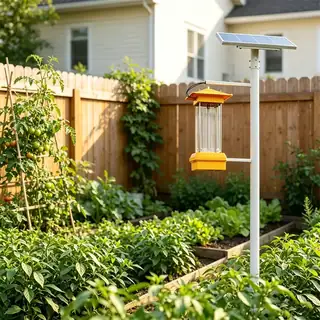
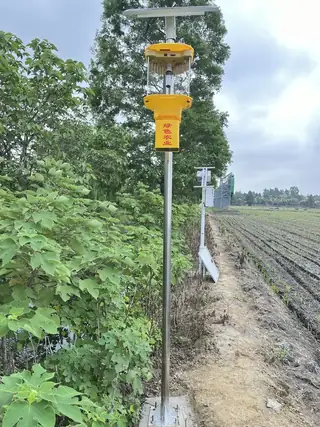
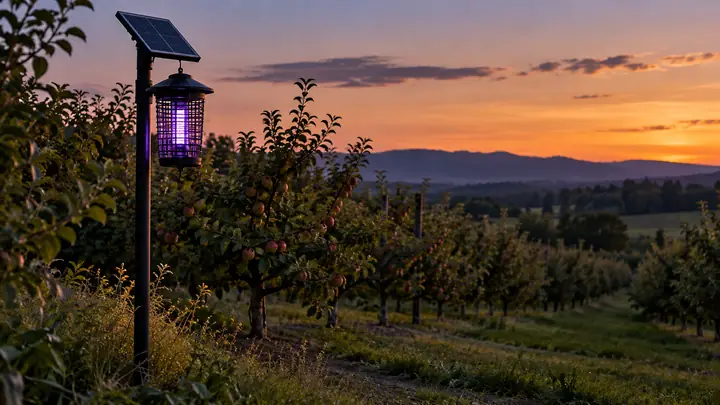
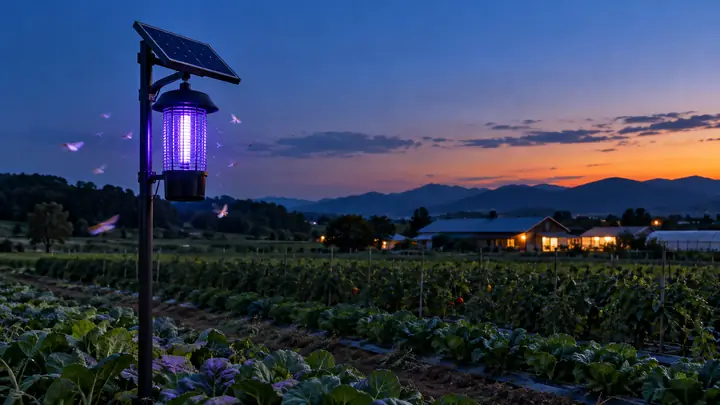
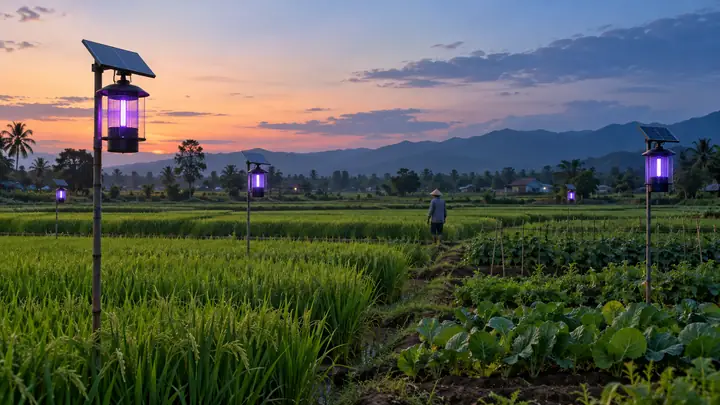
In open fields, solar-powered pole lamps are the norm, because running mains power to the middle of a field is costly. Typical practice:
- Lamps of roughly 10–30 W mounted slightly above the crop canopy; in orchards, near or just above the tree canopy.
- Lamps spaced on a grid, with spacing set by lamp power and terrain; the solar insect-killing lamp guide linked above covers coverage per hectare.
- Run times limited to the first few hours after dusk, which covers much of the flight activity of many pest moths while sparing later-flying non-target species.
For orchards, combining lamps with good irrigation and canopy management keeps trees vigorous enough to tolerate pest pressure; see drip irrigation for orchards and fields.
Do insect light traps work in greenhouses?
They can, with caveats. In a closed greenhouse, the main pests are often whiteflies, aphids, thrips and fungus gnats, which are not strongly drawn to UV lamps at night. Yellow and blue sticky cards, insect netting on vents and biological control usually do more against them. Light traps are useful in greenhouses mainly for:
- night-flying moths that enter through vents (for example in tomato and pepper crops),
- monitoring what is getting through the insect screens, and
- open-sided structures and high tunnels where outdoor pests move in freely.
Place traps near vents and doors rather than in the middle of the crop, and avoid running UV lamps where biological control agents such as predatory insects are released, to limit losses of beneficials. For structure and screening choices, see our commercial greenhouse guide and the greenhouses and sunrooms range.
What is the best fly light trap for barns and livestock areas?
Flies are the main insect problem around dairy, poultry and pig housing. A fly light trap catches house flies best indoors and in shaded areas, where it does not compete with sunlight. Practical points:
- Inside buildings, glue-board or enclosed grid traps reduce the risk of insect fragments falling on feed or animals.
- Mount traps away from feed bunks and milk rooms, at a height where flies rest, often 1.5–2 m.
- Outdoor solar insect killers around the perimeter can intercept night fliers heading to building lights.
- Fly pest control still depends mostly on manure removal, drainage and ventilation; light traps are a supplement.
Why use insect light traps over fish ponds?
Aquaculture farms in parts of Asia mount lamps over ponds so that attracted insects fall into the water as a free supplementary feed, while also reducing insect pressure on nearby crops. These lamps need corrosion-resistant housings and a placement that keeps the panel clear of shade. The solar LED black-light pest lamp for fish ponds is designed for this use.
How to plan an insect light trap programme: step by step
- Confirm the pests. Scout and identify the species causing damage; confirm they are night fliers attracted to light.
- Define the goal. Decide whether you need monitoring data, population control, or both. This decides trap type and number.
- Choose the trap type. Grid or frequency-vibration for control; suction or IoT counting traps for monitoring.
- Map the site. Mark field boundaries, canopy height, shade, competing lights, hives and water bodies.
- Set spacing and height. Base spacing on lamp power and terrain; mount lamps just above canopy.
- Program run times. Use dusk sensors and timers to match the pest flight window; enable rain stop.
- Record catches. Count or photograph samples weekly; relate peaks to scouting and crop damage.
- Review each season. Adjust lamp numbers, positions and timing based on results and bycatch.
What should you check before buying farm light traps?
For agricultural projects, compare suppliers on panel and battery sizing, lamp spectrum, IP rating, grid guarding, controller functions and spare-part availability. IoT features are worth paying for when you manage many sites or need data for advisers. Our commercial bug zapper guide explains specifications in more depth, and the solar pest control category lists the lamp types we manufacture.
Mars Vertical Farm has 20+ years of production experience, three production lines in Shanghai and exports to growers and distributors from Brazil to Vietnam and South Africa. Contact us with your crop, pests and field area, and we will propose a trap type and layout.