Short answer
A solar bug zapper charges a battery from a solar panel by day and runs an ultraviolet lamp at night that draws flying insects onto an electric grid or into a fan trap. It works best on night-flying moths and beetles and poorly on mosquitoes. Choose one whose panel and battery can power the lamp for at least two to three cloudy nights.
What is a solar bug zapper?
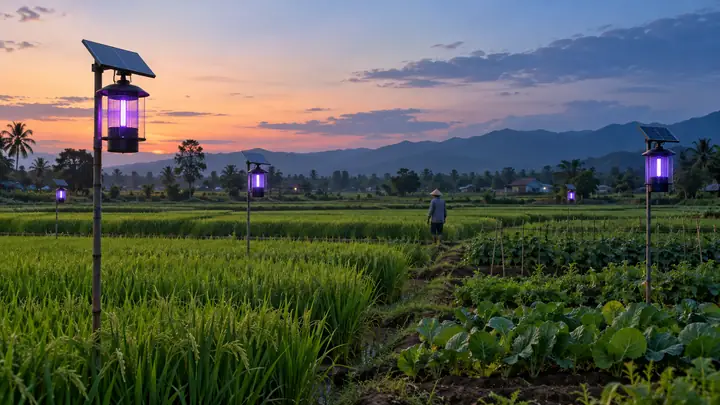
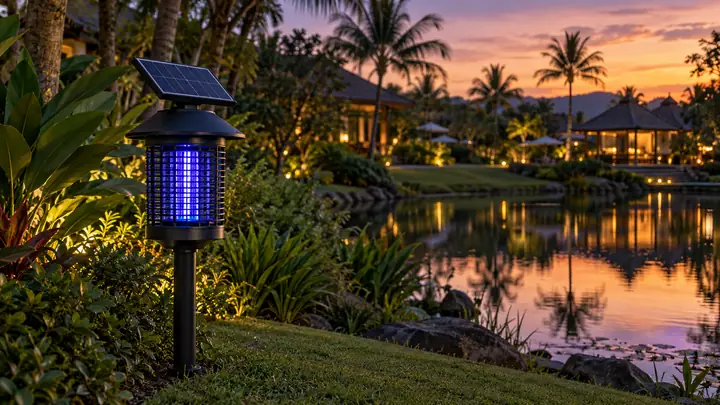
A solar bug zapper is an outdoor insect killer that charges a battery from a small photovoltaic panel during the day and, after dusk, runs an ultraviolet lamp that lures flying insects onto a high-voltage grid or into a fan-driven catch bag. Because it needs no mains cable, a solar powered bug zapper can be placed anywhere with a few hours of direct sun: a farmyard, orchard edge, fish pond, campsite or resort garden.
The category is broad. At one end are hand-sized solar bug zapper lanterns with a 1–2 W panel; at the other are pole-mounted agricultural units with a 30–60 W panel, a large lithium battery and a 15–30 W lamp. This guide explains what separates them, how to read a specification sheet, and what a solar bug zapper outdoor installation can and cannot do. If you are planning lamps across whole fields, read our solar insect-killing lamp guide for hectare-scale layout; here we focus on choosing the right unit.
How does a solar powered bug zapper work?
Every solar insect zapper has the same four building blocks, and the quality of each one decides how well the whole unit performs.
- Solar panel. A monocrystalline or polycrystalline module converts sunlight into DC power. Its rated wattage, multiplied by the local peak sun hours, sets the daily energy budget.
- Battery and controller. A lithium iron phosphate (LiFePO4), lithium-ion or sealed lead-acid battery stores the energy. A charge controller protects it from overcharge and deep discharge and switches the lamp on at dusk using a light sensor.
- Light source. UV-A tubes or LEDs, usually peaking around 365–395 nm, sometimes combined with violet, blue or green wavelengths, attract night-flying insects.
- Killing or capture mechanism. An electrified grid (the classic "zap"), a suction fan that pulls insects into a bag or tray, or a combination of both.
On a sunny day the panel recharges the battery; the controller runs the lamp for a programmed number of hours after dark, then shuts it off to save energy and reduce harm to non-target insects. Better units also stop the lamp during rain, because wet grids arc and insects fly less in rain anyway.
What types of solar bug zappers are there?
Most products fall into three groups. The right choice depends less on brand claims and more on the area you need to treat and how many nights in a row the unit must run without sun.
| Type | Typical panel | Typical lamp | Realistic use | Main limitation |
|---|---|---|---|---|
| Solar bug zapper lantern | 1–3 W | UV LEDs, under 2 W | Patio table, tent, small garden corner | Very small attraction radius; short runtime after cloudy days |
| Garden stake or hanging solar bug light | 2–6 W | UV LEDs, 2–5 W | Yard perimeter, path lighting with insect control | Weak grid and small battery; limited weather sealing |
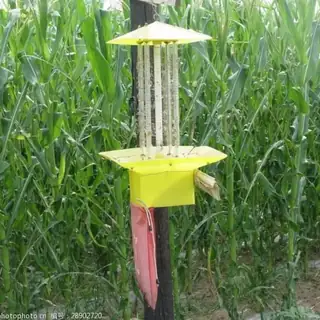
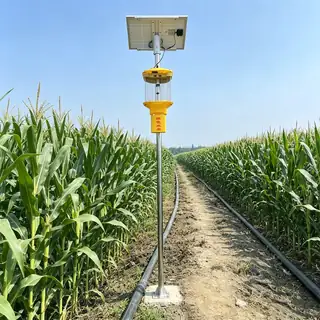
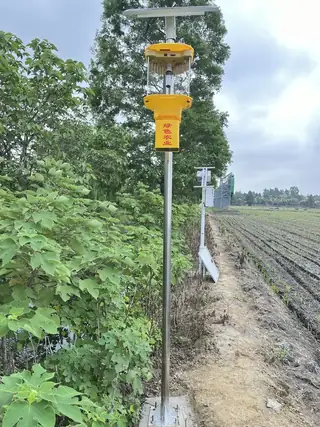
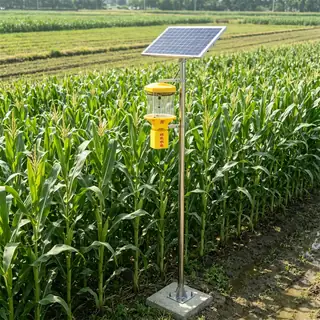
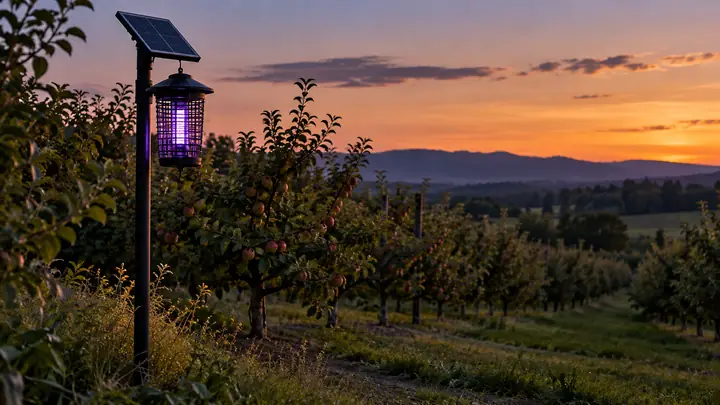
| Pole-mounted solar insect killer | 20–60 W | UV tube or LED array, 10–30 W | Farms, orchards, ponds, parks, resorts | Higher upfront cost; needs a pole, foundation and placement plan |
Lanterns and garden lights are mainly consumer convenience products. For professional sites (orchards, vegetable farms, livestock yards, aquaculture ponds) a pole-mounted unit such as our 21W solar LED orchard pest control lamp is the practical starting point, because only that class has the panel and battery to run reliably every night of the season.
Do solar bug zappers work?
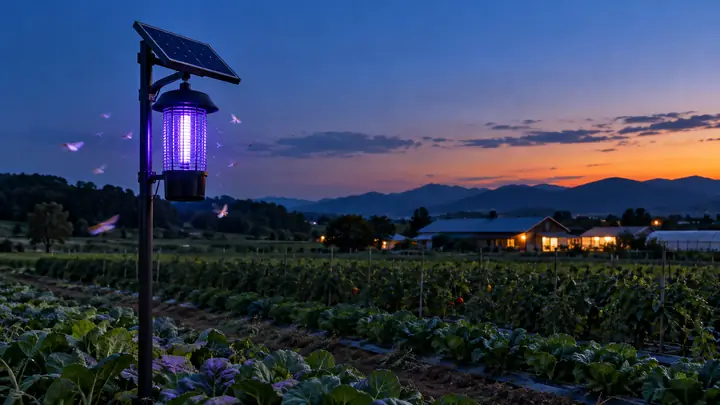
Yes, but only against insects that are strongly attracted to light at night. Solar bug zappers work well on many moths, beetles (such as chafers and scarabs), planthoppers, leafhoppers and some midges. That is exactly why agricultural growers use them: the adult moths of many caterpillar pests are night fliers drawn to UV.
The question "do solar mosquito zappers work?" has a less flattering answer. Female mosquitoes find people mainly by carbon dioxide, body heat and skin odour, so a UV lamp alone catches relatively few of them. A long-cited University of Delaware study of an electric light trap in a suburban yard found that biting flies made up well under 1% of the insects killed. A solar mosquito zapper outdoor can still reduce nuisance insects around a lit area, but it should not be your only mosquito measure. We cover this in detail in do bug zappers work? and in our outdoor mosquito zapper guide.
When reading solar bug zapper reviews, keep this in mind: a tray full of dead insects proves the unit runs, not that it is removing the species you care about. Identify a sample of the catch before deciding a unit "works".
Which specifications matter when buying a solar bug zapper?
Solar panel and battery capacity
The most common failure of cheap solar powered bug zappers is not the lamp but the energy system. A simple sizing check:
- Daily lamp energy (Wh) = lamp watts × hours run per night.
- Battery capacity (Wh) should cover that figure for at least 2–3 nights without sun, plus a margin so the battery is not deeply discharged.
- Panel watts × local peak sun hours × roughly 0.7 (losses) should exceed one night of lamp energy, so the battery refills on an average day.
For example, a 15 W lamp running 4 hours uses about 60 Wh a night. Three nights of autonomy is about 180 Wh of usable battery, and in a location with 4 peak sun hours a panel of roughly 25–30 W refills one night's use. Units with a 5 W panel and a 15 W lamp cannot keep up, whatever the label says.
Lamp type and wavelength
Black-light (UV-A) sources are the standard attractant. Some agricultural lamps add specific visible bands to target particular pests or to reduce bycatch of beneficial species. LED arrays last longer and use less power than fluorescent tubes, but output and spectrum vary a lot between suppliers, so ask for the peak wavelength and the lamp wattage, not just "UV".
Grid voltage or suction fan
Electrocution grids on outdoor units typically run in the low thousands of volts at very low current. A higher voltage kills larger insects such as beetles more reliably, but the grid must be guarded by an outer mesh. Suction units, like our waterproof solar insect suction lamp, are quieter, work in damp conditions and keep specimens intact for identification, which is useful if you also want to monitor pest pressure.
Weatherproofing and build
For a solar bug zapper outdoor waterproof rating, look for IP65 or better on the electronics, a rain shield over the grid, UV-stabilised plastics or powder-coated metal, and stainless fasteners. Coastal and pond sites need extra corrosion resistance.
Controls
Useful functions include dusk switching, adjustable run time (for example 2, 4 or 6 hours), rain stop and low-battery cut-off. On larger farm installations, IoT units add remote status, counts and alerts; these are covered in our solar insect-killing lamp guide linked above.
What is the best solar bug zapper for your site?
There is no single best solar bug zapper, because the best solar powered bug zapper for a balcony is useless in a 2-hectare orchard. Match the unit to the job:
- Small garden or patio: a solar bug zapper lantern or stake light is fine for occasional comfort, with modest expectations for mosquitoes.
- Farmyard, barn surroundings or livestock area: a pole-mounted solar insect killer with a strong grid, placed away from where animals rest. See insect light traps for farms and greenhouses.
- Orchards and vegetable fields: agricultural solar lamps with 15–30 W lamps on 2–3 m poles, laid out on a grid.
- Fish ponds: lamps mounted over water so killed insects drop in as supplementary feed, such as the solar LED black-light pest lamp for fish ponds.
- Resorts, campsites and public grounds: robust, guarded units with remote monitoring. Our article on commercial bug zappers covers this class.
Solar bug zapper buying checklist
Use this list when comparing quotations or product listings:
- Write down the target insects and confirm they are night-flying and attracted to light.
- Check the panel wattage against the lamp wattage and nightly run time using the sizing rule above.
- Ask for battery chemistry, capacity in Wh (not just mAh) and expected cycle life.
- Confirm the lamp type, wattage and peak wavelength.
- Confirm the kill method: grid voltage and guard spacing, or fan type and catch-bag size.
- Check the IP rating, housing material and rain-stop function.
- Check controls: light sensor, timer settings, low-voltage cut-off.
- Ask about mounting height, pole and foundation requirements.
- Confirm certification for your market (for example CE marking for Europe) and that spare lamps, grids and batteries are available.
- Agree on packaging, shipping terms and after-sales support before ordering in volume.
Where should you place a solar bug zapper?
Placement matters as much as the hardware. The panel needs unshaded sun for most of the day, ideally facing the equator. The lamp should draw insects away from people and crops, not towards them:
- Set it roughly 5–10 m from seating or doorways so insects are pulled away from the area you want protected.
- Avoid competing light sources such as floodlights next to the lamp.
- In crops, mount the lamp slightly above canopy height.
- Keep it away from flowering plants and hives to limit bycatch of pollinators.
How long does a solar powered bug zapper last?
A well-built unit typically lasts several seasons. Batteries are the main wear item: lead-acid batteries often need replacing after a couple of years, while LiFePO4 packs usually last considerably longer. Clean the panel and grid regularly, empty catch trays, and check seals before each season. Remove dead insects with a brush after switching off and discharging the grid.
Buying solar bug zappers in volume
For distributors and farm projects, Mars Vertical Farm manufactures pole-mounted solar insect-killing lamps in Shanghai, with CE-marked products, ISO 9001 quality management and OEM/ODM options for private-label projects. Browse the full solar pest control range, read our notes on importing agricultural equipment from China, and contact our export team with your target pests, site size and destination port for a quotation on EXW, FOB Shanghai or CIF terms.