Short answer
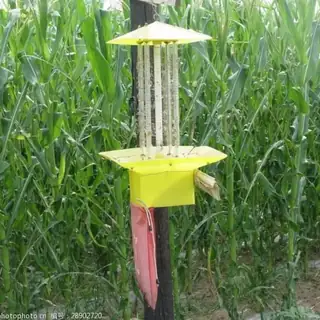
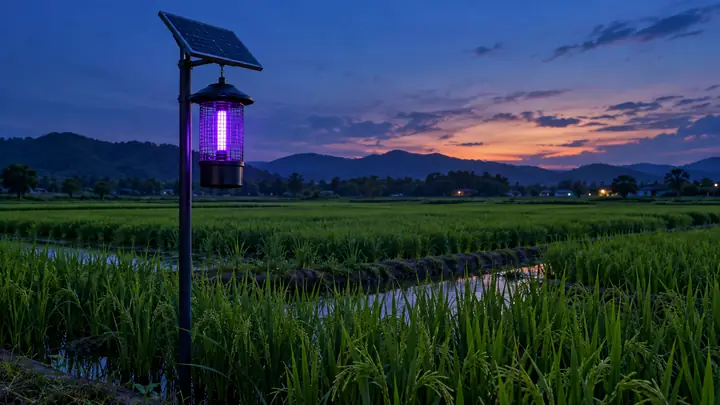
A solar insect-killing lamp uses ultraviolet and visible light to attract night-flying insects such as moths, beetles and planthoppers, then kills them on a high-voltage grid or traps them with a fan. In open, flat fields one lamp typically covers roughly 1.5–3 hectares, so lamps are laid out in a grid about 100–150 m apart, mounted slightly above the crop canopy and set to run in the first hours after dusk.
How do solar insect-killing lamps work?
Many night-flying crop pests are strongly attracted to ultraviolet and short-wavelength visible light. A lamp combines four parts:
- Light source: a black-light tube or LED array, often emitting several wavelengths to attract a broader range of species. A rating of around 20 W is common for field units, such as our 21 W solar LED black-light lamp.
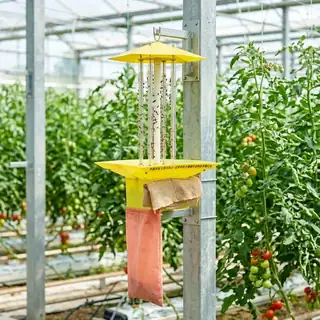
- Killing or trapping method: a high-voltage electric grid, a fan that sucks insects into a bag, or a collection funnel.
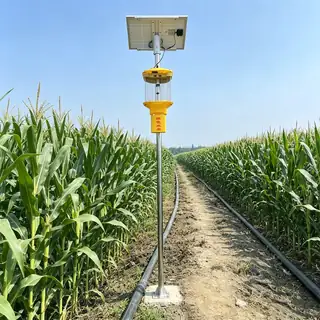
- Solar power: a panel, charge controller and battery mounted on the same pole.
- Controls: a light sensor switches the lamp on at dusk, a timer limits run hours, and on many models a rain sensor turns the grid off in wet weather.
Lamps are one part of integrated pest management (IPM). They lower adult populations of attracted species and show when flights begin, but they do not control aphids, mites or day-flying pests.
Which type of lamp should I choose?
| Type | How it kills or traps | Best for | Considerations |
|---|---|---|---|
| High-voltage grid (electric shock) | Insects touch charged wires | Field crops, vegetables, orchards | Grid needs regular brushing; fence or mount high where people or animals pass |
| Frequency-vibration lamp | Several light wavelengths combined with a grid | Mixed pest populations | Broader attraction can also raise bycatch |
| Suction (fan) lamp | Fan pulls insects into a bag or chamber | Areas where a grid is unsuitable; mosquito control | Fan draws extra power; bag must be emptied |
| IoT monitoring and reporting lamp | Traps insects, photographs them and uploads counts | Large farms, cooperatives, research and extension programs | Needs network coverage and a data platform; higher cost per unit |
How many lamps do I need per hectare?
Coverage depends on terrain, crop height, competing lights and the target species, so treat any single figure with caution. Practical planning ranges:
- Open, flat field crops (rice, vegetables, cotton, corn): roughly 1.5–3 ha per lamp.
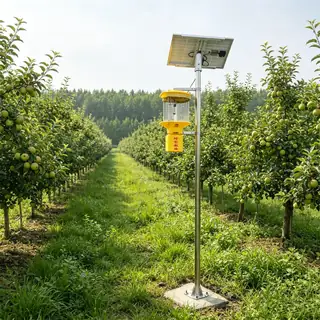
- Orchards and tall crops: roughly 1–2 ha per lamp, because canopies block light.
- Fish ponds: one lamp over or beside each pond, where falling insects become supplementary fish feed.
Example: a 30-ha flat vegetable farm at about 2 ha per lamp needs around 15 lamps. Laid out in a grid, that works out to roughly 140 m between lamps. Concentrate lamps on field edges facing the direction pests usually arrive from, and add one or two near known hot spots.
Where and how high should lamps be mounted?
- Height: place the light source slightly above the crop canopy, commonly about 1.2–1.5 m above low field crops and at or just above canopy height in orchards. Raise the lamp as the crop grows if the pole allows it.
- Clear view: keep lines of sight open; tree rows, buildings and walls shrink coverage.
- Away from competing lights: streetlights and yard lights pull insects away and confuse coverage.
- Away from homes and gathering areas: lamps attract insects toward them, so do not place them next to houses, packing sheds or animal pens.
- Solar access: face the panel toward the equator and keep it clear of shade during the middle of the day.
- Stable footing: anchor poles in concrete or with ground screws rated for local wind.
How do I limit harm to beneficial insects?
Light traps also catch non-target insects, including some natural enemies of pests. Sensible operation reduces that:
- Run only in the pest season. Switch lamps off outside the flight periods of your target pests.
- Use a timer. Many target moths and beetles fly most actively in the first few hours after dusk. Running roughly from dusk to around midnight is a common compromise.
- Do not over-install. More lamps than needed increase bycatch without proportional benefit.
- Check catches. If a lamp mainly catches non-target species, move it or shorten its hours.
Your local agricultural extension service can advise on flight periods for the pests in your region.
How should the solar power system be sized?
- Battery autonomy: choose a battery that can run the lamp for at least two to three nights without sun. In monsoon or cloudy seasons, more is better.
- Battery type: lithium batteries are lighter and tolerate more cycles; lead-acid batteries cost less up front but are heavier and usually wear out sooner.
- Panel size: the panel must recharge the battery on a short winter or cloudy day. Ask the supplier how many hours of run time the lamp gets after a full day of sun at your latitude.
- Protection: look for waterproof housings, such as our waterproof solar suction lamp, and charge controllers with over-charge and deep-discharge protection.
What does IoT monitoring add?
IoT lamps photograph or count insects in the collection chamber and upload results over a cellular or other wireless link. Typical functions include daily catch counts, species identification by image recognition, trend charts, threshold alerts and lamp status (battery, panel, faults). Benefits:
- Better spray timing: spray when counts cross an action threshold instead of on a calendar.
- Fewer field visits: check remote fields from a phone.
- Regional pest maps: cooperatives can compare counts across many farms.
Before buying, confirm mobile network coverage at each lamp location, who owns and stores the data, any subscription costs, and how accurate species identification is for your local pests. Validate automatic counts against manual counts during the first season. Options include the IoT insect monitoring and reporting lamp and the IoT electric-shock insect killer lamp.
What maintenance do lamps need?
- Brush the high-voltage grid weekly during peak flights, with the lamp switched off.
- Empty collection bags or trays and clean the chamber.
- Wipe dust and bird droppings off the solar panel monthly.
- Check battery health before each season and replace it when run time drops noticeably.
- Inspect seals, cables and pole fixings after storms.
If you are importing lamps for a project, our China import checklist covers shipping and paperwork. See all solar pest control lamps, or send us your crop, field area and map for a layout and quote.