Short answer
A commercial bug zapper is a heavy-duty insect killer built for unattended nightly use outdoors or in large buildings. It has a stronger UV lamp, a higher-voltage guarded grid or suction fan, a weatherproof housing and automatic controls. Acre coverage claims are unstandardised estimates, so several well-placed mid-sized units usually outperform one very large zapper.
What is a commercial bug zapper?
A commercial bug zapper is a heavy-duty electric insect killer built to run every night, outdoors or in large buildings, for season after season. Compared with a household unit, it has a more powerful UV lamp, a higher-voltage and better-guarded grid or a suction fan, a weatherproof housing, and controls for unattended operation.
Industrial bug zappers are used on farms, around livestock housing, at aquaculture ponds, and on the grounds of resorts, campsites, golf courses, parks, warehouses and factories. This guide explains what separates commercial units from consumer gadgets, how to read coverage claims such as a "1 acre bug zapper", and what to check when specifying or importing large outdoor bug zappers in volume. For an overview of what these devices can and cannot kill, read do bug zappers work? first.
How is a commercial bug zapper different from a residential one?
The differences come down to power, durability and how long the unit runs between interventions.
| Feature | Residential zapper | Commercial outdoor zapper | Industrial solar pole unit |
|---|---|---|---|
| Lamp power | Roughly 2–20 W | Roughly 20–80 W (one or more tubes or LED arrays) | Roughly 10–30 W LED or tube, optimised for battery runtime |
| Grid | Small area, light guard | Large area, higher voltage, sturdy outer guard | Higher voltage, heavy guard, or suction fan |
| Power source | Mains or small battery | Mains, often with a long outdoor-rated cable | Off-grid solar panel and battery |
| Housing | Plastic, splash resistant | Metal or UV-stabilised plastic, weather resistant | Sealed electronics (often IP65+), powder-coated or stainless parts |
| Controls | On/off switch | Timer or photocell | Dusk sensor, timer, rain stop, low-battery cut-off, optional IoT |
| Typical sites | Patios, gardens | Restaurants' outdoor areas, loading docks, barns | Fields, orchards, ponds, parks, remote sites |
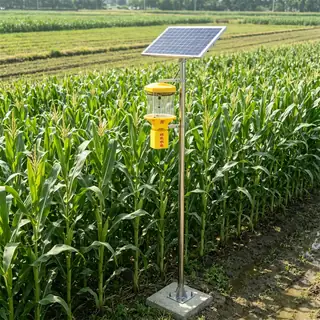
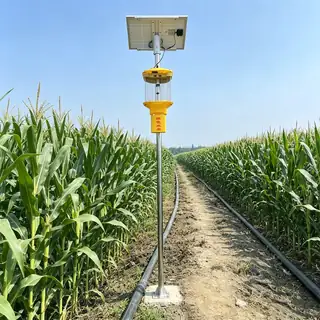
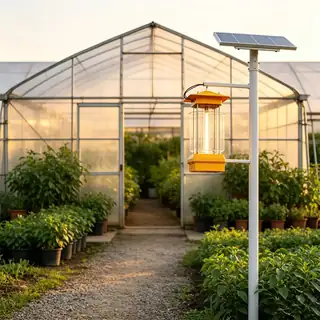
For off-grid outdoor sites, solar pole units avoid trenching and cabling, which is often the largest installation cost. Examples include the solar electric shock IoT insect killer and the waterproof IoT high-voltage mosquito zapper.
What is the largest bug zapper, and does bigger mean better?
People searching for the biggest bug zapper or a huge bug zapper usually want to protect a large area with one device. That rarely works. A lamp's attraction falls off quickly with distance, and on most sites competing lights, vegetation and wind limit how far insects will travel towards it. Doubling lamp power does not double the area protected.
In practice, several mid-sized units spaced across a site outperform one very large unit in the middle. A large mosquito zapper or high powered bug zapper earns its place where pest pressure is heavy and the unit can be sited between the insect source and the area to protect, for example between a wetland and a guest terrace.
How should you read "1 acre" and "1/2 acre" coverage claims?
Coverage figures such as "1 1/2 acre bug zapper" or "1/2 acre bug zapper" are marketing estimates, usually measured in ideal conditions: open ground, no competing lights, high insect density and calm air. They are not standardised. Treat them as a relative indicator of lamp power rather than a design figure.
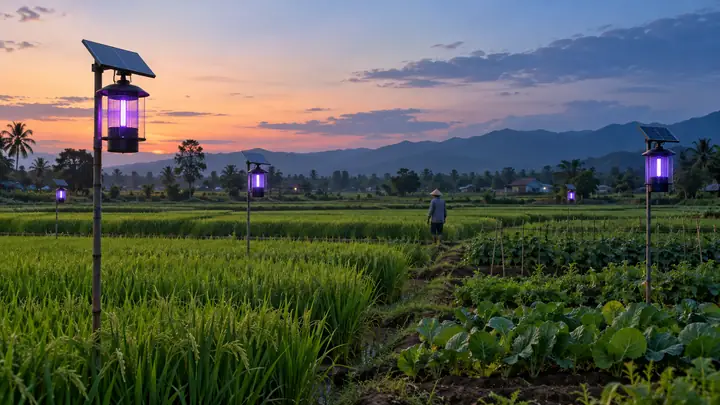
For agricultural planning, engineers generally work from lamp spacing rather than acreage per unit. In open, flat fields one solar insect-killing lamp is often planned for very roughly 1.5–3 hectares, depending on lamp power, crop and terrain; our solar insect-killing lamp guide explains that layout. For resorts or parks, plan by the zones you need to protect and the routes insects take to reach them.
Which specifications matter for industrial bug zappers?
Lamp power and spectrum
Ask for lamp wattage, type (tube or LED) and peak wavelength. UV-A sources around 360–400 nm attract most night fliers. Mixed-spectrum lamps can target particular agricultural pests.
Grid voltage, spacing and guarding
Commercial grids typically run at several thousand volts with very low current. Higher voltage helps kill large beetles and moths cleanly, but an outer guard must stop people and animals touching the live grid. Ask for grid voltage, grid spacing and guard mesh size.
Capture mechanism
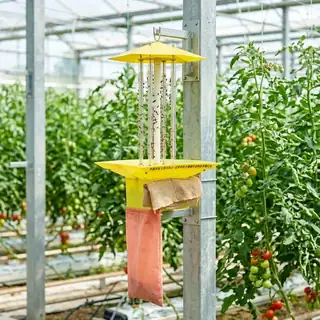
Grid units are simple and effective on large insects. Suction units, such as the waterproof solar insect suction lamp, work in wet weather, catch small insects that miss the grid and keep specimens intact for counting.
Power system
For solar models, check panel watts, battery chemistry and capacity in Wh, and the number of nights the unit can run without sun (typically two to three is a sensible minimum). Our solar bug zapper guide shows a simple sizing calculation.
Enclosure and materials
Look for IP65 or better on electronics, rain shields over the grid, corrosion-resistant metal or UV-stabilised plastic, and stainless fasteners, especially near the coast, ponds or livestock, where ammonia is corrosive.
Controls and IoT
Photocell switching, programmable run time, rain stop and low-battery protection are standard on good commercial units. IoT versions report status, faults and catch counts to a dashboard, which saves site visits when you manage many lamps.
Safety and certification
Electric insect killers fall under appliance safety rules in most markets. The international standard for these devices is IEC 60335-2-59, and for the European market products need CE marking. Ask the supplier which standards the product has been tested against and request the documentation.
Where are commercial mosquito zappers and insect killers used?
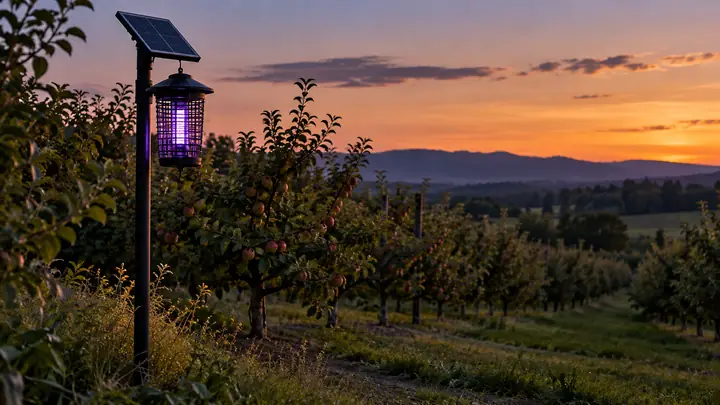
- Agriculture: moth and beetle control in field crops, vegetables and orchards. See insect light traps for farms and greenhouses.
- Livestock: perimeter units around barns and poultry houses to intercept night fliers drawn to building lights.
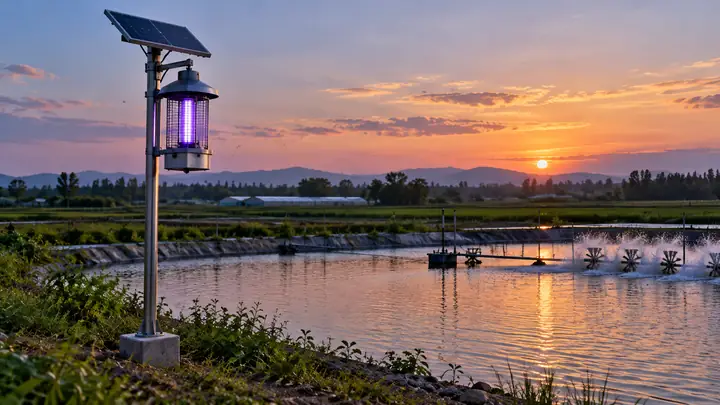
- Aquaculture: lamps over ponds that drop insects into the water as supplementary feed.
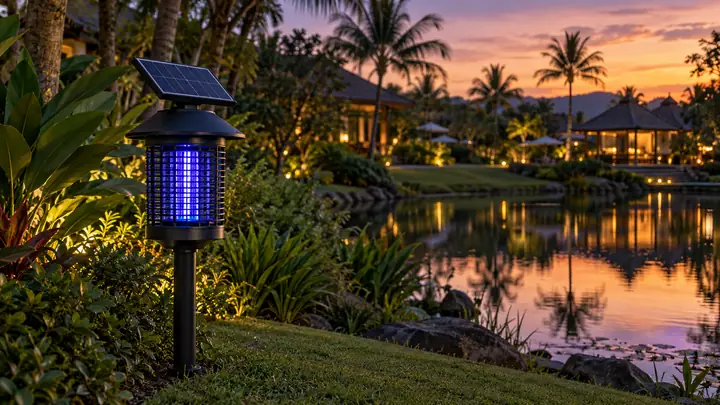
- Hospitality and public grounds: commercial mosquito traps and zappers around resort gardens, campsites and park facilities, combined with breeding-site control.
- Industrial sites: outdoor units at loading docks and yards to reduce insects drawn towards building openings.
For indoor food-handling areas, many operators prefer enclosed glue-board light traps rather than open grids, so that insect fragments cannot fall onto products. Follow your local food-safety rules and auditor guidance for those areas.
Is a commercial mosquito killer worth it?
A commercial grade mosquito killer that relies only on UV light will catch many insects but relatively few biting mosquitoes, which find people mainly by carbon dioxide and body heat. For mosquito-focused sites, combine lamps with removing standing water, larviciding where permitted, and, where justified, traps that release carbon dioxide or attractants. Our outdoor mosquito zapper guide compares these options.
Procurement checklist for commercial bug zappers
- Define the target insects and confirm they are night fliers attracted to light.
- Map the site: zones to protect, insect sources, competing lights, power availability and shade.
- Decide between mains and solar; for solar, verify panel, battery and autonomy.
- Specify lamp power, spectrum, grid voltage and guard, or suction fan.
- Set minimum enclosure requirements (IP rating, materials, corrosion protection).
- Specify controls: photocell, timer, rain stop, low-battery cut-off, IoT if needed.
- Request certification documents for your market and a spare-parts list (lamps, grids, batteries, fans).
- Agree mounting: pole height, foundation, wind loading and installation instructions.
- Confirm packaging, labelling and shipping terms; for imports, read our guide on importing agricultural equipment from China.
Should you choose a mains-powered or solar commercial bug zapper?
Both have a place. The decision usually comes down to where power is available and what installation costs.
- Choose mains power when units sit on or next to buildings with outdoor-rated sockets, when you need high lamp power all night, or when shade makes solar unreliable. Cable runs, outdoor junction boxes and residual-current protection add to installation cost.
- Choose solar for fields, orchards, ponds, park perimeters and any site where trenching cable is expensive or impractical. Solar units also keep running during grid outages and can be moved when pest hot spots change.
- Consider a mix on larger estates: mains units near buildings, solar units along the far boundaries.
For solar units, the right panel and battery size depends on local sun hours in the worst month of your pest season, not on the annual average.
Where should a large outdoor bug zapper be installed?
Placement decides results more than any specification. The aim is to intercept insects before they reach people, animals or crops, not to draw them in.
- Distance: set units roughly 10–15 m or more from seating, doorways and serving areas, so insects are pulled away from them.
- Between source and target: place lamps between breeding or resting areas (wetlands, hedges, manure stores, crop fields) and the zone you want protected.
- Height: mosquito-focused units are usually mounted low, around 1.5–2 m; moth and beetle lamps in crops sit just above the canopy; perimeter units around buildings are often 2–3 m to stay out of reach.
- Competing light: keep units away from floodlights or switch those off during operating hours.
- Wind and foundations: poles for solar units need a foundation rated for local wind loads, as the panel acts like a sail.
How do you maintain a heavy duty bug zapper?
Switch off and discharge the grid before any work. Brush the grid and empty trays or bags regularly; build-up can cause arcing and reduce kill rates. Clean solar panels, check seals before each season, replace fluorescent tubes as their output declines, and watch battery performance after the first couple of seasons.
Working with a manufacturer
Mars Vertical Farm manufactures solar insect-killing lamps and IoT units in a 2,000+ m² factory in Shanghai, with ISO 9001 quality management, CE-marked products and OEM/ODM options for distributors. Browse the solar pest control range and request a quotation with your site type, target pests and quantities.