Short answer
Hydroponic strawberries and tomatoes are usually grown in coir, rockwool or perlite with drip-fed nutrient solution. Tomatoes grow in Dutch buckets or slabs, trained up high wires at an EC of about 2.0 to 3.5 mS/cm. Strawberries grow in raised coir bags, gutters or vertical A-frames at a lower EC of about 1.0 to 1.8. Both need pollination support indoors.
How are hydroponic strawberries and tomatoes grown?
Hydroponic strawberries and tomatoes are usually grown in a soilless substrate, such as coconut coir, rockwool or perlite, fed by drip irrigation with a nutrient solution, rather than in pure water like lettuce. Tomatoes are typically trained up high wires in buckets or on slabs, while strawberries grow in raised gutters, grow bags or vertical A-frame troughs.
Both are high-value fruiting crops, and both reward controlled growing with cleaner fruit, longer seasons and higher yields per square meter than open fields. They are also more demanding than leafy greens: they need more light, higher EC, careful climate control, pollination and regular crop work such as pruning, trellising and runner removal. This guide compares the two side by side, covering systems, media, nutrition, climate and pollination, so you can plan the right setup for each.
Which fruits and vegetables can be grown hydroponically?
Most crops can be grown without soil, but only some make commercial sense. Here is a short list of hydroponic fruits and vegetables grouped by system:
| Crop group | Examples | Common system | Typical EC range (mS/cm) |
|---|---|---|---|
| Leafy greens | Lettuce, spinach, kale, pak choi | NFT, deep water culture, vertical racks | About 1.0 to 2.0 |
| Herbs | Basil, mint, parsley, cilantro | NFT, towers, ebb and flow | About 1.0 to 1.8 |
| Strawberries | Day-neutral and short-day varieties | Gutters, grow bags, A-frames, towers | About 1.0 to 1.8 |
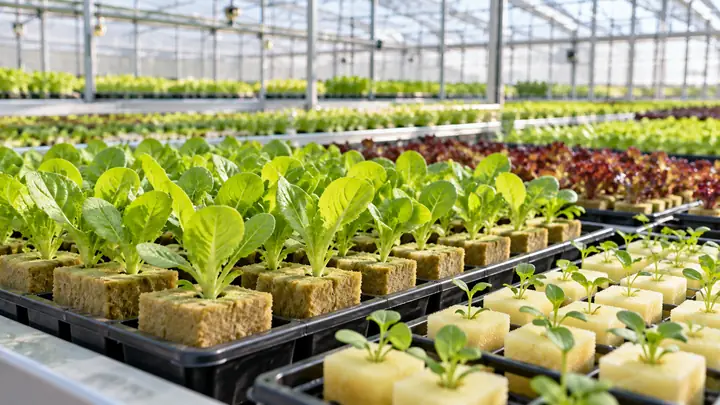
| Tomatoes | Beefsteak, truss, cherry | Dutch buckets, rockwool or coir slabs | About 2.0 to 3.5 |
| Other vine crops | Cucumbers, sweet peppers, eggplant, melons | Dutch buckets, slabs, bags | About 1.8 to 3.0 |
Ranges are typical starting points and vary with growth stage, season and variety. Root crops such as potatoes and carrots are possible but rarely economic in hydroponics.
How does hydroponics tomato growing work?
Commercial hydroponic tomatoes are almost always grown in substrate with drip irrigation. The two main formats are:
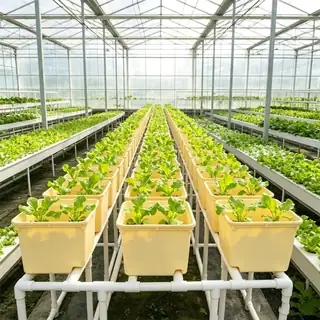
- Dutch (Bato) buckets: individual buckets filled with perlite, clay pebbles or a coir mix, usually two plants per bucket, with drippers and a shared drain line that returns runoff to the tank. They are easy to set up and expand. See our large commercial Dutch bucket system.
- Slabs in gutters: rockwool or coir slabs laid in raised gutters, with three to four plants per slab. This is the standard in large high-tech greenhouses.
Key points for growing hydroponic tomatoes:
- Use indeterminate varieties bred for greenhouses. They can grow several meters long over a season, so they are trained up strings to an overhead wire and lowered and leaned along the row as they grow.
- Prune weekly. Remove side shoots (suckers) while they are small and keep one main stem per plant. Extension guidance notes that unpruned, untrained plants can lose a large share of their yield.
- Feed at higher EC than leafy greens, typically rising as fruit sets, with pH around 5.5 to 6.5 in the root zone. Watch drain EC and drain percentage on slabs.
- Hold a day-night temperature difference. Many growers aim for roughly 20 to 25 °C by day and 16 to 18 °C at night, adjusting to steer the plant toward leaf or fruit growth.
- Give plenty of light. Tomatoes need far more light than lettuce. Winter crops at higher latitudes usually need supplemental lighting to stay productive.
Tomato kits sold for home growing, often called a hydroponic tomato growing kit or hydroponic tomato kit, follow the same principles at small scale: a bucket or bag of substrate, a dripper or wick, a small pump and a support stake or string.
How do you grow strawberries hydroponically?
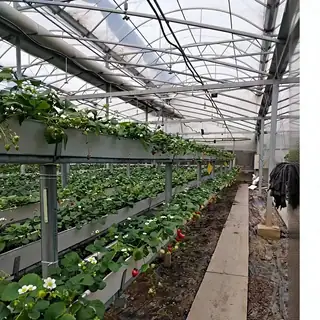
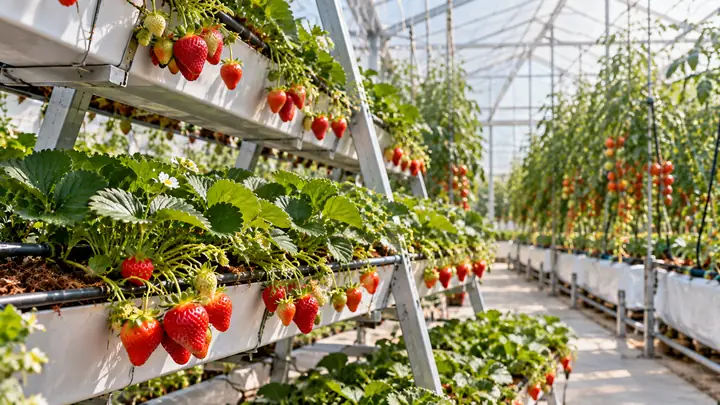
Most hydroponic strawberries grow in coir, either in grow bags or in slabs laid in raised gutters or troughs at working height. Raising the crop off the ground makes picking faster and cleaner, improves airflow around the fruit, and reduces fruit rot.
- Choose the right type. Day-neutral (everbearing) varieties flower over a long season and suit year-round indoor production. Short-day (June-bearing) types give a concentrated crop and may need chilling and day-length control.
- Plant healthy, disease-free stock, usually as bare-root plants or plug plants, with the crown just above the substrate surface.
- Keep EC moderate. Strawberries are more salt-sensitive than tomatoes, so most growers keep EC lower and watch drain EC to avoid buildup.
- Keep nights cool. Cooler nights help fruit sugar and firmness. Very warm conditions push vegetative growth and soft fruit.
- Remove runners and old leaves regularly so that the plant's energy goes into flowers and fruit, and keep the canopy open.
What size grow bag for strawberries?
For growing strawberries in grow bags, a common rule of thumb is roughly 2 to 4 L of coir per plant. In practice, that means a small bag of a few liters holds one plant, and a long coir grow bag or slab of about 1 m usually carries around 8 to 12 plants in staggered rows. Planting strawberries in grow bags too densely saves space but increases disease pressure and makes picking harder. Use bags with drainage slits at the bottom, and set them on a slight slope so that excess solution drains away.
Strawberries in a bag are also popular with home growers, but commercial bags differ: they are filled with washed, buffered coir, sized to the gutter, and fed by drippers on a timer or a radiation-based controller.
Does vertical strawberry farming work?
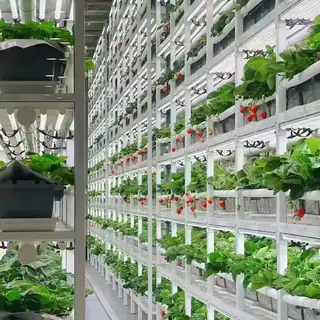
Yes. Strawberries are compact, light-tolerant and easy to harvest at height, which makes them one of the best fruit crops for vertical systems. Growing strawberries vertically usually takes one of three forms:
- A-frames in greenhouses: two or more tiers of gutters on an A-shaped steel frame, carrying coir slabs or troughs. These roughly double or triple plants per square meter compared with a single raised row. See our A-frame strawberry trough for coir slabs and our A-frame vertical systems guide.
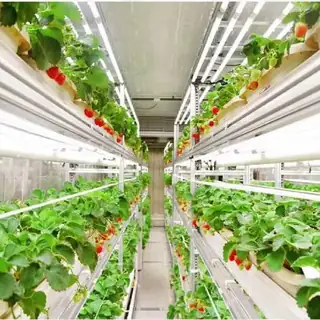
- Multi-layer racks indoors: stacked channels under LEDs in a closed room or container, as in our multi-layer vertical strawberry growing system.
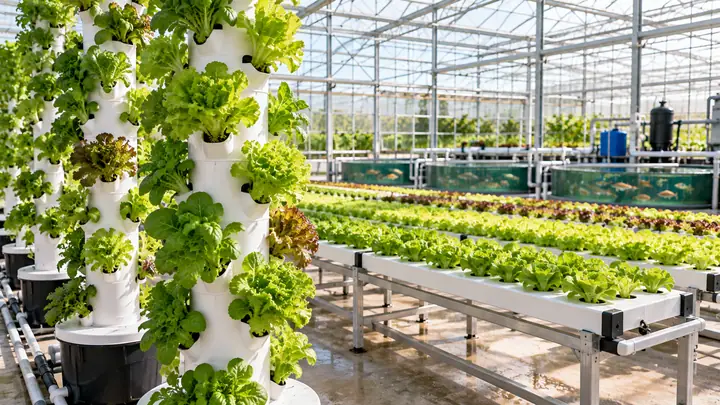
- Towers: vertical columns with pockets, suited to smaller farms, agritourism and retail displays.
Vertical strawberries need even light on every tier, good air movement between layers to prevent gray mold, and a plan for pollination.
What does an indoor strawberry farm need?
A fully enclosed indoor strawberry farm, sometimes called a strawberry factory or strawberry plant factory, controls light, temperature, humidity and CO₂ completely, so it can produce in any climate and any season. The extra requirements compared with lettuce are higher light levels, cool night temperatures, careful humidity control and, above all, pollination. Our climate-controlled indoor strawberry plant factory is designed around these needs.
How are hydroponic tomatoes and strawberries pollinated?
Pollination is the step most new indoor growers underestimate:
- Tomatoes self-pollinate, but the pollen has to be shaken loose. Greenhouses usually use bumblebee hives or handheld electric vibrators on each flower truss a few times a week. Without it, fruit set is poor and fruit is often misshapen.
- Strawberries need pollen moved between flower parts. Poor pollination produces small, deformed berries. Growers use bees or bumblebees, air movement, or manual pollination with brushes in small indoor units.
In fully closed rooms, bees need careful management of light spectrum, temperature and hive health, so plan pollination early in the design.
What problems affect hydroponic tomatoes and strawberries?
- Blossom-end rot (tomatoes): a dark, sunken patch at the base of the fruit, caused by calcium not reaching fast-growing fruit. It is usually linked to irregular irrigation, high EC or poor transpiration rather than a lack of calcium in the solution. Keep irrigation steady and humidity moderate.
- Gray mold (both crops): a fungal rot that spreads in humid, still air, especially on strawberry fruit and tomato stem wounds. Keep air moving, avoid condensation at night and remove infected material promptly.
- Powdery mildew (strawberries): white patches on leaves, favored by humid nights and dry days. Monitor closely and choose tolerant varieties.
- Root zone salt buildup: rising drain EC in slabs and bags. Increase the drain percentage or run a short flush with lower-EC solution.
- Pests: whitefly, spider mites, aphids and thrips. Use insect screens, sticky traps and biological control where available.
Strawberries vs tomatoes: side-by-side comparison
| Factor | Tomatoes | Strawberries |
|---|---|---|
| Common system | Dutch buckets, rockwool or coir slabs | Coir bags or slabs in gutters, A-frames, racks |
| Plant height | Several meters, trained on high wire | Compact, about 20 to 30 cm |
| Vertical stacking | No (tall vine crop) | Yes, very suitable |
| EC | Higher, about 2.0 to 3.5 mS/cm | Lower, about 1.0 to 1.8 mS/cm |
| Temperature | Warm days, moderate nights | Mild days, cool nights |
| Pollination | Vibration (bees or tools) | Bees, airflow or manual |
| Main crop work | Sucker removal, lowering, leaf pruning | Runner and old leaf removal, picking |
Setup checklist for a fruiting crop system
- Define your market: fresh retail, restaurants, pick-your-own or processing, and the weekly volume you need.
- Choose the structure, such as a greenhouse, a tunnel or a closed plant factory, based on climate and energy cost. See our commercial greenhouse guide.
- Select the growing format: buckets or slabs for tomatoes; gutters, A-frames or racks for strawberries.
- Pick the substrate and confirm its specification; our growing media guide compares the options.
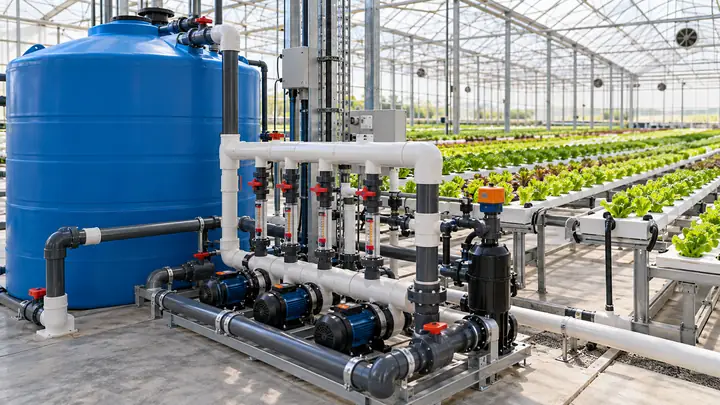
- Size irrigation and fertigation from peak flow and the number of zones, as explained in how to size a fertigation system.
- Plan climate control (heating, cooling, ventilation, humidity, CO₂) and lighting for your darkest month.
- Plan pollination, crop work labor, and harvest and cold-chain logistics.
Ready to plan a strawberry or tomato project?
Mars Vertical Farm manufactures Dutch bucket systems, strawberry gutters, A-frames and strawberry plant factories at its 2,000+ m² Shanghai factory, with OEM/ODM available. Browse our vertical hydroponic systems, or send us your crop, area and climate for a layout and quotation.