


Short answer
The best strawberry plant varieties for hydroponic and indoor farms are usually day-neutral types such as Albion, San Andreas, Monterey and Seascape, because they flower largely regardless of day length and fruit continuously at mild temperatures of about 18 to 24 °C. June-bearing and many Japanese premium varieties can also be grown indoors, but they need controlled short days and cool temperatures to trigger flowering.
What is a strawberry plant, and which types suit hydroponics?
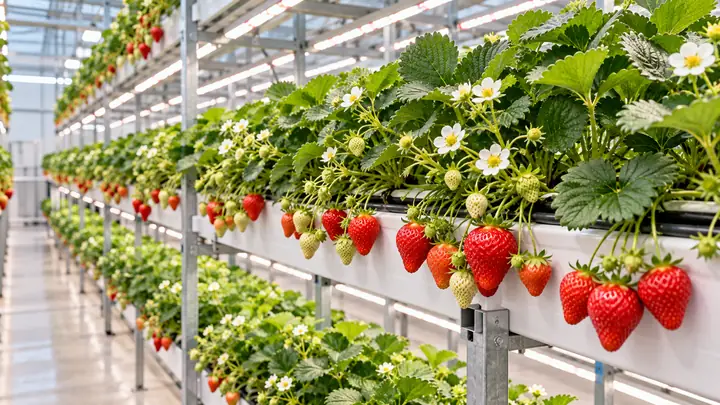
A strawberry plant (Fragaria × ananassa) is a low, herbaceous perennial in the rose family that grows from a short central crown, produces white flowers and spreads by runners. For hydroponic and indoor farms, the best strawberry plant choice is usually a day-neutral variety such as Albion, San Andreas or Monterey, because day-neutral types flower and fruit continuously under controlled conditions instead of giving one short spring crop.
This guide focuses on choosing varieties and planting stock. For system layouts, substrates and general crop care, see hydroponic strawberries and tomatoes; for feeding, pH, light and pollination, see strawberry plant care.
What do strawberries grow on: vines, bushes or crowns?
Strawberries grow on crowns, not on vines or bushes. Each crown is a compressed stem that produces leaves, flower trusses and roots. The long "strawberry vines" people describe are runners, also called stolons, which are horizontal stems that root to form new daughter plants. Branch crowns that form beside the main crown are sometimes called strawberry suckers or shoots; they add flower trusses and are normally kept on fruiting plants.
Is a strawberry a flower?
The strawberry plant produces flowers, and each berry develops from one flower. Botanically the fruit is an aggregate accessory fruit: the red flesh is a swollen receptacle and the "seeds" on the surface, called achenes, are the true fruits. Every achene that is fertilized sends growth signals to the flesh around it, which is why poor pollination gives misshapen berries.
What are the different types of strawberries?
Growers sort strawberry varieties into three types by flowering response: June-bearing (short-day), everbearing and day-neutral. Botanists recognize more than 20 wild Fragaria species, and breeders have released hundreds of named cultivars of the garden strawberry, so "how many types of strawberries are there" depends on whether you count species or varieties. For production planning, the flowering type matters more than how many kinds of strawberries exist.
| Type | How flowering is triggered | Fruiting pattern | Runners | Fit for indoor and hydroponic farms |
|---|---|---|---|---|
| June-bearing (short-day) | Flower buds form when days shorten and temperatures cool in autumn | One concentrated crop of about 2–4 weeks in spring | Many | Good in greenhouse forcing programs and with managed photoperiod; less flexible indoors |
| Everbearing | Older term for types that flower under long days | Two or three flushes, spring to autumn | Fewer | Fair; modern day-neutrals usually outperform them |
| Day-neutral | Largely insensitive to day length; flowering slows at high temperatures, roughly above 30 °C (86 °F) | Continuous flowering and fruiting while conditions stay mild | Few to moderate | Best fit for plant factories, vertical racks and year-round hydroponics |
Many nurseries still label day-neutral strawberry plants as "everbearing", including Albion. Today, a variety sold as everbearing is usually a day-neutral variety sold under the older name.
Why do day-neutral strawberries suit hydroponic strawberry plants?
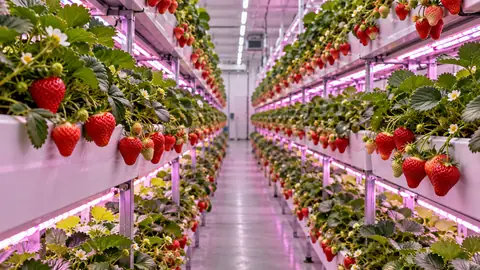
Day-neutral strawberries suit hydroponics because a plant factory or greenhouse can hold temperature and light steady, and day-neutral varieties respond by flowering continuously. That gives a steady weekly harvest, steady labor and better use of expensive growing space.
- Predictable output: with day temperatures around 18–24 °C (64–75 °F) and cooler nights, day-neutral plants keep producing new trusses for many months.
- Fewer runners: less labor removing strawberry runners from fruiting plants, and more energy directed to fruit.
- Compact habit: most day-neutral varieties fit gutter, trough and A-frame spacing of about 20–30 cm (8–12 in) between plants.
- Replanting cycle: strawberries are perennials, but most hydroponic farms treat them as annuals or two-year crops, replanting when yield and fruit size decline. So when people ask "are strawberries perennials or annuals", the honest answer is perennial plants grown as annuals in commercial systems.
When do strawberry plants bloom and produce fruit?
Day-neutral strawberry plants typically begin to bloom within about 4–8 weeks of planting healthy plug or bare-root plants, and first ripe berries usually follow roughly 2–3 months after planting. Each berry takes around 4–6 weeks from open flower to ripe fruit, faster in warm conditions. June-bearing plants outdoors bloom in spring and fruit once. Indoors, "when will my strawberry plant produce fruit" depends mainly on plant quality, temperature and light, so buy strong, crown-rich plants.
Best day-neutral strawberry varieties for indoor growing
The most widely grown day-neutral strawberry varieties come from the University of California breeding program and are available from licensed nurseries in many countries. University of California and extension descriptions summarize them roughly as follows; performance varies with climate and system, so always trial before scaling.
- Albion: the industry-standard day-neutral for shipping from California. Albion gives very large, firm, scarlet berries with good flavor when fully ripe. University of California ratings list it as moderately resistant to Verticillium wilt, Phytophthora crown rot and powdery mildew, but susceptible to Fusarium wilt and Macrophomina. Plants are easy to find, which makes Albion a good benchmark variety.
- San Andreas: very large, firm, bright red berries with good flavor; like Albion, it is rated moderately resistant to powdery mildew. Yields are moderate and may peak in cool conditions.
- Monterey: very productive, with medium-large berries and average flavor. Monterey is rated susceptible to powdery mildew, so it needs good climate control and hygiene.
- Seascape: among the sweetest day-neutrals, with medium-sized, softer berries. A good option for direct retail and local markets.
- Portola: early and consistent, with light-colored, softer fruit and lower flavor; mainly used for volume.
A note on Albion strawberry seeds: named cultivars do not come true from seed, so seed sold as "Albion" will not reproduce the variety. Commercial growers always buy runner-propagated plants from licensed nurseries.
What about Japanese and other premium strawberries?
Japanese strawberry varieties are prized for sweetness, aroma and appearance, and they are the reference point for the premium strawberries grown in many indoor farms. Well-known examples include Amaou from Fukuoka (large, very sweet, low acidity), Tochiotome from Tochigi (balanced and firm), Benihoppe from Shizuoka (more acidic and aromatic) and white strawberries such as Hatsukoi no Kaori. "Kyoto strawberry" usually refers to premium berries from the Kyoto area rather than one variety. Other Asian strawberry programs, such as Korea's Seolhyang, descend partly from Japanese parents.
Two practical points matter for growers outside Japan:
- Licensing: many Japanese varieties are protected by plant variety rights and are not legally available as plants abroad. Buy only from nurseries that hold a license, and get it in writing.
- Flowering type: many Japanese varieties are short-day types bred for greenhouse forcing. Indoors they need flower induction with short days and cool temperatures, then long days for fruiting, which requires precise lighting and HVAC control.
Disease resistant, non-GMO and organic: what do the labels mean?
Disease resistance is one of the most valuable variety traits indoors, while non-GMO and organic labels are mostly about marketing and certification.
- Disease resistant strawberry plants: indoors the main threats are powdery mildew, gray mold (Botrytis), crown and root rots and two-spotted spider mite. No variety is immune, so choose tolerant varieties and control humidity and airflow. See fungus gnats and powdery mildew control.
- Non-GMO strawberries: commercial strawberry varieties are bred conventionally by crossing and selection. Genetically modified strawberries are not in commercial production, so a "GMO strawberry" is not something growers need to avoid when buying plants.
- Are hydroponic strawberries organic? It depends on the country and certifier. In the United States some certifiers can certify hydroponic operations under the USDA National Organic Program, while European Union organic rules generally do not allow soilless crops to be labeled organic. Organic status is therefore a question of certification, not of plant variety.
How do you grow strawberry plants from runners?
Strawberries are propagated from runners, and the process is simple: let a mother plant send out runners, root the daughter plants in plugs, then cut them free. A runner on a strawberry plant is a thin horizontal stem that forms a new plantlet at a node. Day-neutral varieties produce fewer runners than June-bearing types, so commercial nurseries keep dedicated mother plants.
- Choose healthy mother plants from certified, virus-tested stock. Never propagate from plants with mites, mildew or crown rot.
- Let runners form under long days and warm temperatures, removing any flowers on mother plants.
- Peg each daughter plant into a plug tray or small pot of moist substrate while it is still attached. See hydroponic growing media for coir and peat options.
- Wait for roots. Daughters usually root within 1–3 weeks. Cut the runner from the mother plant once a gentle tug shows firm resistance from new roots, typically after 2–3 weeks.
- Cut the runner close to the daughter and harden plants for a week in shade and higher humidity before transplanting.
On fruiting plants, remove strawberry plant runners as soon as they appear so energy goes to fruit. Note that propagating patented varieties for sale or for your own farm may require a license from the variety owner.
Where do I buy strawberry plants for a hydroponic farm?
Buy strawberry plants for commercial production from licensed, certified nurseries that supply virus-tested stock, not from garden centers. Strawberry plants for sale come in three main forms:
- Bare-root plants: dormant, low cost and easy to ship; need careful rehydration and cold storage.
- Plug plants: rooted runner tips in plugs; establish quickly in substrate and suit plant factories.
- Tray plants: larger, pre-conditioned plants with flower buds formed; higher cost but faster first harvest.
Order several months ahead, specify crown diameter and certification, and plan delivery timing so plants arrive when the system is ready. Plants for commercial farms are usually shipped chilled.
Getting a quote
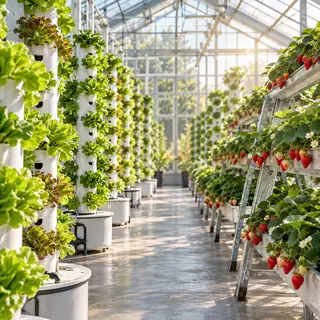
The right strawberry plant variety and the right growing system work together: day-neutral varieties for continuous harvests, licensed premium varieties for high-value markets, and climate control that keeps both productive. Mars Vertical Farm manufactures strawberry plant factories, multi-layer vertical strawberry systems and A-frame troughs factory-direct, with custom sizing for your building and varieties. See also our guide to A-frame vertical systems, then share your varieties, target output and space for a layout and quotation.